Deposit in China estimated at 7.6 tonnes of gold and 1512 tonnes of silver
Shandong Gold confirmed resources of 7.6 t of gold and 1,512 t of silver at the Teligentai gold-silver deposit in Inner Mongolia.
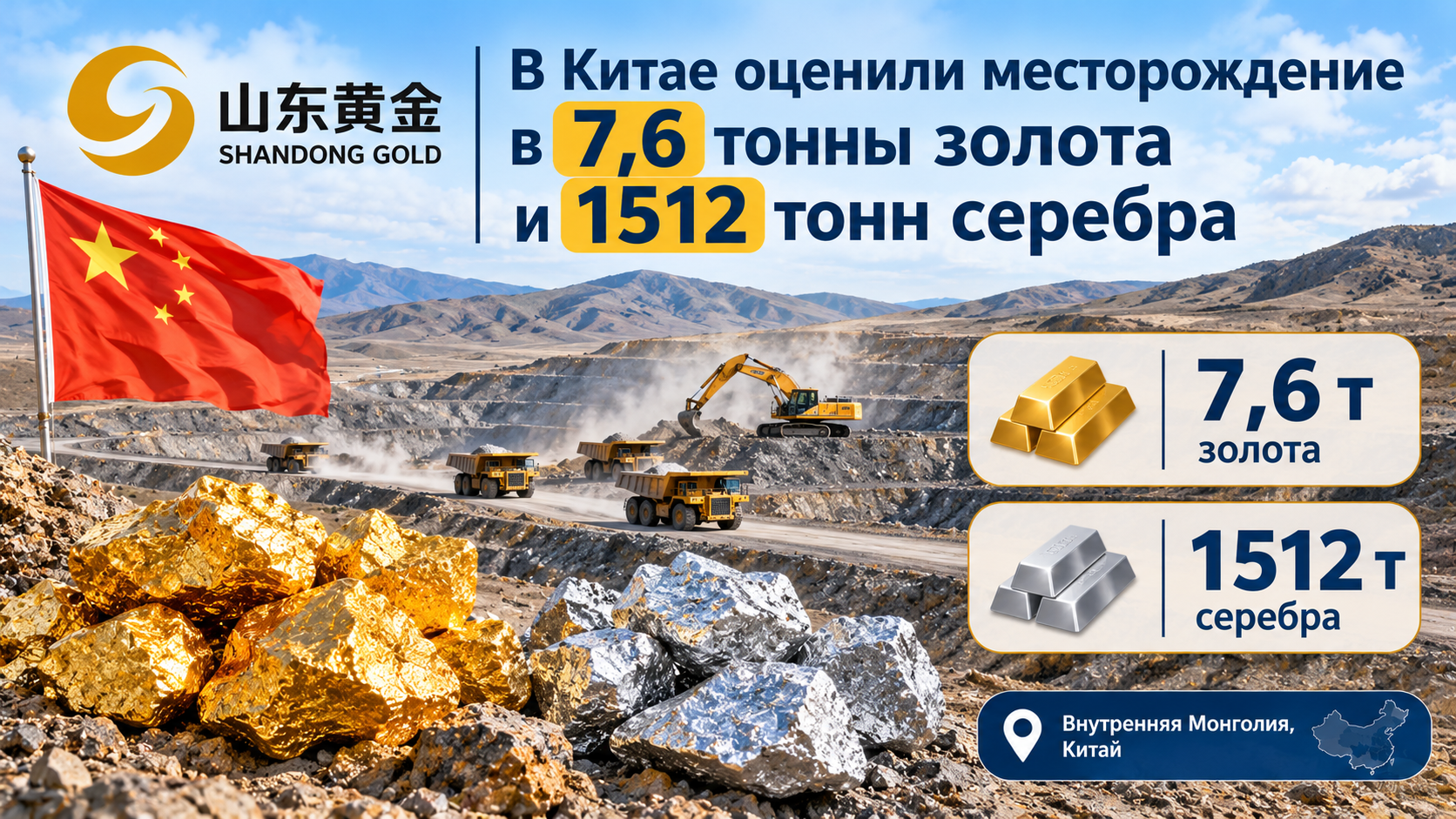
The deposit is located in the Onniud Banner of the Chifeng city district; its exploration report has passed official expert review and registration, the newspaper Dazhong Ribao reports.
The bottom line
- In ore zones I and II, resources of 7.6 t of gold and 1,512 t of silver have been identified, with an ore volume of 7.97 million t.
- The work was carried out by Inner Mongolia Shanjin Geological and Mineral Exploration, a unit of Shandong Gold Group.
- Exploration took about 20 months: around 100,000 m were drilled, with up to 25 drilling rigs operating simultaneously.
- Shandong Gold plans to move from exploration to production.
What the exploration revealed
The deposit is located in Inner Mongolia, in the Onniud Banner. A banner is an administrative unit similar to a district. Exploration has identified in ore zones I and II resources of 7.6 t of gold and 1,512 t of silver, with a total ore volume of 7.97 million t. The report has passed expert review and registration, which completes one of the stages of geological study.
Resources are the less studied part of mineral raw materials; they are not yet equal to reserves: further technical and economic assessment is needed for production. For example, at the Kogadyr deposit in the Zhambyl region of Kazakhstan, resources are estimated at 44.5 t of gold, but the state has approved reserves of only about 12 t. By mass, there is far more silver at the deposit than gold.
How the exploration was conducted
The company obtained the prospecting license for an area of 63.34 km² in April 2024: the right to geological study cost 30.2 million yuan. Over the following approximately 20 months, geologists drilled about 100,000 m, with up to 25 drilling rigs operating simultaneously.
What comes next
According to Shandong Gold, the company expects to move the project from exploration to production and to continue prospecting in neighboring areas. The result is described as important for implementing the national strategy of a new round of mineral exploration.
What is happening with gold in Kazakhstan
Over the nine months of 2026, Kazakhstan produced 84.7 t of unrefined and semi-processed gold versus 95.2 t a year earlier: output declined by 11%. At the Vasilkovskoye deposit, Kaz Zinc expects output of 2-5 t of gold per year: exploration showed more than 190 t there, production will begin in 2027 and end in 2042.
Based on the results of state geological exploration in 2024-2025, the increase in silver reserves in the country amounted to about 9,432 t, and gold - 157.2 t. At the same time, registration often means clarification of reserves of already known deposits rather than the discovery of new ones. Gold and silver are also present in copper concentrate: the Ministry of Industry and Construction is working on an export duty on it so that raw materials are processed within the country; critics of the tariff calculation methodology point out that the formula does not take into account the processor's income from associated gold and silver.
There are also integrated projects in Kazakhstan. In the Pavlodar region is the Beskauga copper-gold-silver deposit: the Canadian company Mogotes Metals has registered a subsidiary in the Astana International Financial Centre (AIFC) for this project.
Author's conclusion
The value of the asset is determined by the combination of metals: by mass, there is far more silver in the resources than gold, and whether both metals can be extracted will determine the conversion of resources into production.
Comments ()