First gold from Kogadyr, acquired by Timur Turlov, planned to be produced by 2030
Entrepreneur Timur Turlov bought the Kogadyr gold deposit in Kazakhstan's Zhambyl region in 2023, but first gold is only expected by 2030.
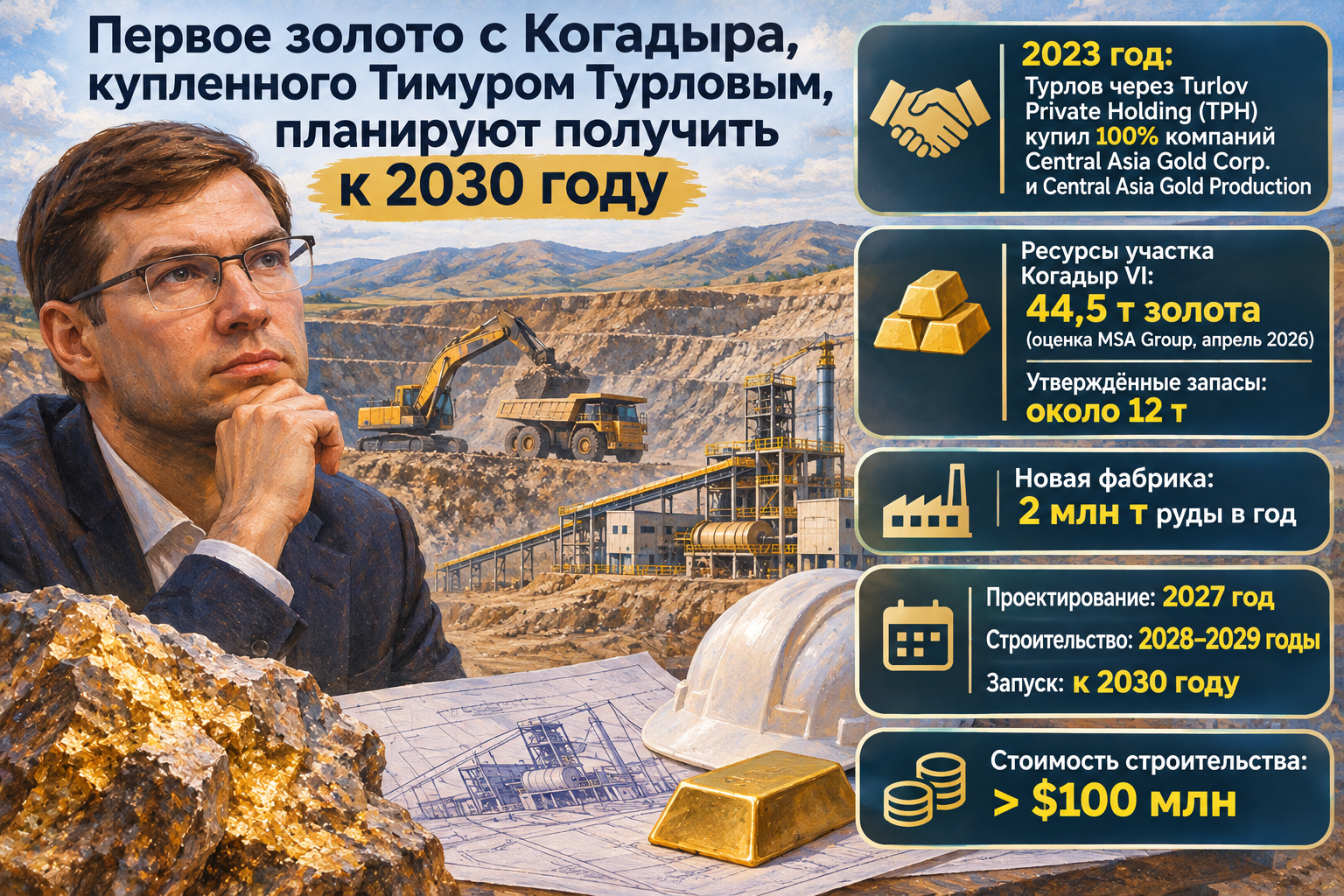
First, a new plant needs to be built: design is scheduled for 2027, construction for 2028-2029. This is stated in a Forbes Kazakhstan article.
The gist in brief
- Turlov through Turlov Private Holding (TPH) bought 100% of Central Asia Gold Corp. and Central Asia Gold Production in 2023; the transaction price was not disclosed.
- The resources of the Kogadyr VI site, according to an MSA Group estimate (April 2026), amount to 44.5 t of gold, but the state has approved reserves of only about 12 t.
- A new plant with a capacity of 2 million t of ore per year is planned to be launched by 2030; previously 2027 was mentioned.
- According to the company's estimate, construction of the plant will most likely cost more than $100 million.
What kind of deposit this is
Kogadyr is located in the Zhambyl region, and the main site is Kogadyr VI. The deposit is owned by Central Asia Gold Corp. LLP and Central Asia Gold Production LLP. Both companies came under the control of Turlov Private Holding in 2023, which is separate from Freedom Holding. TPH head Olga Baskakova calls the holding a classic investment company: it develops projects and may sell them.
Since 2023, TPH has invested about $6 million in the project for geological exploration, technological research and fulfillment of contractual obligations. The money went through interest-free loans. The exploration license has been extended until 2027, and the production contract was renewed in 2025 and is valid until 2046.
Why the previous plant did not work
Gold was mined at the site before. In 2014, a heap leaching unit was launched, and from 2015 to 2019 about 760 thousand t of ore were mined. As the open pit deepened, oxidized ore was replaced by sulfide ore. Gold was extracted less efficiently from it: instead of the projected 65%, about 40% was recovered. In early 2019, operations were stopped as unprofitable. The old plant will not be restarted.
How much gold is in the ground
According to an MSA Group estimate under the international JORC 2012 standard, the resources of Kogadyr VI amount to 44.5 t of gold: 22.4 t in the Indicated category (assessed with sufficient confidence) and 22.1 t in the Inferred category (estimated provisionally). The average grade is 0.93 g/t. Previously, consultant SRK Consulting estimated resources at 39.5 t. The State Commission on Reserves approved about 12 t. Forbes emphasizes that 44.5 t is the estimated amount of gold in the ground, not the volume that is guaranteed to be recovered.
What they plan to build
Instead of the old unit, they plan to build a new gold recovery plant (GRP) with a capacity of 2 million t of ore per year with the possibility of phased expansion. The open pit is expected to be operated for about 20 years. Design may cost more than 1 billion tenge, and the plant itself, according to the company's estimate, will most likely cost more than $100 million (over 45 billion tenge).
Direct cyanidation performed best: gold recovery on the sample was 92-94%, while flotation was 82.9-88.7%. The samples were tested at VNIItsvetmet in Ust-Kamenogorsk. Before the final choice, pilot and closed-circuit tests and a check of the effect of copper are still needed. Additional exploration is planned at the Kogadyr IX, Yuzhny Kogadyr and other areas of the license.
What is happening with gold in Kazakhstan
Gold output in the country is declining. In the nine months of 2026, 84.7 t of unprocessed and semi-processed gold were produced, 11% less than a year earlier, and this is the second year of decline: in 2025, output fell by 4%. At the same time, gold ore mining increased by 9.4% to 30.5 million t, while concentrate output fell by 16.9%.
New projects are still mostly at the exploration stage. Kaz Zinc intends to mine gold at the Vasilkovskoye deposit in the Akmola region until 2042, with mining scheduled to start in 2027. Gold will also be sought at the Atasu site in the Akmola region until 2032, but whether there will be mining there is unknown. In the Aktobe region, Geoland Minerals plans to look for gold, tungsten, copper and cobalt; the presence of a deposit there has not yet been confirmed.
Author's conclusion
The key number in this story is not 44.5 t, but about 12 t: that is how many reserves the state approved, while the rest are still resources. Until the difference is converted into reserves and the processing method is finally selected, the 2030 deadline remains a plan that has already been pushed back from 2027.
Comments ()