Kazakhstan's mini-refineries checked against open data: many found with debts and frozen accounts
Forbes Kazakhstan cross-referenced its refinery registry with public company data and reviewed last year's high-profile cases.
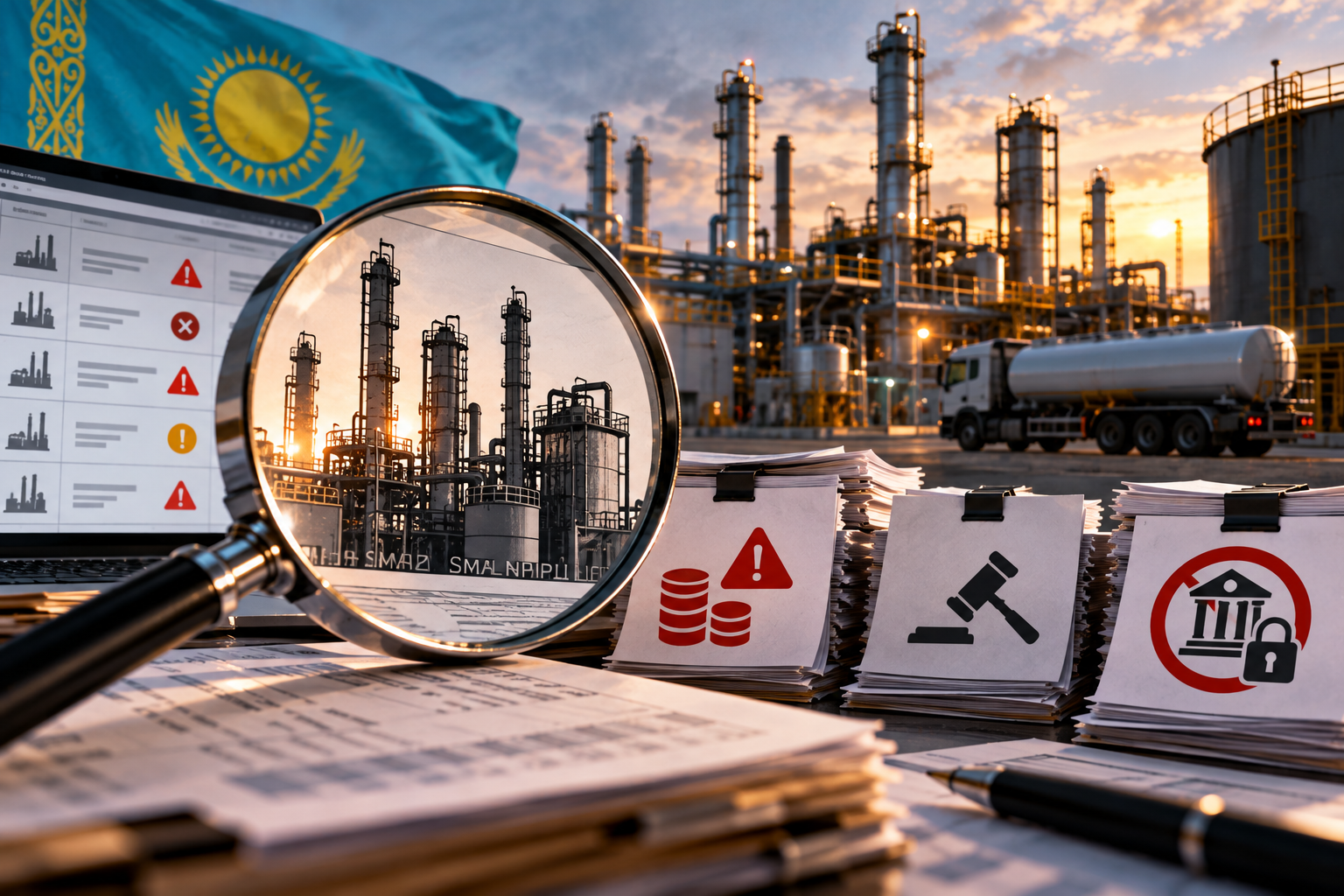
Of the companies checked, two were declared bankrupt by court, five have tax debts, and ten have unpaid administrative fines. According to the Ministry of Energy, more than 30 mini-refineries are registered in the country, and 22 are considered operational.
The gist in brief
- Ministry of Energy: more than 30 mini-refineries are registered, 22 are operating.
- The "List of Refineries of the Republic of Kazakhstan" dated March 26, 2026 contains 28 entries, including three large plants, two bitumen plants, and one gas processing plant.
- Among the companies checked, 6 have frozen accounts, property, or vehicles, 4 directors are banned from leaving the country, and 16 have changed owners at least once.
- 10 companies showed none of these red flags.
What was found in the registry
The plant names in the list are short or commercial, so Forbes editorial staff matched the records with companies using open data: name, type of activity, address, and tax payments. Of the companies checked, 2 were declared bankrupt by court decision, 5 have tax debts (from 1 million to 1.22 billion tenge), and 6 have frozen accounts, property, or vehicles. 4 have enforcement proceedings underway (from 33 million to 381.8 million tenge), 4 directors are banned from leaving the country, and 10 have unpaid administrative fines. One company's re-registration was invalidated, and one is listed in Samruk-Kazyna's registry of unscrupulous suppliers. According to Adata as of October 2026, 16 companies have changed owners at least once. The categories overlap, so a single company may have multiple red flags.
Which cases made headlines over the year
The largest case is a 2019-2023 scheme involving Batys Nefte Trade, Standart Petroleum, and Mangystau Oil Refining. The group bought oil from subsoil users and processed it; the products were declared as heating oil using false quality certificates and shipped by sea through the Aktau port. The trader exported more than 160,000 tonnes of petroleum products, and the smuggling volume was estimated at approximately 45 billion tenge. Five defendants were sentenced to eight years, and the organizer is on an international wanted list. Both mini-refineries and a tanker were confiscated, and more than 2 billion tenge in taxes and duties was recovered.
In June 2026, the AFM completed an investigation into a group of nine people who, through 12 legal entities, shipped more than 190,000 tonnes of AI-92 gasoline to Kyrgyzstan disguised as petrochemical products. The shadow turnover was estimated at 37.2 billion tenge. At the Turksib station, eight tank cars containing about 500 tonnes of gasoline worth 138 million tenge were seized. Other cases include a tunnel under the border with Uzbekistan for gasoline smuggling and an illegal mini-refinery in the Mangystau region that since 2022 has processed more than 28,500 tonnes of unaccounted oil and shipped its products as fuel oil.
What experts say
PACE Analytics Director Askar Ismailov notes that small-scale refining has historically carried heightened risks of opaque oil and product flows: small-volume shipments are hard to track, and the difference in export duties on oil and petroleum products creates an incentive for abuse. State control, he says, has changed: metering devices and digital fuel traceability systems have emerged. It is too early to say the shadow segment has disappeared. He recommends maintaining a full material balance, as well as laboratory control and reconciliation with customs data.
ALC Attorneys Managing Partner Farid Aliyev reminds that not every corporate dispute is a crime; everything depends on specific actions. He warns against collective punishment of law-abiding companies and proposes procedural guarantees: reasoned decisions and the right to appeal.
How Kazakhstan is expanding oil refining
Mini-refineries remain a small part of the industry; the authorities are betting on large plants. The Ministry of Energy plans to increase oil refining from the current 18 million tonnes per year to 39 million tonnes. The Shymkent refinery will be expanded from 6 to 12 million tonnes by 2030, the Pavlodar petrochemical plant from 5.5 to 9 million tonnes by 2031, and the Atyrau refinery from 5.5 to 6.7 million tonnes by 2028. A new complex with a capacity of up to 10 million tonnes is expected to be launched by 2033, with its location to be chosen by the end of 2026.
Author's conclusion
The two largest known schemes are valued at 45 billion and 37.2 billion tenge, but 10 of the companies checked showed no red flags at all. That is precisely why Forbes authors and experts caution against judging the entire sector by high-profile cases.
Comments ()