A project for a 28.4 million cubic meter reservoir is being launched on the Bolshoy Uzen
A new reservoir project on the Bolshoy Uzen River has launched in West Kazakhstan Region.
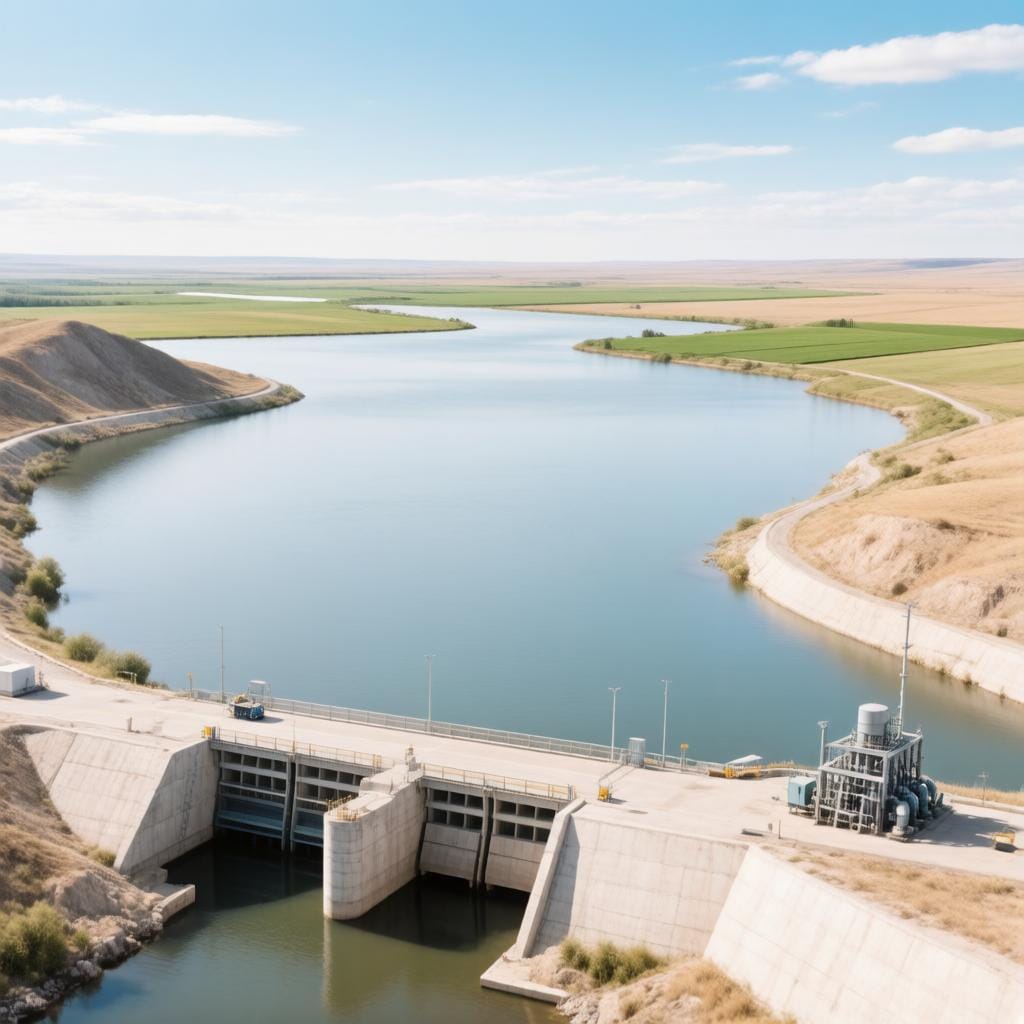
The volume of the new reservoir will be 28.4 million cubic meters. The project is being implemented with the support of the Islamic Development Bank, reports Kapital.kz.
The essence in brief
- In the Kaztalovsky district of the West Kazakhstan region, with the support of the Islamic Development Bank (IsDB), implementation has begun on a reservoir project on the Bolshoy Uzen River with a volume of 28.4 million cubic meters; it will provide irrigation for 12,000 hectares of limans with the prospect of expansion to 20,000 hectares.
- With IsDB support, the region also plans to reconstruct the Bitikskoye reservoir and four main canals — according to the ministry, this will improve water supply to about 28,500 hectares of land.
- All projects include the introduction of automated water metering elements.
- This was announced by the Minister of Water Resources and Irrigation Nurzhan Nurzhigitov at a meeting with residents of the region in Uralsk; residents asked about protecting small rivers from depletion, preventing pollution of water bodies, and reconstructing hydraulic structures.
What is known about the project
The new reservoir will appear in the Kaztalovsky district. Its main task is irrigation of limans: currently this concerns 12,000 hectares, and in the future the area may be increased to 20,000. Liman irrigation is, as a rule, spring flooding of low-lying areas with floodwater; in dry steppe regions it is more often used for fodder crops and hayfields. The ministry does not specify which crops are planned to be grown on these lands.
Nurzhigitov linked all projects being implemented in the region to several tasks at once.
"Solving issues in the water sector requires joint action by central government and local executive bodies, water management organizations, and water users. The projects being implemented in the West Kazakhstan region are aimed at ensuring a stable water supply, reducing its losses, more efficient irrigation of agricultural land, and protecting settlements from floods," the minister noted.
A river that begins in Russia
The Bolshoy Uzen is not only a Kazakh river. It originates on the Obshchy Syrt in Russia's Saratov region, its length is about 650 km, and the river ends in the Kamys-Samara lakes in western Kazakhstan. Therefore, the filling of the new reservoir will depend, among other things, on the flow formed on Russian territory. This issue is not discussed in the ministry's statement.
Transboundary issues in Kazakhstan's water policy are not new. It is worth recalling that since the beginning of 2026, the country has held 38 negotiations with neighbors on transboundary waters, of which 11 were with China and Russia. The Bolshoy Uzen is a reminder that not only the country's water security as a whole, but also the water supply of individual districts depends on transboundary rivers — and not necessarily only on large rivers such as the Syr Darya or the Irtysh.
Reconstruction and water metering
In parallel with the new reservoir, reconstruction of the Bitikskoye reservoir and four main canals is planned. According to the ministry, these projects will improve water supply to about 28,500 hectares, but it is unclear from the release whether this figure also includes the 12,000 hectares of limans under the new reservoir, or whether these are different areas.
It is also noteworthy that all projects include elements of automated water metering. This echoes the industry's overall course. The country's main canals are currently being modernized because water losses during transportation in some systems reach 40–60%. And at the national level, a unified information system of water resources was recently put into commercial operation, which should provide an accurate picture of the state of water bodies.
What residents asked about
A significant part of the meeting in Uralsk was devoted not to new construction sites, but to the state of existing water bodies. Residents asked how to protect small rivers from depletion, how to prevent pollution of water bodies, and when hydraulic structures would be reconstructed. Following the personal reception, the minister gave specific instructions to the heads of relevant committees and departments, but the content of these instructions is not disclosed in the report.
Author's conclusion
The project on the Bolshoy Uzen is a typical example of the water policy that Kazakhstan has been building in recent years: fewer losses, more metering, and accumulation of flood flow for irrigation. So far, the key parameters are not publicly known — cost, loan terms, timelines — so it is too early to judge the project's feasibility. There is also a fundamental limitation: a reservoir does not create water, but accumulates flow, which means its effectiveness will be determined by how much water comes down the river, including from abroad. Residents' question about protecting small rivers from depletion therefore concerns not only the environment, but also the reliability of water management projects themselves.

Comments ()