Agricultural machinery production in Kazakhstan grew by almost a quarter over the year
Kazakhstan's plants have boosted output of tractors, harvesters and seeding rigs far faster than the country's sown area is growing.
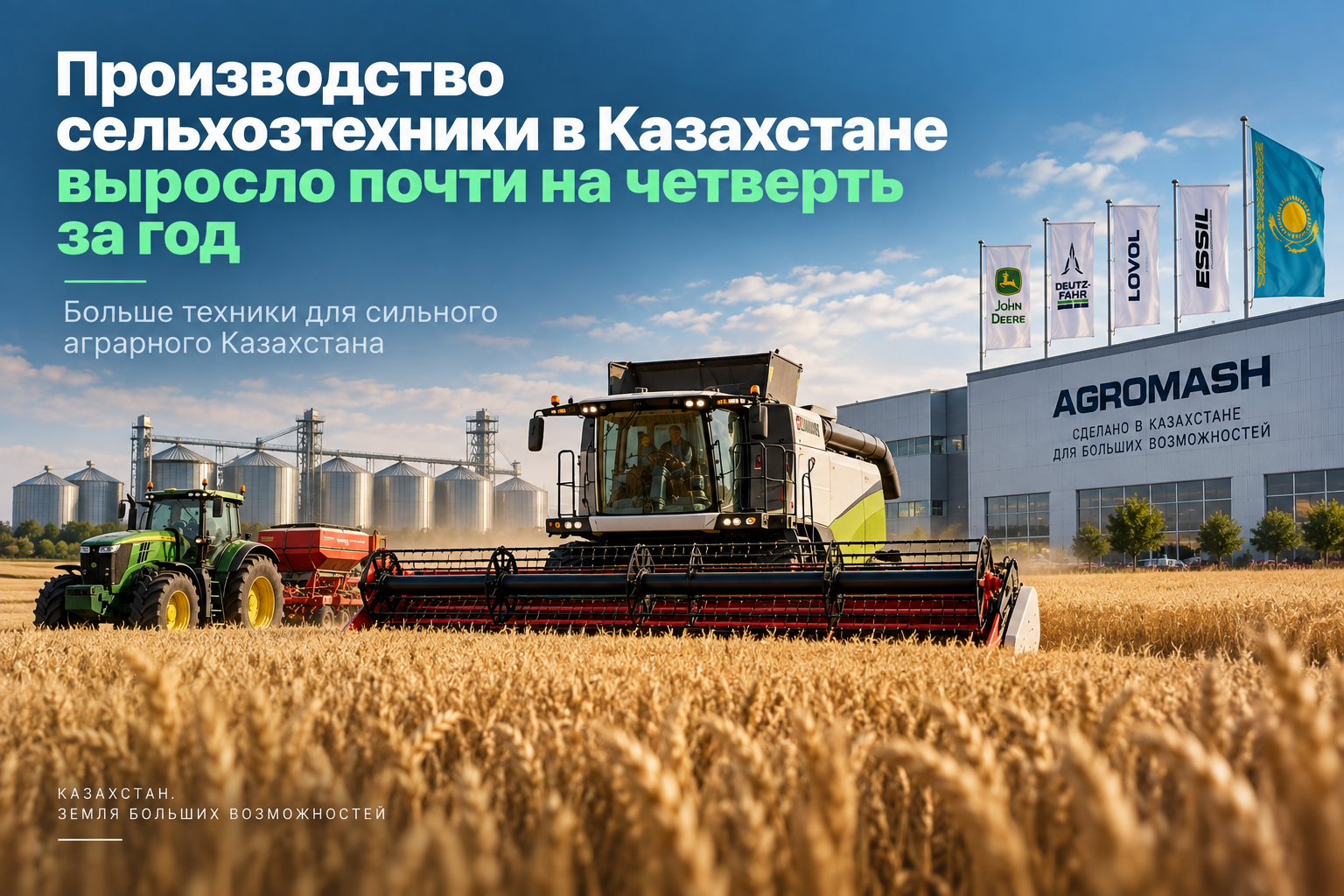
This growth is driven not only by domestic demand, but also by the localization of several global agricultural machinery manufacturers at once.
The essence in brief
- At the end of 2025, agricultural machinery production in Kazakhstan grew by 22.3% compared to 2024 — 40 enterprises are engaged in the production of agricultural and forestry machinery.
- The main share of production (72.5%) consists of agricultural machines; in 2025, 1,236 combine harvesters were assembled — 13.7% more than in 2024; the leaders in their production were Akmola (47.9%), Kostanay (32%), and North Kazakhstan (18%) regions.
- Exports of combine harvesters in 2025 amounted to 16 units — to Tajikistan, Georgia, and Uzbekistan; in 2026, machinery production is planned to be brought to 9.9 thousand units (+6%), and fleet renewal to 8%.
- The volume of machinery sold to farmers under leasing grew by 35% over two years — from 7,710 machines worth 178 billion tenge in 2023 to 10.4 thousand machines worth 269 billion tenge in 2025; for 2026, 350 billion tenge has been allocated for preferential leasing with subsidies of up to 30%.
Who produces what
The country's current agricultural machinery fleet already numbers 133.9 thousand tractors, 5.6 thousand high-performance seeding complexes, and 71.4 thousand seeders — according to Vice Minister of Agriculture Azat Sultanov, the machinery is fully ready for field work. The geographic concentration of combine harvester production is telling: almost half of the total volume comes from a single Akmola region, and together with Kostanay and North Kazakhstan regions, the three northern regions provide virtually all of Kazakhstan's grain harvesting machinery output — a logical consequence of the fact that the main areas of the country's grain belt are concentrated there.
Localization of global brands
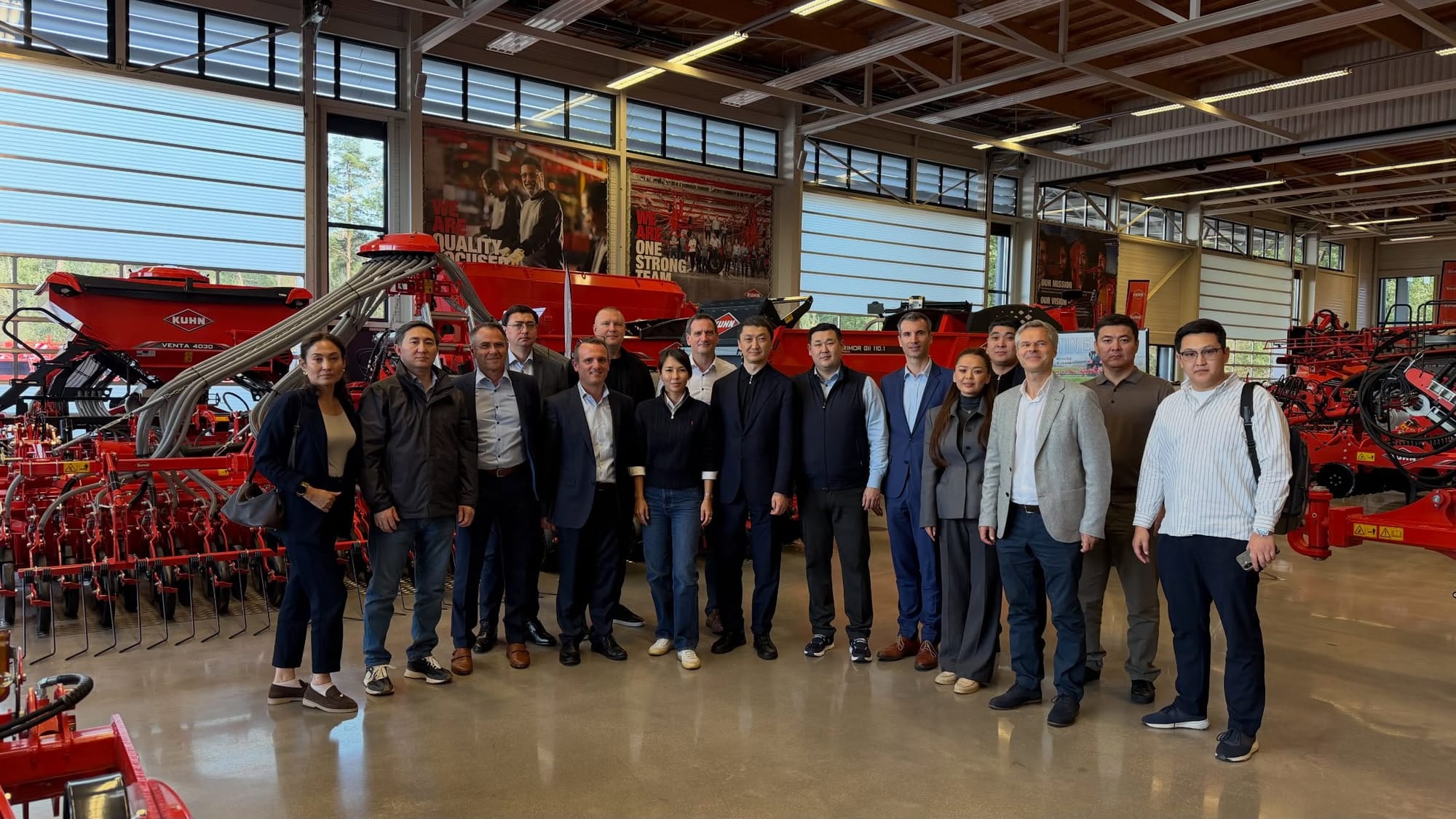
The growth in production is largely ensured by the arrival of several global manufacturers in the country at once — and the locomotive of this process is the Kostanay plant AGROMASH, reports the Ministry of Agriculture. In addition to already existing projects with John Deere, Deutz-Fahr, and Lovol, as well as the production of domestic ESSIL combine harvesters, in 2026 the enterprise attracted seven new international companies at once: Väderstad, Dewulf, Lindsay Corporation, Amity Technology, Vervaet, Kuhn Group, and Brandt Agricultural Products. Thus Kostanay is consistently turning into a major multi-brand center of agricultural machine building — not just individual assembly lines, but a concentration of international and local manufacturers on one site with technology transfer and the development of local competencies.
At the same time, AGROMASH is deepening localization itself — since 2021, a localization center has been operating at the enterprise, increasing the output of units, parts, and components within the country. At the end of 2025, the site produced more than 2 thousand units of self-propelled machinery and over 300 thousand components for agricultural machines — the output of components specifically grew fivefold compared to previous years. This is not just an efficiency figure: local production of spare parts shortens delivery and repair times during the most critical period for farmers — the sowing and harvesting campaigns — reducing dependence on international logistics.
Leasing as a demand driver
The growth in production relies on an equally noticeable growth in demand, supported by the state preferential leasing program — with a rate of 5% per annum, no down payment, and a term of up to 10 years, plus subsidies of up to 30% of the machinery cost. Over two years, the total volume of machinery sold to farmers grew by 35% — from 7,710 machines in 2023 to 10.4 thousand in 2025, and the amount of financed transactions increased from 178 to 269 billion tenge. The dynamics are especially noticeable for self-propelled machinery: in 2025, farmers bought 4,249 tractors — 50% more than in 2023 (2,846 units), and the number of combine harvesters purchased grew by 58%, to 807 units. The trend continues this year as well — according to KazAgroFinance, as of August 1, 2026, 8,920 units of machinery worth 286.5 billion tenge have already been sold under leasing, 23% more than in the same period last year.
A separate advantage of local production is the developed service infrastructure: AGROMASH already has 9 branches and 11 representative offices in the grain-growing regions of the country, which ensures the availability of spare parts and prompt dispatch of specialists directly to farms.
Part of a broader localization picture
The mechanism of subsidized leasing of agricultural machinery logically echoes what we analyzed with regard to water-saving technologies: a similar scheme through KazAgroFinance also operates for drip and sprinkler irrigation systems. In both cases, the state is betting not simply on purchasing finished imported machinery, but on the gradual transfer of production into the country — whether it be irrigation equipment or full-fledged assembly lines of global agricultural machinery brands. This is part of a broader trend that we are also observing in other industries: from rare metals to mineral fertilizers, Kazakhstan is consistently trying to move from simple imports of finished products to their production or processing on its own territory.
Author's conclusion
The 22.3% growth in agricultural machinery production over the year is a notable figure, but its sustainability will depend on whether it is possible to maintain the growth rate of leasing financing at a comparable level: without affordable lending, farmers simply have nothing to buy new machinery with, no matter how many plants produce it. The plans to bring fleet renewal to 8% in 2026 look realistic against the backdrop of the dynamics already achieved, but it is precisely the ratio of domestic production, exports, and the actual rates of renewal of the country's machine fleet in the coming years that will show whether the current growth will consolidate or turn out to be a temporary surge amid the launch of new assembly lines.

Comments ()