Australian company obtains a site in North Turgai for oil and gas exploration
Australia's Grand Gulf Energy has secured rights in Kazakhstan to geologically study an 8,750 sq km area in the North Turgai Basin.
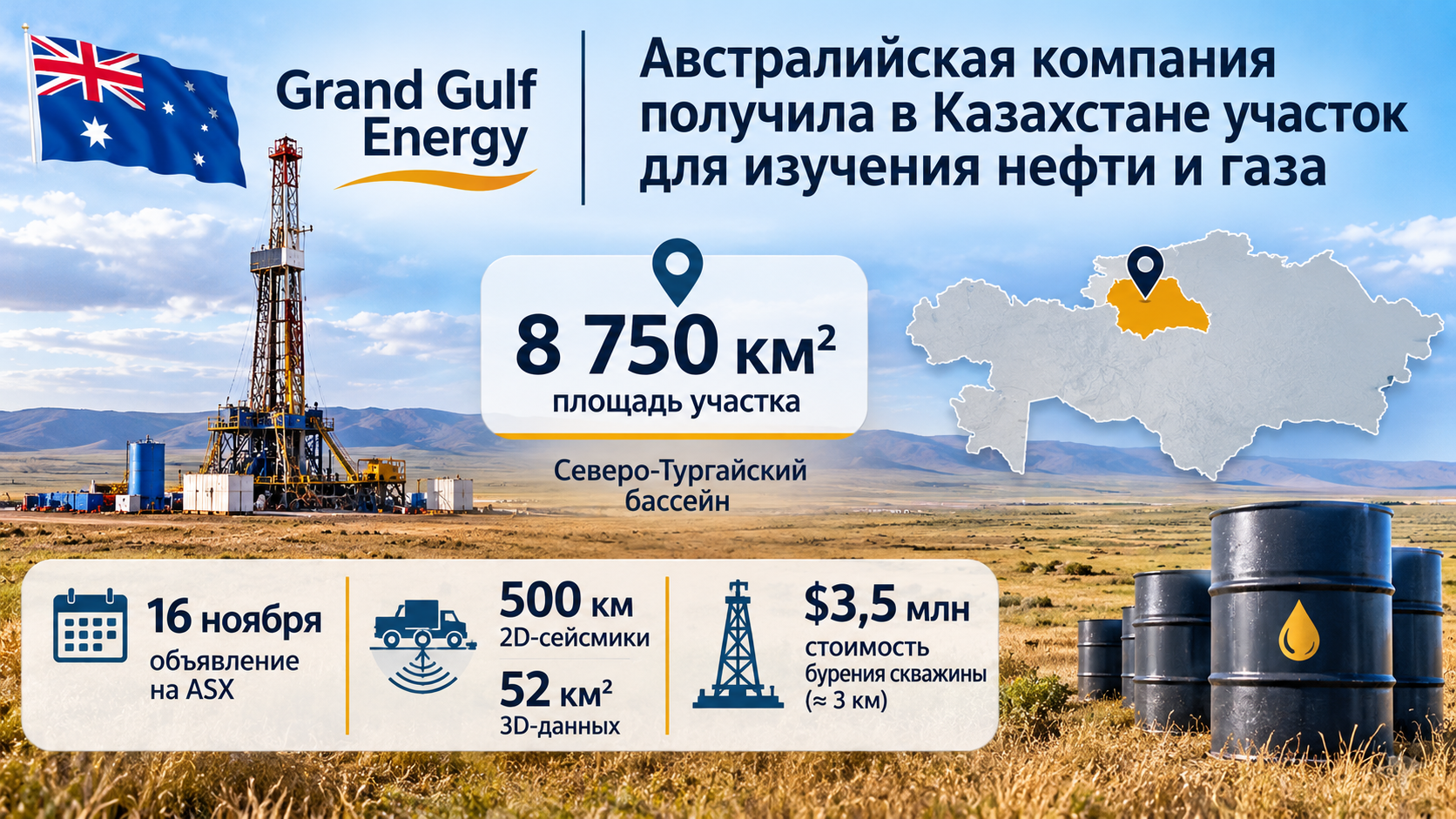
The company hopes to find large accumulations of oil and gas there in structures it considers similar to Tengiz and Kashagan, but for now it plans to study archival data and has not yet made a drilling decision, writes "Aq Zhaiyq".
The gist in brief
- Grand Gulf Energy has received the right to conduct geological exploration of 8,750 km² in the North Turgai Basin.
- The company announced the license on November 16 on the Australian ASX exchange.
- Most of the block has never been surveyed by seismic exploration; there are about 500 km of 2D profiles and 52 km² of 3D data.
- No drilling decision has been made yet: archival data will be studied first, and drilling will cost approximately USD 3.5 million per well about 3 km deep.
What the company received
Grand Gulf Energy is a small exploration company whose shares trade on the Australian ASX exchange. The license for geological exploration of the block in the North Turgai Basin was issued by the Geology Committee of Kazakhstan's Ministry of Industry and Construction. The company announced receipt of the right on November 16.
The company's goal is to find large accumulations of oil and gas in structures it considers similar to the Tengiz and Kashagan fields in the Caspian Basin. The comparison with them remains the company's own assessment for now.
What is known about the geology of the block
Most of the territory has not been surveyed by seismic exploration, either in Soviet times or after independence. Currently available are about 500 linear kilometers of 2D seismic and 52 square kilometers of 3D seismic on and near the block.
The company has identified several prospective Devonian carbonate structures at a depth of about 2.8 km. Middle Devonian carbonates in this area have not been drilled before. In terms of geology, the basin is compared with the North Caspian, Volga-Ural, and West Siberian basins, and the company is interested in carbonate reef structures similar to Kashagan reservoirs.
What's next and how much it will cost
At the first stage, the company will study archival geological, drilling, and seismic data. It will make a drilling decision after assessing the best prospective targets and their commercial potential. Drilling a well about 3 km deep, according to the company's estimate, will cost about USD 3.5 million, and it sees this as an advantage of Kazakhstan.
If a field is found, the company expects access to existing oil routes: to the domestic market and for export toward China and the Black Sea.
How oil is being sought in other regions of Kazakhstan
The search for new reserves is also underway in other regions. KazMunayGas is forming a consortium with Shell, Chevron, Sinopec, and CNOOC for seismic exploration and subsequent deep drilling in the Paleozoic deposits of the Caspian region. The Chingiz field in Western Kazakhstan is being prepared for pilot production from May 1, 2027; no decision on commercial development has been made yet.
What the company does
In addition to the Kazakhstan block, Grand Gulf Energy has the Red Helium project in Utah, an oil project in Louisiana, and an interest in the Namibian offshore. Its interests cover oil, gas, helium, and critical minerals. The Kazakhstan project could become one of the largest in its exploration portfolio.
Author's conclusion
This is an application for study, not a discovery: the company has neither its own wells nor a drilling decision on the block. The comparison with Kashagan remains its own assessment, and only new seismic exploration and drilling can verify it. For now, the news means one thing: another foreign explorer has appeared in Kazakhstan's under-studied northern basin.
Comments ()