Belgium lets Chinese laser weeding robots into the EU.
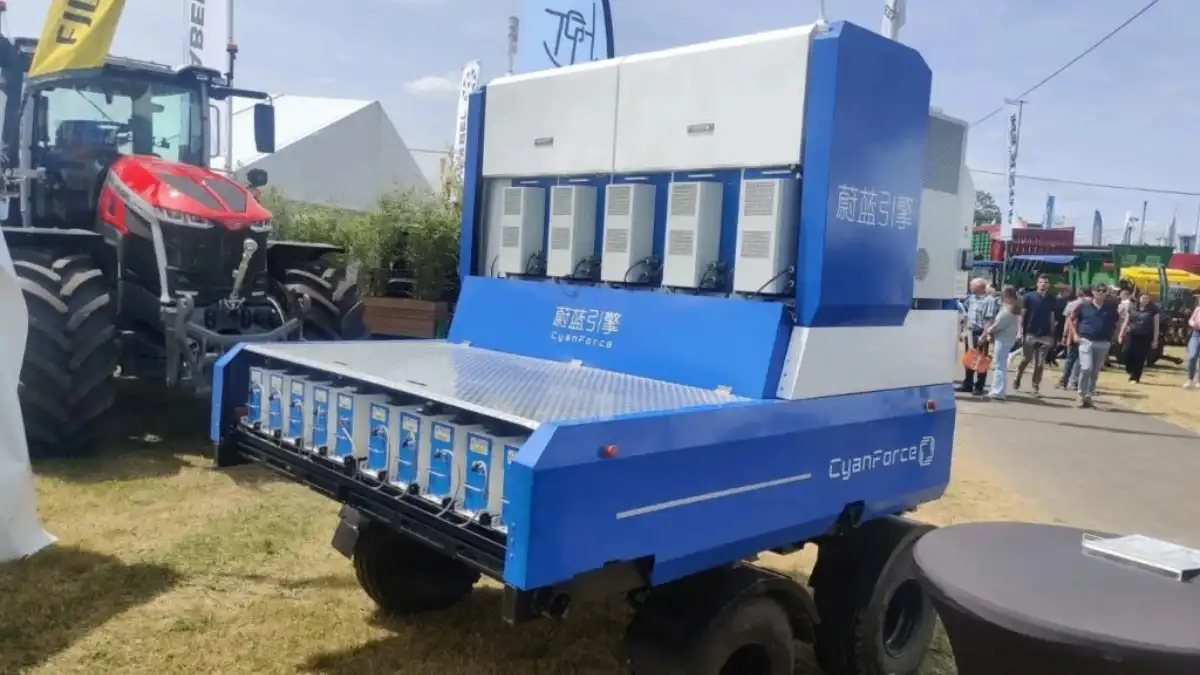
Belgian firm Hands On Tech is the EU's first importer of China's CyanForce laser-weeding robots, which zap weeds with laser pulses instead of herbicides.
The very fact is telling: usually, advanced agricultural technologies flow from Western Europe or the USA to China, not the other way around. This time, the flow has reversed direction.
The gist in short
- Belgian company Hands On Tech has become the first EU importer of Chinese laser weeding robots CyanForce, showcasing the first unit at the Foire de Libramont 2026 trade fair.
- The robot identifies weeds using a computer vision system and destroys them with a laser pulse — without herbicides, mechanical impact, or contact with the crop plant.
- The showcased model has a working width of 2 meters and is mounted on a tractor via a three-point hitch; the company is preparing a lineup of six models with widths ranging from 1.2 to 6 meters.
- The technology is being developed in China, with final assembly to take place in Belgium to meet European certification standards; serial production and full market entry are expected by the end of 2026 — early 2027.
How the laser weeder works
The machine presented in Belgium operates on a principle that is simple in words: a computer vision system identifies weeds in the crop row, after which a laser beam destroys them with pinpoint precision — without spraying, without mechanical pulling, and without contact with the crop plant. The showcased unit is mounted on a standard tractor via a three-point hitch and has a working width of 2 meters, but this is only the first model: CyanForce is preparing a lineup of six machines with widths from 1.2 to 6 meters to cover both small vegetable farms and large producers with row crops.
A reversal in the technology flow
Until now, advanced precision farming solutions — robotic weeding, laser systems, computer vision for fields — were primarily developed by companies from Western Europe and the USA. The arrival of CyanForce in Belgium breaks this pattern: the technology itself was created in China, and the European side acts not as the developer but as a localization hub — final assembly of the machines will take place in Belgium specifically to comply with local technical requirements and certification procedures. This is the same scenario by which Chinese manufacturers previously entered the European market with electric vehicles and consumer electronics, only now applied to agricultural machinery.
China has already shown similar solutions
CyanForce is not the only Chinese developer in this niche. Earlier, Chinese company Huagong Technology presented its own laser weeding robot, the Hg LaserWeeder, which can operate around the clock and, according to the manufacturer, destroys over 95% of weeds. The top version of this machine is equipped with 32 laser heads and can destroy up to 320,000 weeds per hour — 4–8 times faster than traditional methods, including manual labor and chemical treatment. The algorithm was tested in fields in Yunnan and Heilongjiang provinces. These are different companies and different machines, but both cases demonstrate the same thing: Chinese agritech is no longer copying Western solutions but offering its own — and mature enough to enter the European market.
Why this matters for Kazakhstan
The Kazakh agricultural machinery market is already well acquainted with Chinese manufacturers — a cluster for producing LOVOL smart harvesters is being prepared for launch in Kostanay, and Chinese-brand tractors and combines have long been working in Kazakh fields. The arrival of laser weeders fits naturally into this same logic: if Chinese precision farming equipment gains a foothold in the European Union, it will very likely appear in Central Asian markets as well — as a more affordable alternative to Western counterparts. This is especially relevant for Kazakhstan's berry and vegetable sectors, where the chemical load on soil has traditionally been high, and the country is already seeking ways to reduce it — not only through technology but also legislatively: the "On Soil Protection" law, adopted in June 2026, introduces systematic monitoring of agricultural land condition for the first time. Other technologies are already demonstrating a similar logic of reducing chemical load without losing yields — for example, ultraviolet robots, which California-based startup TRIC Robotics uses instead of pesticides on strawberry fields.
Author's conclusion
The appearance of CyanForce in Belgium is not just a standalone story about one manufacturer, but a signal of a broader trend: agritech in China is developing faster than commonly assumed and is already ready to compete with Western developments on their own turf. For Kazakhstan, which depends on imported agricultural machinery while simultaneously seeking ways to reduce the chemical load on soil, this direction is worth keeping an eye on — not as a distant technical curiosity, but as a technology that could reach Kazakh fields sooner than it seems.



Comments ()