Cable along the bottom of the Caspian Sea has gained a German partner, but so far only on paper
Kazakhstan, Azerbaijan and Uzbekistan's Green Corridor Alliance JV signed a memorandum with Germany's Siemens Energy.
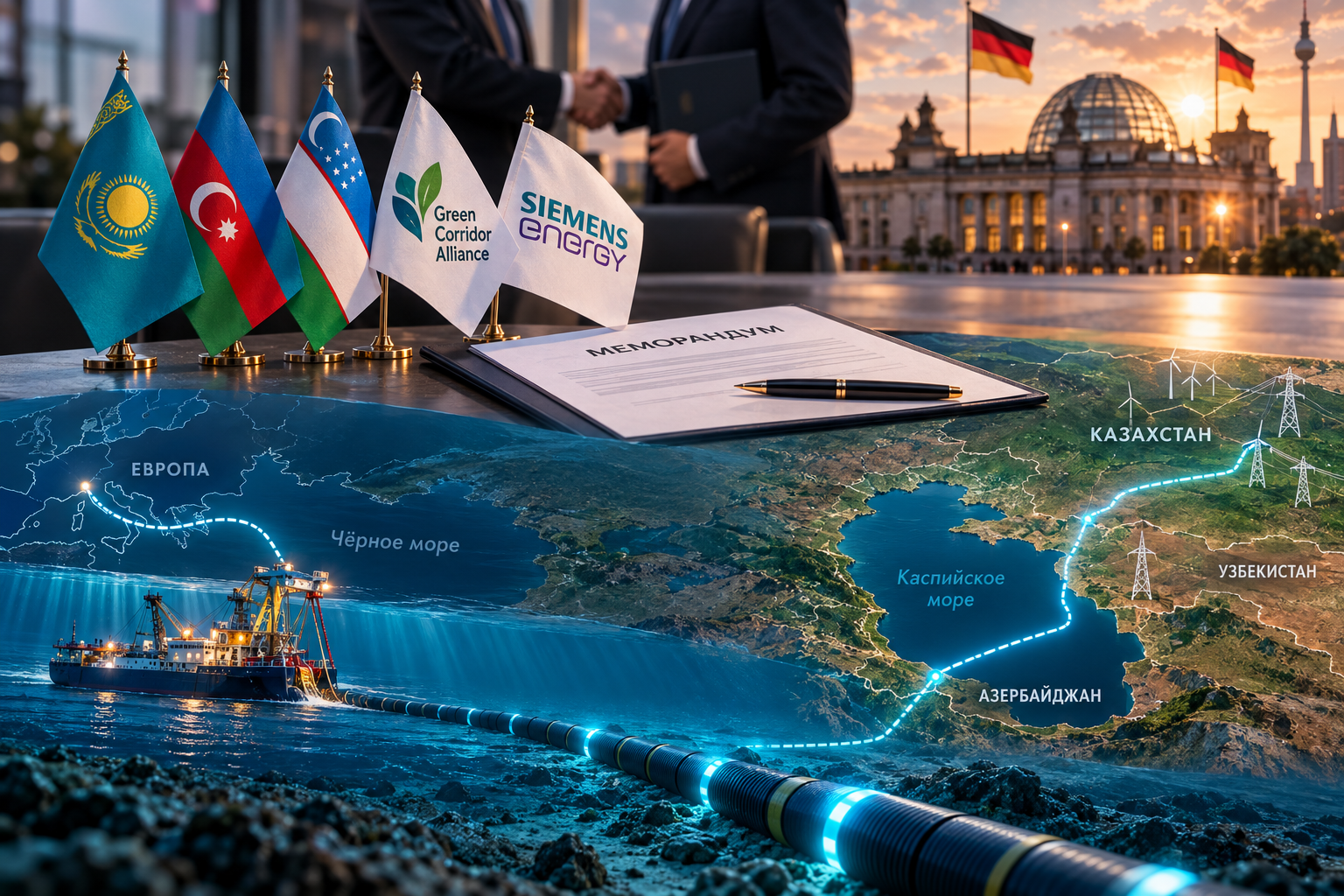
The company may become a technology partner of the Trans-Caspian Green Energy Corridor, through which electricity from Central Asia is planned to be transmitted to Europe, Report.az reports. However, there is still no feasibility study for the project, and the Black Sea cable associated with it is already behind schedule.
The essence in brief
- A memorandum of understanding between Green Corridor Alliance and Siemens Energy was signed in Berlin at the Kazakhstan-German business forum during the official visit of Kassym-Jomart Tokayev to Germany. The document defines areas of cooperation in creating power transmission systems, including possible consulting formats.
- Green Corridor Alliance was created on July 1, 2025 by the system operators of three countries: Kazakhstan's KEGOC, Azerenergy, and National Electric Grids of Uzbekistan.
- The feasibility study for the Trans-Caspian corridor is to be completed by May 2027. Its cost is about 1 million euros, covered by grants from the Asian Development Bank and the Asian Infrastructure Investment Bank.
- After that, energy is to flow to Europe via a cable across the Black Sea with a capacity of 1 GW. Initially, it was planned to launch it in 2026, but a final investment decision on it has still not been made.
What was signed in Berlin
The agreement was announced by the general director of Green Corridor Alliance, Tural Aliyev. The memorandum lays the foundation for working out a partnership in the field of power transmission systems, but does not contain specific obligations: it concerns areas of interaction, including consulting. Before that, in June 2026 at Baku Energy Week, the parties signed a non-disclosure agreement.
High-voltage direct current lines are used for underwater transmission of electricity over long distances. Siemens Energy is one of the few global manufacturers of such equipment, so its interest in the project is important. But the German company's work in the region has already run into politics: at the end of 2025, Rosatom terminated its contract with it for the Hungarian Paks-2 nuclear power plant, because Siemens Energy did not receive an export license.
How the corridor is structured
The agreement on strategic partnership in the production and transmission of green energy was signed by the heads of Kazakhstan, Azerbaijan, and Uzbekistan on November 13, 2024 at the COP29 climate summit in Baku. It was then ratified by the Mazhilis. The project envisages laying a high-voltage cable along the bottom of the Caspian Sea. After that, energy is to go through Azerbaijan and Georgia and along the bottom of the Black Sea to Romania.
The volume of supplies has not yet been determined. Uzbekistan's Minister of Energy Jurabek Mirzamakhmudov cited a range of 2-5 GW and clarified that the exact figure "will depend on the cable's capacity and the partners' willingness." The Uzbek side also stated that separate generating capacity would be built for export so as not to burden its own power system. The financial model and main technical parameters will become known only after the feasibility study is completed. Azerbaijan's Minister of Energy Parviz Shahbazov confirmed that the deadline is May 2027.
The bottleneck in the Black Sea
The Trans-Caspian cable only makes sense if there is a way to deliver the energy further to Europe. This task is to be solved by the Black Sea cable between Georgia and Romania, an agreement on which Azerbaijan, Georgia, Romania, and Hungary signed back in December 2022. Its length is about 1195 km, its capacity is 1 GW, and if built, it will be the longest underwater power cable in the world.
This project has problems with its schedule, although it is moving forward. In 2022, its launch was planned for 2026 at a cost of about 2.3 billion euros, and according to the latest estimates, the cost has increased by about one and a half times. In July 2026, the project completed its feasibility study and officially moved to the implementation phase: the company GECO was tasked with developing a roadmap up to a final investment decision, and the participants asked the European Commission to include the corridor in the new list of projects with access to European financing. But the investment decision itself, which was expected around April 2026, has still not been made, and at the end of July the project only moved to preparing a seabed survey.
There is also an arithmetic discrepancy. Even the lower bound of supplies from Central Asia, 2 GW, is twice the capacity of the Black Sea cable, and Azerbaijani energy is also supposed to flow through it. This means that for the corridor to operate fully, either additional lines or other routes will be needed. Azerbaijan, for example, is simultaneously developing a corridor through Georgia and Turkey to Bulgaria.
Author's conclusion
The memorandum with Siemens Energy is a useful signal: a major manufacturer of equipment for underwater energy transmission is showing interest in the project. For comparison, one cable has already been laid along the bottom of the Caspian: the Aktau-Sumgait fiber-optic line, which Kazakhtelecom and AzerTelecom built with their own funds, is supposed to start operating this autumn. But a power cable of several gigawatts is a project of a completely different scale and cost, and so far it has neither a contract, nor money, nor even a feasibility study behind it. For Kazakhstan, which participates in the project through KEGOC, the main questions lie ahead: what volume of exports is realistic, where the export green generation will come from, and who will finance the cable along the bottom of the Caspian. The experience of the Black Sea cable, which in four years became one and a half times more expensive and still did not reach an investment decision, shows that the distance between signing memorandums and a real flow of electricity to Europe is measured in years.
Comments ()