Central Asia has increased gas consumption and halved exports over ten years
Gas consumption in five Central Asian countries hit 119.6 bcm in 2025, up 76% from 2015, while the region's exports nearly halved over the same period.
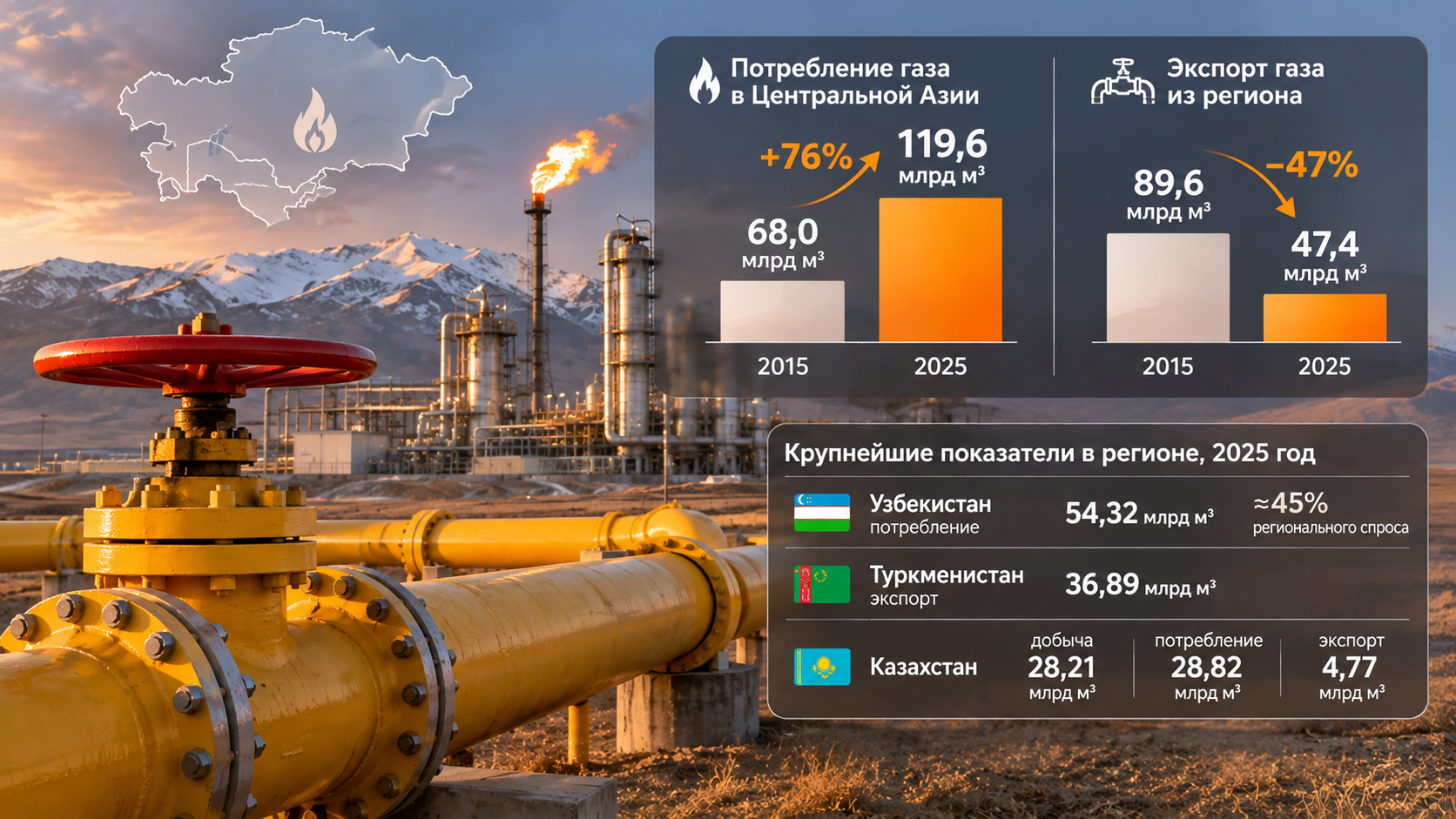
The conclusions follow from the data in the Eni World Energy Review 2026 report, and the totals for the five-country region are cited by UzDaily.
The gist in brief
- Gas consumption in the region rose to 119.6 billion m³ (+76% compared with 2015), while exports fell from 89.6 to 47.4 billion m³.
- Uzbekistan consumes 54.32 billion m³ (about 45% of regional demand), while Turkmenistan exports 36.89 billion m³.
- In 2025, Kazakhstan produced 28.21 billion m³ of gas, consumed 28.82 billion m³, and exported 4.77 billion m³, compared with 20.11 billion m³ in 2015.
- The region's gas reserves are concentrated in Turkmenistan: 13,900 billion m³ versus 1,830 in Kazakhstan.
What the gas data show
The regional totals, as UzDaily notes, are calculated from Eni data for Kazakhstan, Kyrgyzstan, Tajikistan, Turkmenistan, and Uzbekistan. Regional production in 2025 amounted to 140.9 billion m³ versus 153.0 in 2015: Turkmenistan produced 72.48 billion m³, Uzbekistan 40.16, and Kazakhstan 28.21. Consumption is growing faster than production: Uzbekistan consumed 54.32 billion m³, Turkmenistan 35.58, and Kazakhstan 28.82. Per capita, Turkmenistan consumes the most gas, 4,671 m³ per year, while Uzbekistan consumes 1,466 m³ and Kazakhstan 1,382 m³.
Who exports and who imports
Regional exports have nearly halved, from 89.6 to 47.4 billion m³. Turkmenistan accounts for 36.89 billion m³, roughly 78% of the regional volume, Uzbekistan for 5.72, and Kazakhstan for 4.77. Imports amounted to about 26.1 billion m³: Uzbekistan imported 19.88 billion m³, Kazakhstan 5.37, Kyrgyzstan 0.64, and Tajikistan 0.20. According to Eni, proven gas reserves at the end of 2025 stood at 13,900 billion m³ in Turkmenistan, 1,830 in Kazakhstan, and 846 in Uzbekistan.
What about oil, solar, and emissions
Oil production in the region amounted to about 2,385 thousand barrels per day, of which Kazakhstan produces 2,098 thousand, that is, about 88% of the volume. Solar station capacity rose to 7,359 MW versus 4,417 MW a year earlier: 5,934 MW in Uzbekistan and 1,325 MW in Kazakhstan. CO₂ emissions in the region in 2024 amounted to about 473.5 million t versus 363.8 million t in 2015, with Kazakhstan accounting for 243.0 million t, about 51%. The review contains no emissions data for 2025.
What is happening with gas in Kazakhstan and Uzbekistan
In Kazakhstan, the gasification rate rose from 43% in 2016 to more than 64% by the start of 2026, but access to gas remains unequal: from 99.8% in Atyrau and Mangystau regions to zero in North Kazakhstan, Pavlodar, and Abai regions. The second gas processing plant at Kashagan will be built by a consortium with Chinese companies. In Uzbekistan, gas production is falling: in the first eight months of 2026 the country produced 24.2 billion m³, 16.3% less than a year earlier, and the new field in Ustyurt does not yet solve the shortage problem: the energy minister allows for imports to rise to 10-11 billion m³ per year by 2030. At the same time, Uzbekneftegaz over nine months discovered five gas fields amid a fivefold increase in 3D seismic survey volumes. The global backdrop, meanwhile, is set by record demand: in 2025 it grew by 1.7%, to 4.202 trillion m³.
Author's conclusion
Kazakhstan sits in the middle of this picture: the country's gas production is almost enough for its own consumption, 28.21 versus 28.82 billion m³, and the gap is closed by imports of 5.37 billion m³, while exports amounted to 4.77 billion m³. The indicator worth monitoring is the ratio of production to consumption: if it holds, gas for the domestic market will remain the first item in the balance, and export volumes will depend on how much is produced beyond that.


Comments ()