China produces more agricultural products than India, the US, and Brazil combined — global ranking based on FAO data
FAO released 2024 data on agricultural production value by country.
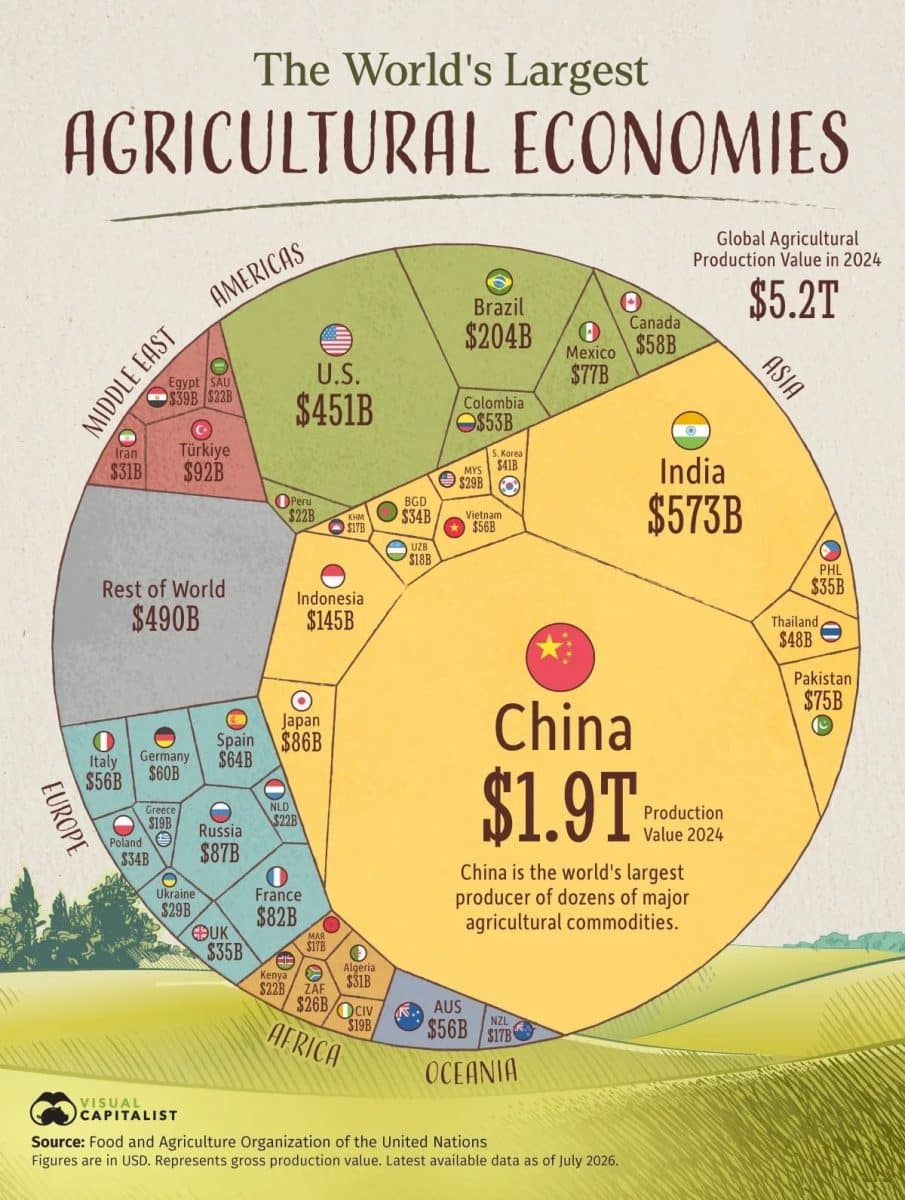
The global volume reached $5.2 trillion — the agricultural sector remains one of the largest industries in the global economy. The ranking clearly shows: the world is divided into countries that win through production scale and those that win through high value-added products. Kazakhstan, which declares its ambition to become Central Asia's agricultural hub, is so far noticeably absent from the top of both lists.
The gist in brief
- The global volume of agricultural production in 2024 amounted to $5.2 trillion.
- China produced agricultural goods worth $1.9 trillion — 36% of the global total, exceeding the combined figures of India, the United States, and Brazil.
- Four countries — China, India, the United States, and Brazil — account for nearly 60% of the global value of agricultural production.
- Europe does not compete on scale — it occupies the niche of high-margin products: wine, dairy products, olive oil. Russia leads in Europe thanks to grain exports.
- Kazakhstan is not included in the global agricultural ranking by production value — despite record grain harvests and its status as one of the largest wheat producers.
Why China is a world of its own
The gap between the first place and everyone else is striking. China's agricultural sector, worth $1.9 trillion, surpasses the combined production of the next three largest countries — India (~$530 billion), the United States (~$470 billion), and Brazil (~$340 billion). This is not just leadership — it is dominance of a different order.
The explanation lies in the structure. China and India have enormous domestic food systems that feed nearly three billion people. This means colossal production volumes even at relatively low export prices. The United States combines advanced technology with some of the highest crop yields in the world. Brazil has bet on export competitiveness — and has built one of the most efficient agribusiness complexes in the world.
Two paths to leadership: scale or margin
The ranking divides the world's agricultural economies into two fundamentally different types. The first is winning through scale: vast sown areas, millions of tons of grain, billions of liters of milk. China, India, the United States, Brazil, and Russia dominate here.
The second is winning through margin. France, Germany, Italy, and Spain specialize in products with high added value — primarily wines, dairy products, cheeses, and olive oil. Japan produces expensive marbled beef and premium tea. These countries produce less in tons — but earn incomparably more per unit of output.
Russia leads among European countries mainly due to its grain sector — powerful in volume but relatively low-margin. This allows it to hold a high position in the value ranking, but it does not provide the added value that Western European agribusinesses deliver.
The Kazakhstan context
Kazakhstan has harvested 27 million tons of grain for two consecutive years — record harvests by national standards. The country is in the top 10 global wheat exporters. However, in the global ranking of agricultural production value, Kazakhstan holds a modest position — precisely because most of that volume consists of low-margin grain sold as raw material.
President Tokayev at a meeting with Chinese tech companies directly articulated the challenge: Kazakhstan must move beyond raw material exports and create added value domestically. The FAO ranking clearly shows why: the difference between a country exporting wheat and a country exporting flour, pasta, or animal feed is the difference in position in the global agricultural ranking.
The path from a grain exporter to a full-fledged agricultural economy with high added value — this is exactly what Kazakhstan is trying to achieve through the wheat import ban, preferential lending for processing, and attracting Al Khaleej Sugar and LOVOL plants. The FAO ranking is a measurable benchmark of how successfully this path is being traversed.
Author's conclusion
Five trillion dollars of global agricultural production is distributed extremely unevenly: China alone takes a third. But what is more telling is this: the countries that earn the most per unit of output are not necessarily those that produce the most in tons. Kazakhstan, with its ambition to become Central Asia's agricultural hub, faces a choice: to remain at the bottom of the value ranking with record harvests — or to move up through processing and added value.
Comments ()