El Niño threatens coffee crops in four key countries at once
Your morning coffee is the latest victim of what a strengthening climate phenomenon can affect.
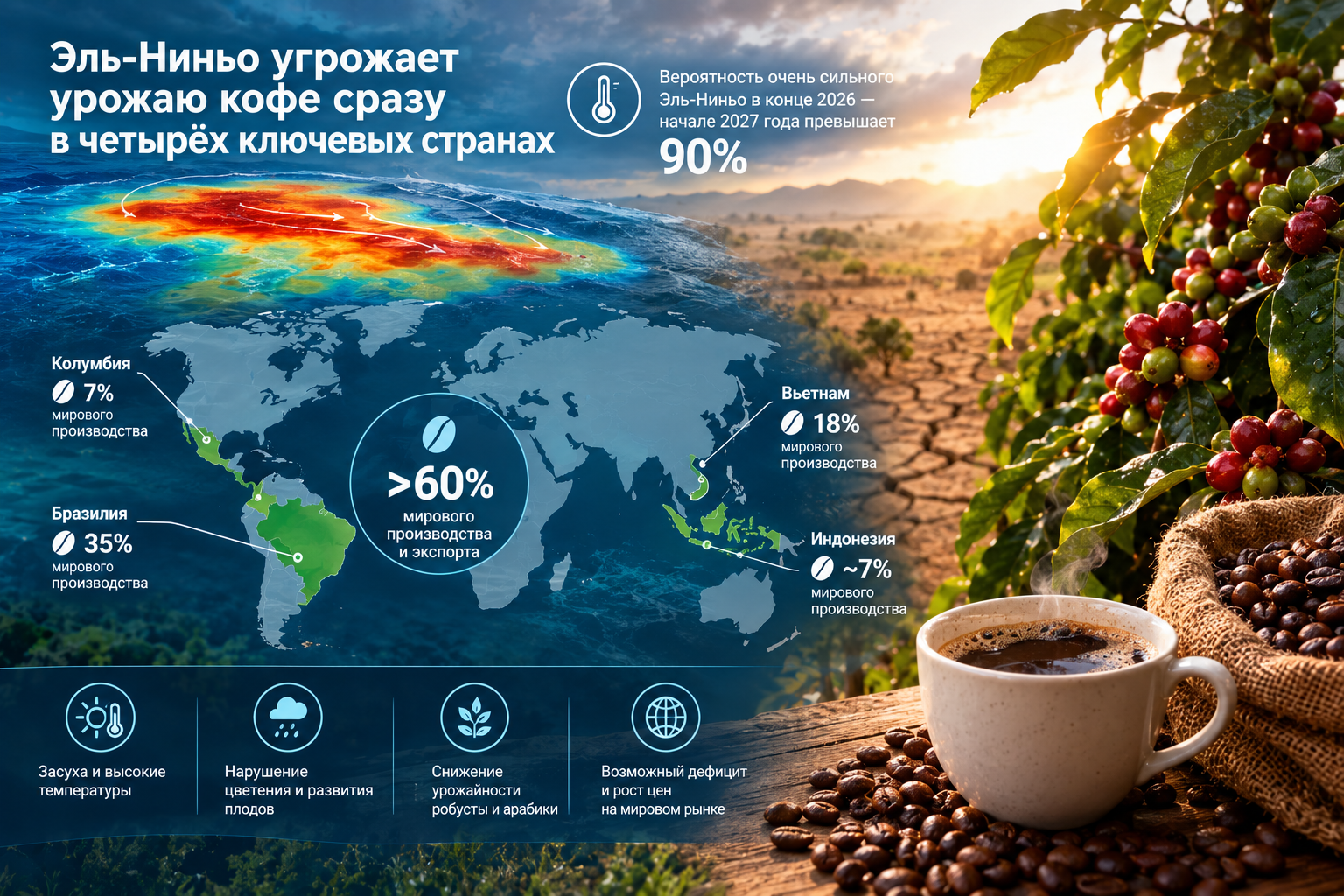
This time, Vietnam, Indonesia, Brazil, and Colombia are simultaneously under threat — countries that account for over 60% of global coffee bean production and exports.
The essence in brief
- El Niño is intensifying, and the probability of a very strong event in late 2026 — early 2027 exceeds 90%, RIA Novosti reported economist from the FAO Markets and Trade Division Fabio Palmeri.
- The greatest concerns are related to robusta production in Asia — primarily in Vietnam and Indonesia, but the consequences could also affect Brazil and Colombia.
- Brazil, Vietnam, Colombia, and Indonesia together account for over 60% of global coffee bean production and exports — meaning a large part of global coffee supply is immediately at risk.
- The scale of the possible impact remains uncertain and will depend on the development of weather conditions in the coming months.
Four countries — four different risk scenarios
The mechanism of the threat differs from country to country. In Vietnam, the intensification of El Niño could bring warmer and drier weather to the Central Highlands — the country's main coffee-growing region — and prolonged drought could increase irrigation demand and affect flowering and fruit development of the next robusta harvest. In Indonesia, below-normal rainfall is already being recorded in southern Sumatra, which, if dry conditions persist, could negatively affect flowering and reduce yields. In Brazil, recent rainfall, by contrast, improved conditions for flowering of the next harvest, but below-normal precipitation and above-normal temperatures are forecast for key coffee-producing regions in the coming months — meaning the favorable picture could turn unfavorable by the time coffee cherries form.
The Colombian paradox
The case of Colombia is especially illustrative: according to Palmeri, a moderate El Niño has in the past even contributed to coffee production in that country, but the intensification of the current event raises concerns precisely because of possible prolonged or severe drought conditions capable of harming flowering, bean development, and final yields. This is a good illustration of a general principle that is often lost in simplified discussions about El Niño — the effect is far from always strictly negative or strictly positive: much depends on the intensity of a particular cycle, not just on the fact of its occurrence.
Part of a series we are following
The coffee story logically continues our previous materials about this El Niño season. We have already written that NOAA raised the probability of record strength for the current event to almost 69%, that an analysis of Galapagos corals showed an increase in powerful El Niño phases specifically since the start of the Industrial Revolution, and that the same emerging super-El Niño threatens one-fifth of the vertebrate species of the Galapagos Islands. The scale of the risks becomes even more evident if one recalls the specific shares of these countries in the global market: Brazil accounts for 35% of global coffee production, Vietnam — 18%, Colombia — 7% — meaning three of the planet's five largest producers are simultaneously exposed to climate risk. Coffee is becoming another link in this chain — this time affecting not the exotic fauna of a remote archipelago, but an everyday product that will affect consumers around the world regardless of whether they follow climate news at all.
Author's conclusion
Palmeri's wording is emphatically cautious — "the scale of the possible impact remains uncertain" — rather than a ready-made forecast of a price collapse or shortage. But the very concentration of risk simultaneously in four countries that provide most of the world's coffee supply makes the situation worthy of attention right now, before these risks materialize into specific harvest figures. If at least some of the listed scenarios materialize simultaneously, the global coffee market risks facing a supply shortage precisely where reserve capacity for quickly compensating for it simply does not exist.

Comments ()