Danube shrinks to historic low, halting Romanian nuclear reactor
Danube water levels at the southern section hit a historic low. Near Baja, depth dropped to 14 cm—half the previous record. Budapest's Margit Bridge foundation is fully exposed. Near Mohács, a WWII ship hull emerged from the river.
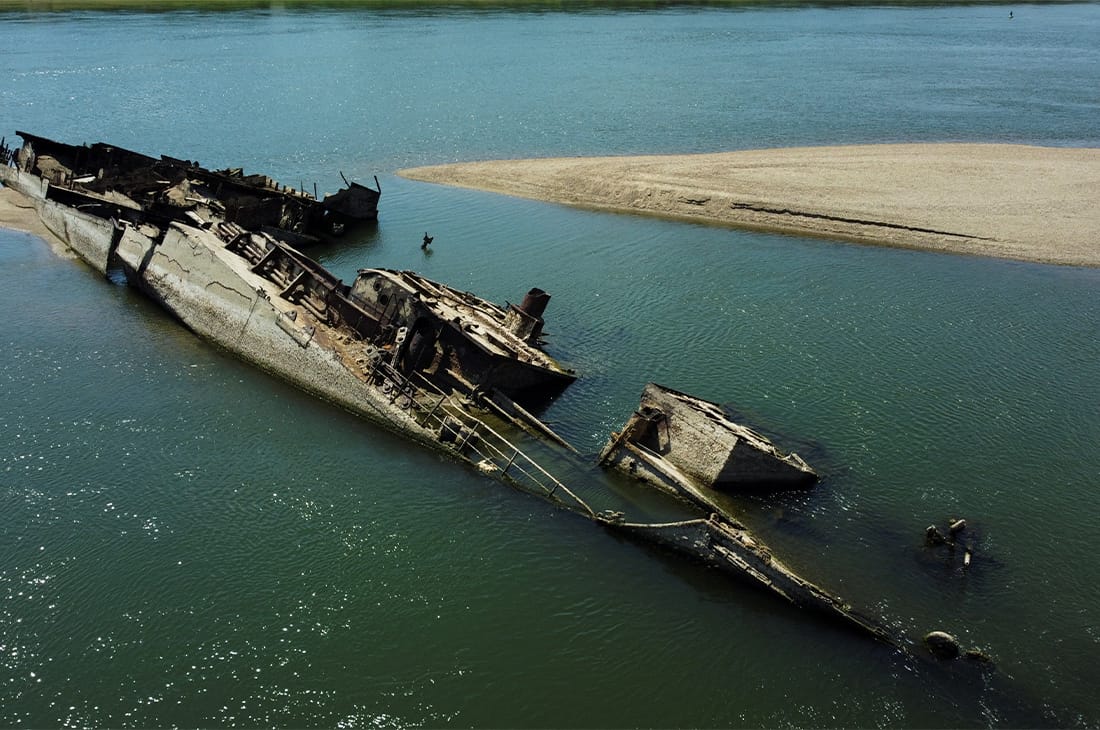
According to Euronews, the drought in Central and Eastern Europe has reached a critical point: the Danube's water level in Hungary has dropped to historic lows. On the most critical day, the water depth near Baja was only 14 centimeters — half of the previous anti-record. Navigation is restricted, and World War II ships have emerged from the river. And on July 28, 2026, Romania announced the controlled shutdown of the first power unit of the Cernavodă Nuclear Power Plant — the reactor is cooled by Danube water, which is catastrophically scarce, reports Romanian TV channel Digi24. For Kazakhstan, which is planning to build a nuclear power plant on Lake Balkhash, this precedent is a direct warning.
In Brief
- The Danube's water level in the southern section has reached a historic low. Near Baja, the water depth dropped to 14 centimeters — half of the previous anti-record. The foundation of Budapest's Margit Bridge is completely exposed. Near Mohács, the hull of a World War II ship has emerged from the river.
- The Sugovica tributary near Baja is almost fordable — the local ecosystem has suffered a devastating blow.
- Romania's Cernavodă NPP shut down its first power unit on July 28 due to the critical shallowing of the Danube. Operator Nuclearelectrica called it a preventive measure to ensure nuclear safety.
- Head of the River Management Department of the local water authority Csaba Abányi: "Over the last 125 years, the water level has dropped below one meter 21 times — and 14 of these cases have occurred in the last 25 years."
- Experts understand the causes of what is happening — but there are neither solutions nor funds for them yet. "The only solution is to wait for a more abundant flow from the upper reaches."
A River You Can Wade Across
The Danube's water level has dropped so low that the foundation of Budapest's Margit Bridge is completely exposed. Dozens of people gather daily on the newly emerged sandbar: some come to see the rare natural phenomenon, others build towers from river stones. Locals recall that similar strips of land under the Margit Bridge have appeared before — but downstream, the situation is far more dramatic.
In the southern section of the Danube, the water level has reached a historic low. Near Mohács, the hull of a ship sunk during World War II has emerged from the river. Due to numerous shallow riffles, navigation has had to be restricted.
The most severe situation is near Baja. Individual branches of the Sugovica tributary have almost completely dried up, causing devastating damage to the local ecosystem. On the most critical day, the water depth was only 14 centimeters — half of the previous anti-record.
A Trend More Frightening Than the Current Crisis
Head of the Flood Protection and River Management Department of the local water authority Csaba Abányi, in an interview with Euronews, emphasizes: what is alarming is not so much the current situation, but the persistent trend.
"If you look at how many times over the last 125 years the water level has dropped below one meter — which is already considered a very low level — it turns out this has happened 21 times. And 14 of these cases have occurred in the last 25 years. This confirms what scientists have long warned about: the Danube will experience periods of low water that are becoming more frequent, lasting longer, and reaching ever lower levels."
Abányi explained the reason: previously, even with a lack of precipitation, the water was replenished by meltwater runoff from the Alps. But due to global warming, Alpine glaciers have sharply retreated — we wrote about this in detail in the context of the closure of routes on Mont Blanc and the Matterhorn — and there is almost no meltwater left.
"The biggest problem is that, unlike a lake, there is no channel here that can simply be opened to replenish water supplies. The only solution is to wait for a more abundant flow from the upper reaches, and for the effects of climate change to become less severe," the expert summarized.
Nuclear Reactor Shut Down by Drought — Again
The Cernavodă Nuclear Power Plant in Romania shut down its first power unit on July 28 due to the critical shallowing of the Danube. Operator Nuclearelectrica called it a preventive measure to ensure nuclear safety.
We have previously written about how French reactors were shut down due to river overheating: plants cannot discharge heated water back, violating environmental regulations. The Romanian case is a different but equally fundamental problem: there is physically not enough water to cool the reactor.
Two events in one summer season — French reactors shutting down due to river heat, and a Romanian one due to their disappearance — form a single picture: European nuclear power is becoming systemically vulnerable to climate anomalies.
The Kazakhstan Context
Recently, Kazakhstan and Russia signed agreements on the construction of a nuclear power plant on the shore of Lake Balkhash. The choice of site — the shore of a large body of water — is dictated precisely by the need for cooling water. Balkhash is a closed lake with an already recorded decline in water level and serious environmental problems.
The Romanian precedent on the Danube and the French one on the Rhône and Seine raise the same question regarding Balkhash: how will the lake's water level behave over the 40–60 years of the plant's operation? What will the water temperature be under conditions of increasing heat? Is the project prepared for a scenario where the cooling water turns out to be either too warm or insufficient in volume?
This is not an argument against nuclear power — it is a technical question that designers must answer before the foundation is laid.
Author's Conclusion
The Danube has exposed its bed and shut down a nuclear reactor. This is no longer a hypothetical scenario from climate scientists' reports — it is the events of July 2026. Europe is rapidly learning that climate infrastructure is a physical reality that nuclear plants, river barges, and bridges must contend with. Kazakhstan, choosing the location and design for its first nuclear power plant, can still learn from others' lessons. While it still has that opportunity.

Comments ()