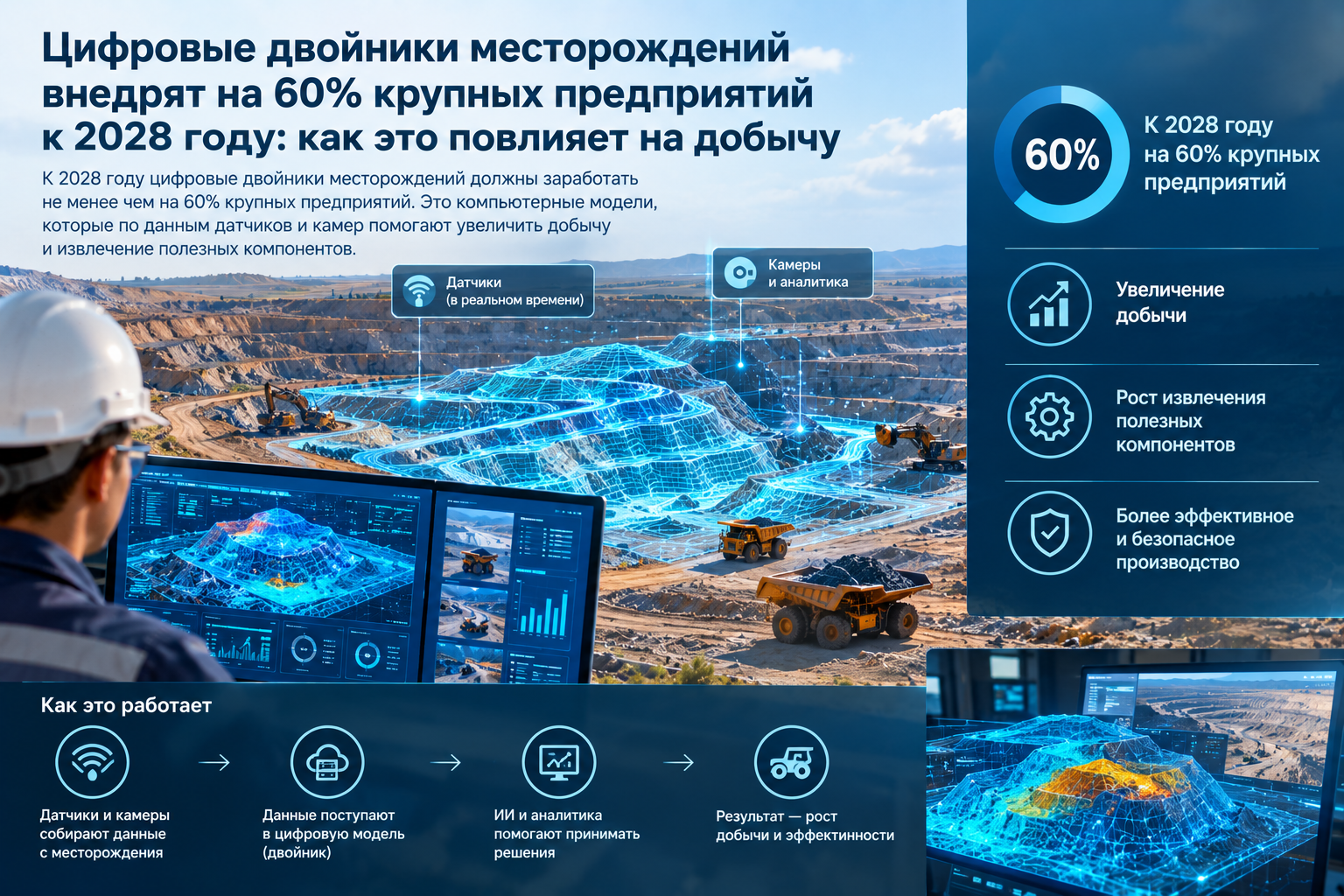
Digital twins of oilfields will be implemented at 60% of large enterprises by 2028
By 2028, digital twins of oilfields should be in use at 60%+ of major enterprises. These computer models use sensor and camera data to boost production and recovery of valuable components.
Minister of Industry and Construction Yersaiyn Nagaspayev said this at a government meeting on October 6, according to Zakon.kz.
The gist in brief
- The minister said that to combat the declining content of useful components in ore, digital twins of the technological process based on sensors and computer vision are being introduced; by 2028 they are planned to be scaled to at least 60% of large enterprises.
- Using KAZ Minerals as an example, according to the minister, an increase in copper recovery of 2% and a growth in factory productivity of 7% have already been achieved.
- According to his data, artificial intelligence is used across the entire production chain: the number of defects decreased by 39%, and emergency situations on the line are detected within 8 seconds.
- Prime Minister Olzhas Bektenov instructed that key production data of the industry be combined into a single "Data Lake" and that within two months priority enterprises and processes for implementing domestic digital solutions be identified.
- The Ministry of Energy, together with Samruk-Kazyna and KMG, must fully launch digital twins at 12 major oil fields by the end of 2028.
What the minister cited
Nagaspayev described the problem as follows: the content of useful components in ore is declining, and digital twins help conduct the technological process more precisely. He did not specify which parameters the twin controls at the KAZ Minerals factory. It is also unclear whether "an increase in copper recovery of 2%" means two percentage points or relative growth. The minister added that a similar approach is used in the automotive industry.
According to him, the practical effect of artificial intelligence is a reduction in the number of defects by 39%, while "emergency situations on the production line are detected within 8 seconds." The report does not say at which enterprises these figures were obtained.
What the prime minister instructed for industry
Bektenov noted that the digital transformation of industry is proceeding unevenly and is so far concentrated at individual large enterprises. The Ministry of Industry was instructed to scale digital solutions across the entire industry and collect key production data into a single industry-wide "Data Lake" - a common data repository on which, according to the government's plan, the implementation of artificial intelligence should be built.
The prime minister also reported that construction has begun on Kazakhstan's first Qazbot complex for the production of robotic systems, and drone logistics is being developed.
"It is important to us that such projects do not remain isolated initiatives," he said.
For this, the state and national companies must form demand in advance, and domestic manufacturers need to be provided with long-term guaranteed contracts. Within two months, the Ministry of Industry must determine the list of priority enterprises and processes, and together with government agencies and national companies, form long-term demand for domestic robots and unmanned solutions.
Oil fields and the power system
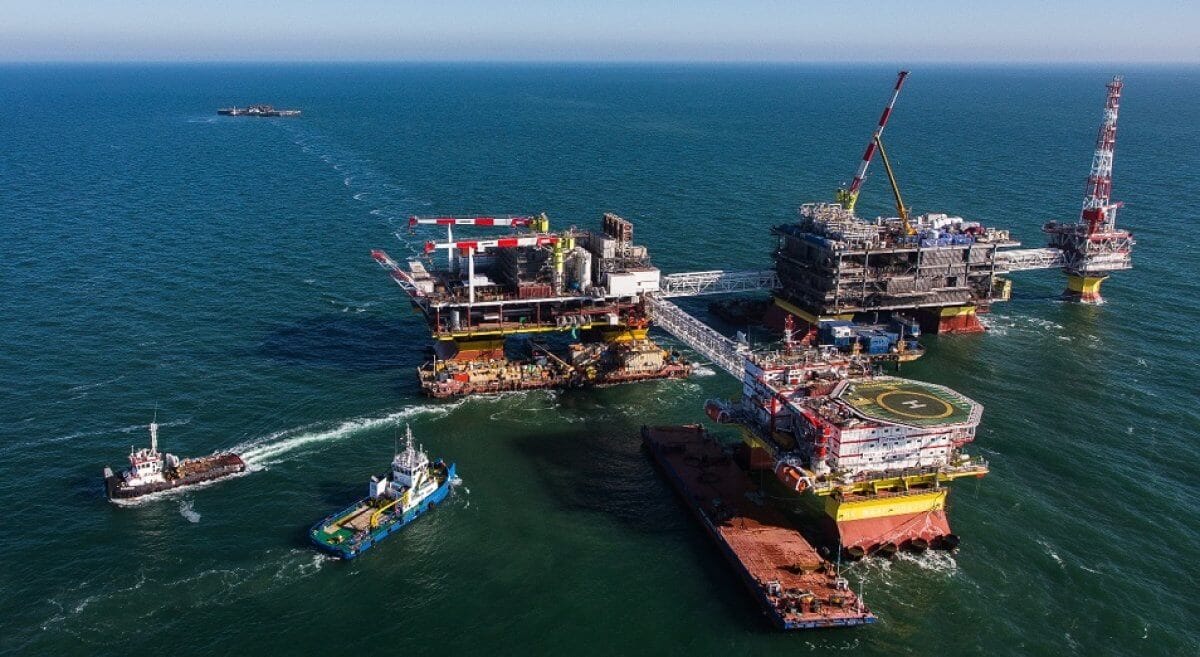
A separate instruction concerns oil and gas. Bektenov said that in the development of mature fields and with the growth of hard-to-recover reserves, the issue of profitability is acute, and artificial intelligence and digital twins are already proving their effectiveness and should become a basic standard. The Ministry of Energy, Samruk-Kazyna, and KMG must scale them across all production assets and fully launch twins at 12 major fields by the end of 2028.
These are the same 12 fields that, according to KMG data, account for about 90% of the company's production. A pilot project is already underway at the Vostochny Moldabek field in Atyrau region: according to KMG estimates, the twin will yield an additional 168 thousand tons of oil over three years and increase the turnaround period to 750 days.
In the power system, according to the prime minister, digitalization is insufficient: there is no end-to-end telemetry, integrated data, or analytical tools. The Ministry of Energy must unite key facilities and information systems of the industry into a single digital contour with data output to the Energy Command Center, conduct a digital inventory of key facilities by the end of the year, and approve unified requirements for the composition, quality, and transmission of industry data.
One such platform in the energy sector is already operating in a separate segment: in August, the Ministry of Energy launched an AI platform for monitoring coal supplies, which combines data from 36 coal-mining enterprises, 586 coal sidings, and more than 1.2 million consumers.
Personnel for such systems are being trained separately: in August, the Ministry of Energy approved the professional standard "Digitalization and Application of Artificial Intelligence in the Energy Sector", which introduces three new professions, including a Smart Grid solutions engineer and a cybersecurity specialist for energy grids.
The same logic in the agro-industrial complex
In the agricultural sector, the consolidation of digital systems is proceeding in parallel: the Ministry of Agriculture is forming a unified digital platform for the agro-industrial complex by the end of 2028.
A similar path has been chosen for natural resources. In September, the authorities announced the consolidation of land, water, forest, and subsoil records into a single digital database, and for water, a unified water resource management system has already been launched, which accounts for about 23 thousand water bodies.
Author's conclusion
At the meeting, the emphasis shifted from individual pilots to scaling: the minister has a target of 60% of large enterprises, while the prime minister has deadlines of two months and the end of 2028. The examples of effect are so far taken from isolated cases, without a breakdown by enterprise.

Comments ()