TEPCO will use AI to find errors in documents for the nuclear regulator
TEPCO, operator of Japan's Fukushima-1 nuclear plant, has begun testing a generative AI system that helps draft applications to the nuclear regulator.
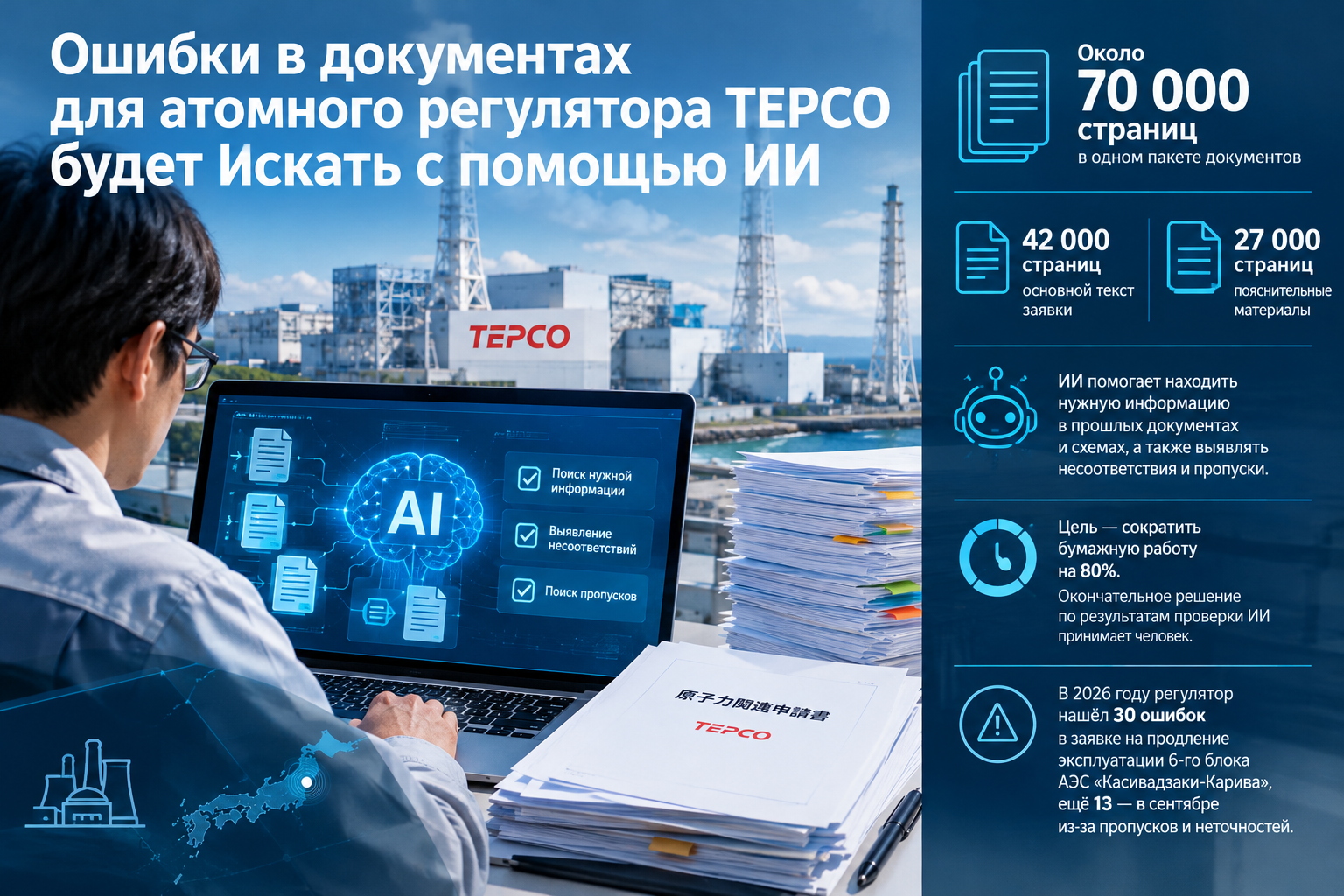
Such document packages reach almost 70,000 pages. The trials began against the backdrop of the regulator having already reprimanded the company twice this year for errors in its applications, writes Nikkei Asia.
The gist in brief
- On October 5, TEPCO, the IT company CTC (ITOCHU Techno-Solutions), and the startup Stockmark announced that they had deployed a pilot version of a "nuclear application preparation support system" in TEPCO's nuclear division. Evaluation of its effectiveness begins in October.
- The main text of an application can run to about 42,000 pages, with explanatory materials adding another 27,000. The system searches past documents and diagrams for the necessary information and helps identify gaps and inconsistencies.
- According to Nikkei Asia, the system is expected to cut paperwork by 80%. TEPCO itself does not cite specific figures in its official statement and emphasizes that the final decision based on the AI's findings is made by a human.
- In 2026 alone, 30 errors were found in TEPCO's application to extend the operation of Unit 6 at the Kashiwazaki-Kariwa nuclear power plant, and in September the company had to make another 13 revisions due to omissions and inaccuracies.
How the system works
The companies announced the project in a joint press release. The system combines generative AI, optical character recognition, and image recognition. It is built on retrieval-augmented generation (RAG) technology: the AI first finds relevant fragments in the archive of past documents and diagrams, then relies on them in its response. The search is based on Stockmark's SAT data structuring platform. Due to the confidentiality of the information, the system was deployed on TEPCO's own servers rather than in the cloud.
The system's task is to help already at the application preparation stage, not just during the final review. Currently, each document is sequentially checked by several divisions for compliance with related documents and diagrams. If the AI can find gaps and inconsistencies earlier, the burden on subsequent review and correction stages will decrease. At the same time, TEPCO emphasizes that the correctness of the AI's conclusions and the need for edits are assessed by humans.
Why this became necessary
According to Nikkei Asia, while preparing the application to restart Unit 7 at Kashiwazaki-Kariwa, about 100 TEPCO specialists worked for several months on a package of roughly 70,000 pages. But it is not just the volume: TEPCO is regularly criticized for the quality of its documents.
Unit 6 at Kashiwazaki-Kariwa, with a capacity of 1,356 MW, became the first reactor TEPCO restarted after the Fukushima accident in early 2026. Almost immediately, 30 errors were found in the company's application to operate the unit for more than 30 years. A representative of the Nuclear Regulation Authority admitted at the first meeting that he did not yet even understand how to conduct such a review. In September, TEPCO reported another 13 revisions to the same application. Among them were cases where the assessment incorrectly stated equipment design and operating conditions. A regulator representative asked the company how it viewed the fact that such things were recurring at this stage.
Broader than one company
After the pilot stage, TEPCO expects to expand the system's functions and offer it to other divisions and other Japanese energy companies. Demand for such tools is tied to the country's push to bring nuclear power back. Before the 2011 accident, 54 reactors operated in Japan, providing about a third of its electricity. Now about 15 are operating, and under the energy strategy the share of nuclear power should rise to about 20% by 2040. Each restart requires years of regulatory review, and the industry lacks specialists capable of preparing such documents.
Author's conclusion
The story of AI at TEPCO is interesting not so much as a technological novelty but as an attempt to solve a very specific problem: a company that the regulator already distrusts after Fukushima continues to submit applications with errors. For now, this is only a pilot project, and the promised 80% savings is an estimate, not a result. The key question is whether AI will become an additional layer of oversight or a pretext to cut the people who provide that oversight. Japan's experience will also be useful for Kazakhstan, which is only beginning to go through licensing for its first nuclear power plant: the volume of documentation for the nuclear regulator there will be comparable, and the cost of errors in it no less.

Comments ()