El Niño threatens global sugar market — prices could rise to $800 per ton
India halts sugar exports. The world's second-largest producer may lose up to 8 million tons of cane crop due to climate change.

The global sugar market is entering a zone of turbulence. El Niño threatens to reduce sugarcane production in India — the world's second-largest sugar producer — by 3–8 million tons. As reported by bb.lv, if the country completely halts exports and Brazil cannot increase supplies, sugar prices could rise to $750–800 per ton.
The Gist
- Due to El Niño, sugar production in India could decrease by 3–8 million tons compared to last year. The main sugarcane-growing regions — Maharashtra, Karnataka, and Tamil Nadu — are already experiencing a moisture deficit.
- India has suspended sugar exports until September 30 — to preserve domestic stocks and assess future harvest prospects.
- White sugar futures on the London exchange in early June have already exceeded $660 per ton. If the Indian export ban continues, the price could reach $750–800 per ton.
- Brazil — an independent sugar exporter — will not be able to quickly compensate for the shortfall due to limited processing capacity.
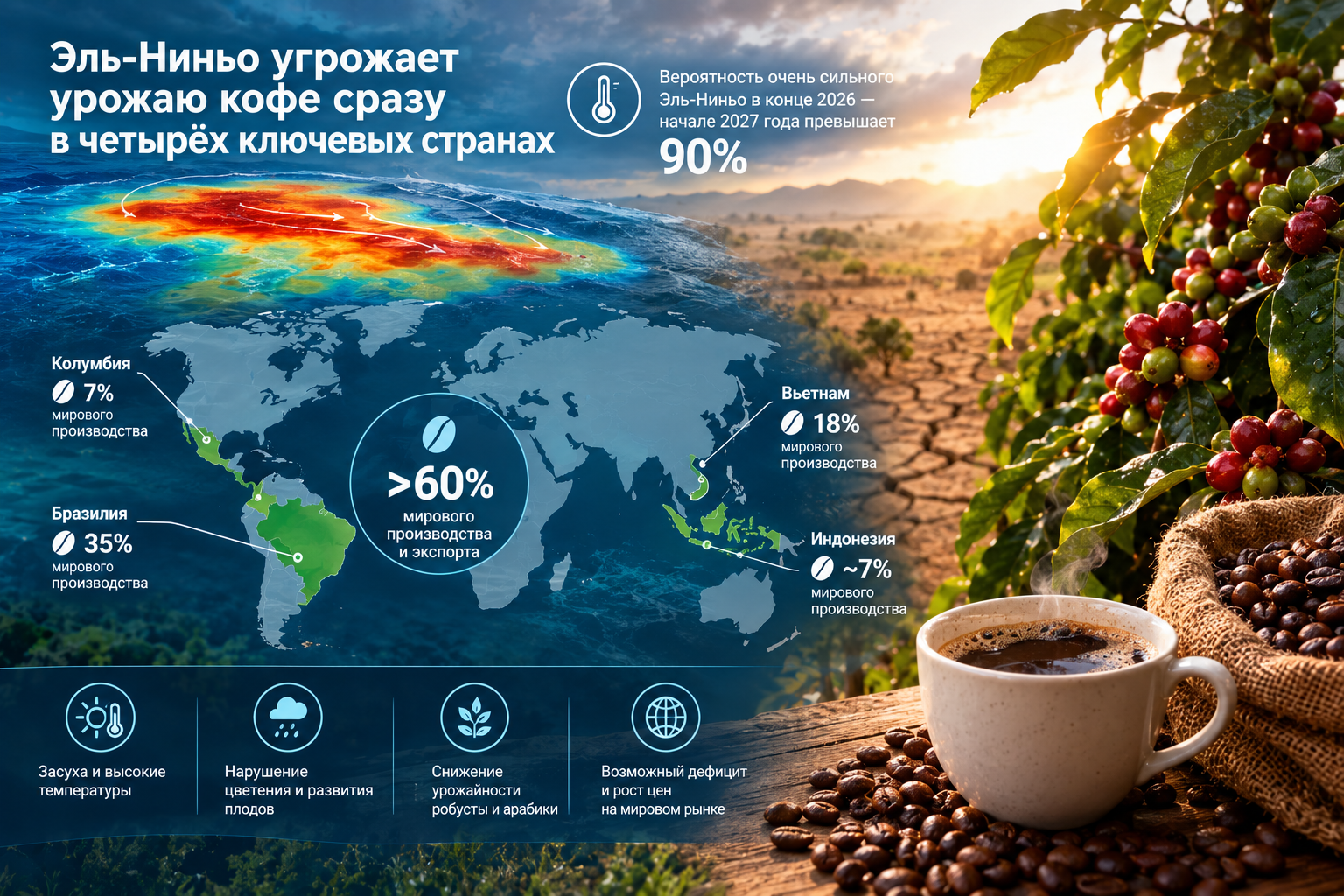
- UN Secretary-General António Guterres estimates the probability of El Niño occurring in the coming months at 90%.
India: When the Monsoon Fails
India is one of the two major sugar producers alongside Brazil. The balance of the global market largely depends on the Indian harvest: in good years, the country exports tens of millions of tons; in bad years, it closes its borders to exports.
The southwest monsoon plays a key role for Indian agriculture — and it is precisely this that could become a risk for the global market. El Niño traditionally weakens the Indian monsoon, reducing rainfall during the dry period. The main sugarcane-growing regions — Maharashtra, Karnataka, and Tamil Nadu — are already recording a moisture deficit. Sugarcane is a water-intensive crop, and even moderate damage leads to a disproportionate drop in yield.
The Market is Already Reacting
White sugar futures on the London exchange in early June have already exceeded $660 per ton amid expectations of potential supply disruptions. This even before the full scale of El Niño's impact is confirmed — markets are pricing in risks in advance.
If the Indian export ban continues, the price of sugar could rise to $750–800 per ton. Brazil could potentially partially compensate for the shortfall — but only partially: the country's processing capacity is limited and does not allow for a rapid increase in exports to the required volume. Furthermore, Brazilian farmers themselves are experiencing a debt crisis amid climate shocks, which reduces their investment potential.
UN Warning
UN Secretary-General António Guterres previously stated that the probability of El Niño arriving in the coming months is about 90%, noting that the phenomenon could exacerbate the effects of global warming and disrupt food security and water systems.
FAO, in turn, has warned of the potential negative impact of El Niño on agricultural production in several key regions — particularly on sugarcane cultivation in India and Thailand. Thailand, the world's third-largest sugar exporter, is also in the risk zone, which could further worsen the supply deficit.
Kazakhstan Context
Kazakhstan is in a fundamentally different position compared to most sugar importers — but this position is far from as strong as it might seem. The country has four sugar factories, three of which process sugar beets with a total capacity of 870,000 tons per year. Meanwhile, annual sugar consumption reaches 500,000 tons, and domestic production from local raw materials covers only 14% of the demand. The rest is imported, partly as raw sugar for processing and partly as refined sugar.
The gap between factory capacity and actual production is easily explained: farmers grow clearly insufficient raw materials to utilize the existing capacity. In 2024, out of the 1.2 million tons of beets grown, only about 608,000 tons were processed — the remainder was exported to Kyrgyzstan or left unclaimed.
The state recognizes the problem.
Minister of Agriculture Aidarbek Saparov stated directly: "Creating new processing capacities and forming a sustainable raw material base are key state priorities."
In December 2025, a memorandum was signed with the Turkish holding Cengiz Holding: the company is considering building two sugar factories with a total capacity of up to 300,000 tons of sugar per year in the North Kazakhstan and Pavlodar regions. Investment — $500 million over 10 years, construction start — 2026, commissioning — within two years.
In parallel, a factory project in Konayev is being implemented jointly with the Emirati company Al Khaleej Sugar — the world's largest standalone sugar refinery. The design capacity is 500,000 tons per year, cost — 313.6 billion tenge, timeline — 2025–2028.
If all announced projects are realized, Kazakhstan will not only cover its own needs but also gain significant export capacity — at a time when the global market is experiencing a deficit due to El Niño. The key condition is not to delay construction and simultaneously expand the raw material base.
Author's Conclusion
The global sugar market is entering a zone of high uncertainty — and climate is to blame. Kazakhstan finds itself in a rare position in this story: a country with real potential for self-sufficiency, which currently covers only 14% of its own needs with domestic raw materials. Three operating factories, a giant under construction in Konayev, and the announced capacities of Turkish Cengiz Holding form a production foundation for the future. But between a memorandum and a working factory lies a distance that Kazakhstan has a knack for stretching. While the world overpays for sugar, the country has a window of opportunity. The main thing is not to miss it while the signed papers gather dust.

Comments ()