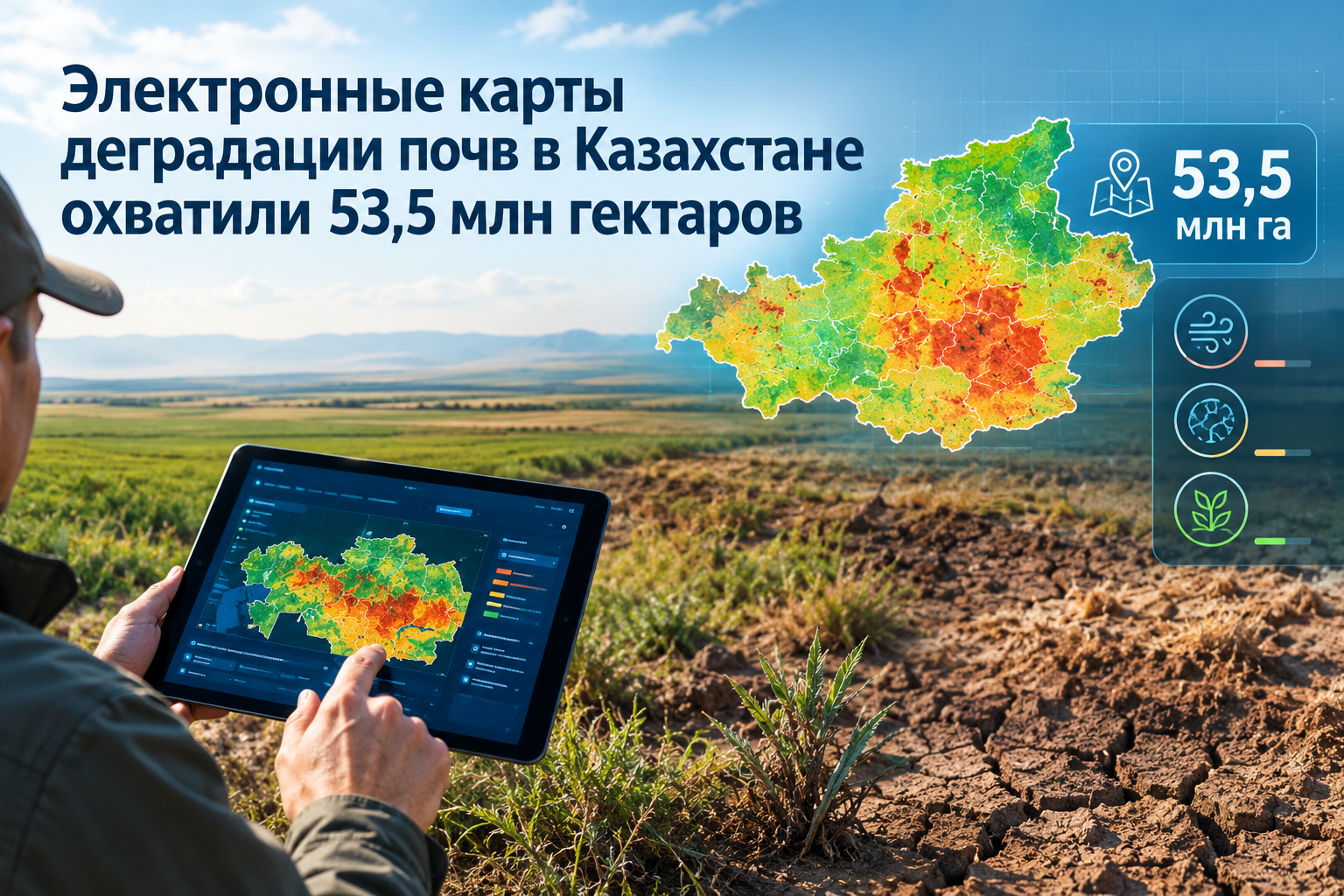
Electronic soil degradation maps in Kazakhstan covered 53.5 million hectares
Kazakhstan's Vice Minister of Agriculture Yermek Kenzhekhanuly presented Kazakhstan's experience in restoring degraded agricultural land in Rome.
The presentation took place at a technical session of the Rome Water Dialogue at the headquarters of the Food and Agriculture Organization of the United Nations (FAO) as part of the World Food Forum 2026. The country's approach is based on digital monitoring, updated legislation, and modern land-use methods.
The gist in brief
- Electronic land degradation maps have been prepared for an area of 53.5 million hectares.
- The roadmap for soil restoration for 2024-2030 was supplemented with 17 regional roadmaps.
- Measures against water and wind erosion are envisaged for an area of more than 2 million hectares.
- A national system for monitoring soil organic carbon is being prepared with FAO: the project runs from March 2026 to December 2027.
What was presented in Rome
According to data from the Ministry of Agriculture, in 2023 a specialized institute for land surveys was created, and electronic degradation maps have been prepared for 53.5 million hectares. The roadmap for soil restoration and fertility improvement for 2024-2030 has been supplemented with 17 regional maps. Measures against water and wind erosion are envisaged for an area of more than 2 million hectares. Pasture restoration includes sowing perennial grasses, and the roadmap for carbon farming was approved in November 2025: it envisages soil-saving technologies and an increase in organic matter in the soil.
"Preventing degradation is more important than eliminating its consequences," said Kenzhekhanuly.
According to him, land restoration is the foundation of both food and water security.
What is being done together with FAO
A separate project with FAO is aimed at creating a national system for monitoring, reporting, and verification of soil organic carbon content. It is currently at the preparatory stage. A digital geoportal, modernization of laboratories, four pilot sites, and national assessment methodologies are planned. At least 80 specialists and 500 agricultural producers will be trained. This is one of the projects under the partnership program: in July, the Ministry of Agriculture and FAO launched three projects, including work on soil carbon, combating locusts with drones, and reviving the Almaty Aport variety. In total, 10 projects worth $9.5 million are being implemented with FAO.
The law on which the approach is based
The Law on Soil Protection, as noted by the Ministry of Agriculture, became the country's first standalone legislative act in this area. It introduces the concepts of soil health and quality, erosion, and rational use of soil resources, defines the legal foundations for soil, agrochemical, and reclamation surveys, and expands the responsibilities of land users. The law came into force on September 8, 2026. Now, in particular, the fertile layer must be removed and preserved before the start of construction and other non-agricultural work.
Author's conclusion
In Rome, an already established system was presented: maps, roadmaps, and a law. But the amounts for soil restoration and the results of the work already begun were not mentioned in the presentation. The carbon project is still only being prepared, and the main question is what it will give farmers in practice.

Comments ()