More than 460 million hectares of forests degraded worldwide, FAO says
FAO's "State of the World's Forests 2026" report reveals over 460 million hectares of forests are degraded worldwide.
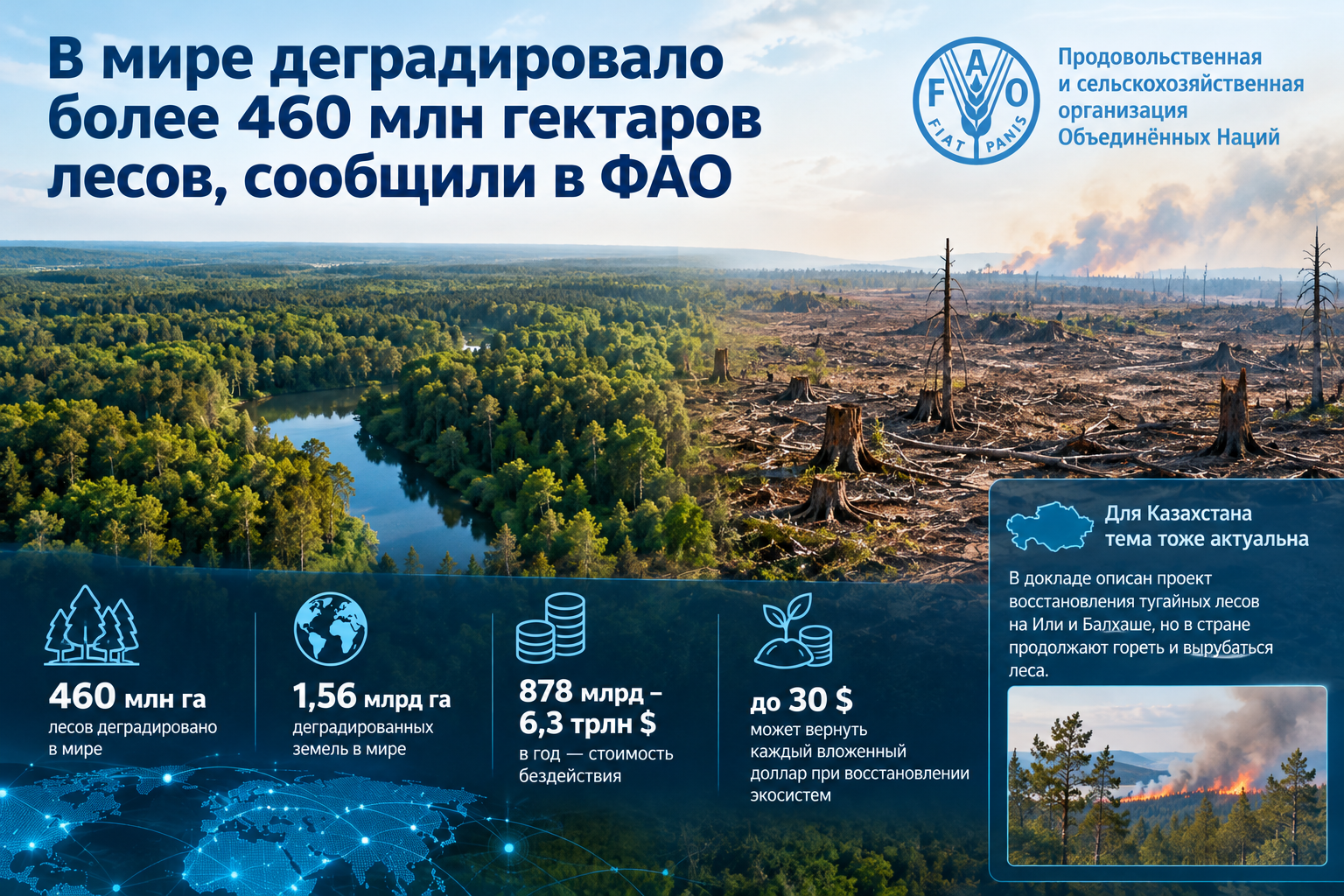
The organization believes that investments in forest restoration pay off, while inaction costs very dearly. The topic is also relevant for Kazakhstan: the report describes a Kazakhstani project, but the country's forests continue to burn and be cut down.
The essence in brief
- There are 1.56 billion hectares of degraded land in the world, including more than 460 million hectares of forests.
- Failure to restore ecosystems costs the world 878 billion to 6.3 trillion dollars per year, according to UN News.
- Under favorable conditions, every dollar invested can return up to 30 dollars.
- The report describes a project to restore tugai forests on the Ili and Balkhash, but in Kazakhstan itself forests continue to burn and be cut down.
What the report showed
The report was presented in Rome at the 28th session of the FAO Committee on Forestry. Forests cover 4.14 billion hectares, about 32% of the land. They are home to up to 80% of terrestrial biodiversity, and nearly a third of people depend on forests and trees for food and income.
Since 1990, the world has lost 489 million hectares of forest due to deforestation. Net forest loss initially declined: from 10.7 million hectares per year in 1990-2000 to 3.68 million in 2000-2015. In 2015-2025, it rose to 4.12 million hectares per year.
Another problem is fires: every year they affect at least 127 million hectares of forest, and their frequency and intensity are growing. Among the causes of degradation, the report names fires, pests, diseases, extreme weather, climate change, and excessive land use.
Forests are also being cut down for new construction. For example, in Finland environmentalists accused Google of cutting down more than 300 hectares of forest for data centers before completing an environmental assessment; the company calls the logging legal.
How much inaction costs and what restoration delivers
According to UN News, failure to restore ecosystems costs the world 878 billion to 6.3 trillion dollars per year. Restoring more than 1 billion hectares of land could generate about 1.8 trillion dollars annually. Investing 2.6 trillion dollars over 15 years in combating land degradation and drought, according to the authors' estimate, will return more than 8 times that amount.
FAO Director-General Qu Dongyu called the restoration of forests and landscapes a strategic investment in sustainable agrifood systems and rural development. He warned that time for action is running out.
Are the promises achievable
According to FAO, 91 countries have pledged to restore 190 million hectares of degraded forests. Achieving the 2030 goals is described by the organization as a serious challenge. The report's authors identify four conditions for success: respect for the rights and knowledge of local people, working at the landscape scale, long-term public and private financing, and coherent policy and legislation.
An example from Kazakhstan
The report describes a project to restore tugai forests and Populus pruinosa in the Ramsar site "Ili River Delta and the southern part of Lake Balkhash." Tugai forests along the rivers of Central Asia and western China now occupy less than 10% of their 1960s area. Populus pruinosa is listed by the IUCN as "near threatened," and its seeds lose viability within a few days.
The project runs from 2018 to 2048: restoration is underway on 25,500 hectares out of a planned 200,000. A cryobank of 100,000 seeds has been created, and local residents collect seeds and earn income.
Efforts to grow new forests are also underway around the capital. Near Astana, a demonstration forest belt of more than 20 hectares is being created, where, together with Chinese scientists, species capable of withstanding steppe frosts, winds, and blizzards are being tested. The site is part of Astana's "Green Belt" covering more than 14,800 hectares.
Financing for forest restoration is still only taking shape. Forest-climate projects in Kazakhstan are seen as a possible source of international climate money through carbon credits under Article 6 of the Paris Agreement. Rules for such projects have already been developed, but there are no specific amounts for forests yet.
Forest fires and logging in Kazakhstan
Successful projects do not eliminate the main problem: Kazakhstan's forests burn regularly. In June 2023, a fire in the "Semey Ormany" reserve covered about 60,000 hectares; according to official data, 14 forestry employees died. In July 2026, a fire broke out again in the same reserve: according to FBRK, NASA's FIRMS satellite system showed about 1,676 hectares of fire, while officials reported 370 hectares.
Problems also concern logging. In October, the National Security Committee reported a scheme of illegal logging in "Semey Ormany," and the prosecutor's office identified more than 30 violations there and suspended logging in 20 blocks. FBRK founder Kirill Pavlov back in 2024 called corruption one of the main causes of the industry's problems.
The Aral Sea region
The report separately describes the Aral Sea region. The area of floodplain forests in Central Asia has shrunk by 90%. In place of the Aral Sea, the Aralkum desert has formed, covering more than 5.5 million hectares. Every year, more than 100 million tons of dust and salts rise from it, and more than 73 million people suffer from the consequences. According to the report, bringing the sea back is impossible; the realistic path is to restore ecosystems throughout the entire basin.
At the same time, Kazakhstan continues work on the Northern Aral Sea, the Kazakhstani part of the sea. The government recently discussed with international financial organizations the revival of the Northern Aral Sea: the first phase includes 133 projects together with the World Bank, with the main work planned for completion in 2030. The goal is to increase the area of the Northern Aral Sea to 3,900 square kilometers and the water volume to 34 cubic kilometers.
Author's conclusion
In the report, forest degradation is presented as a matter not only of ecology but also of food security and economics. The data on payback and the cost of inaction are estimates by the report's authors. For Kazakhstan, the report shows both successes and weaknesses: the restoration of tugai forests is underway, but protecting existing forests from fires and logging remains an unresolved task.
Comments ()