EU energy ministers seek ways to soften winter energy bill hikes
EU energy ministers met in Luxembourg to discuss how to protect households and industry from expensive energy this winter.
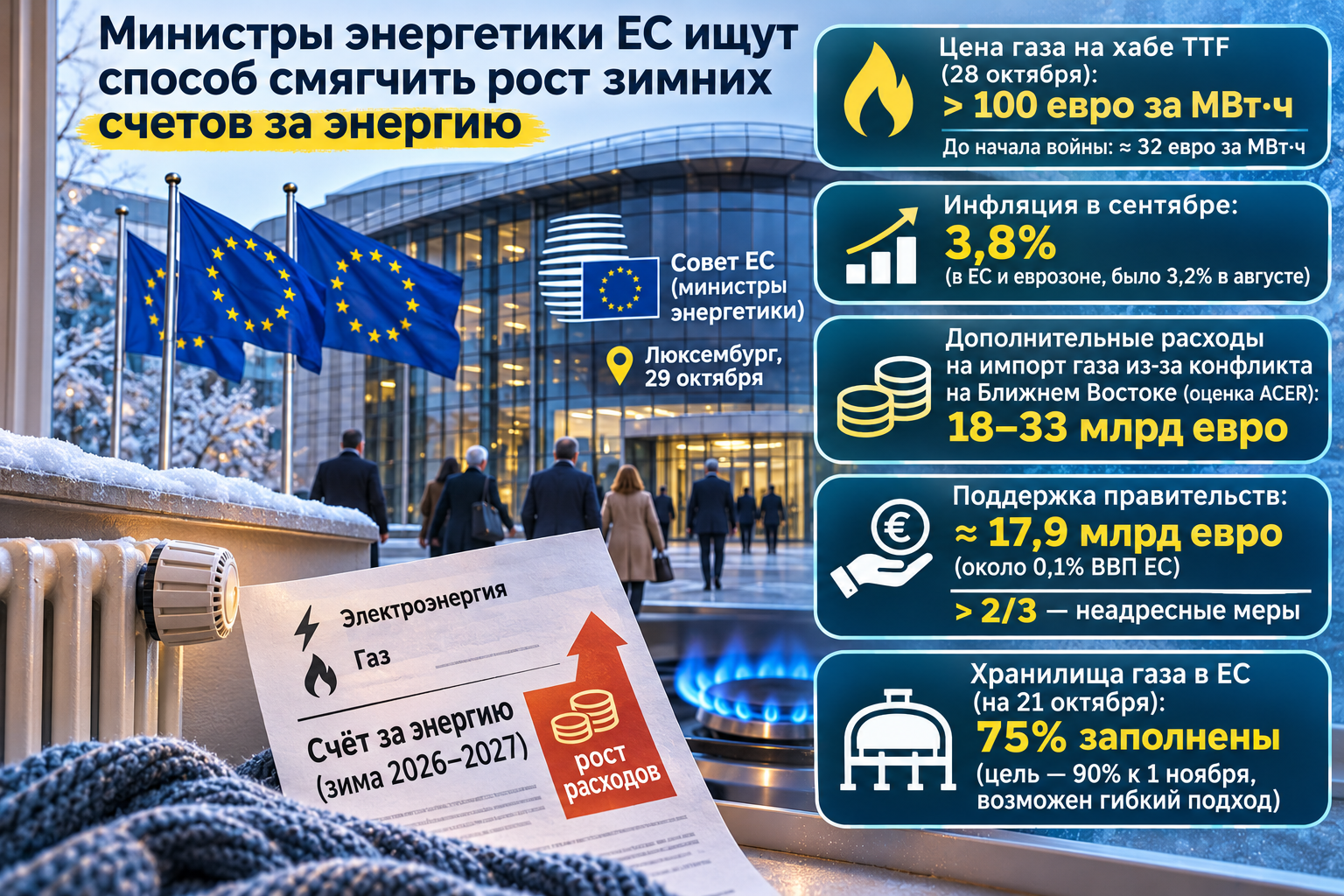
The wholesale price of gas at the Dutch TTF hub at the end of October exceeded 100 euros per MWh for the first time since December 2022, while inflation reached 3.8% in September, according to Euronews.
The gist in brief
- The Energy Council met on October 29 in Luxembourg to discuss network tariffs, future electricity bills and energy security for the 2026-2027 winter.
- Gas at the TTF hub cost more than 100 euros per MWh on October 28, compared with about 32 euros before the war began in late February.
- The EU Agency for the Cooperation of Energy Regulators (ACER) estimates that the Middle East conflict added 18-33 billion euros to the gas import bill.
- Governments are already spending about 17.9 billion euros on support, with more than two-thirds of that money going to non-targeted measures.
What the ministers discussed
The meeting took place on October 29. The agenda included a proposed regulation on network tariffs, a regulation on future electricity bills, energy supply security in winter and energy policy goals after 2030. Ireland's Minister for Climate, Energy and the Environment, Daragh O'Brien, whose country currently holds the EU Council presidency, named accelerating electrification, developing grids and resilience as priorities.
Among the ideas discussed for the winter were reducing the cost of electricity and the tax burden, ensuring that excise duties on electricity do not exceed those on natural gas, making maximum use of existing grids and cross-border lines, and increasing investment in clean energy and diversifying supplies.
Why prices are rising again
Because of the war in the Middle East, liquefied gas supplies from Qatar were disrupted, almost none reached Europe in the summer, and dependence on the United States increased. The TTF gas futures contract traded above 100 euros per MWh on October 28, the first such level since December 2022.
Underground gas storage was 75% full on October 21 against a target of 90% by November 1, and countries may meet it flexibly. According to ACER, the conflict added 18-33 billion euros to Europe's gas import bill for the same volume of fuel. The range depends on whether daily or monthly TTF prices are used.
Inflation in September, according to Eurostat, was 3.8% in both the eurozone and the EU, up from 3.2% in August. Energy's contribution to eurozone inflation was 1.71 percentage points.
What governments have already done
25 of the 27 EU countries have adopted support measures: energy vouchers, price caps, tax and excise cuts. Their cost this year is estimated at 17.9 billion euros, about 0.1% of the EU's GDP. The European Commission believes that more than two-thirds of the aid is not targeted and is insufficiently focused on the most vulnerable.
What remains unclear
There are no official outcomes of the Council meeting, decisions or timelines in open materials yet. Euronews states in its headline that the Strait of Hormuz remains closed, but in the main text it speaks only of the war in the Middle East and transport restrictions. There are no references to official documents in the material.
What is happening with gas and energy in the world and the region
Gas problems are visible not only in prices. Europe's storage facilities in early October were filled to about 71% against the usual 87% for that time of year, the lowest level since 2009. Global gas demand in 2025 rose to a record 4.2 trillion m³, with Asia providing the main increase.
Central Asia also faces gas shortages. Uzbekistan announced the discovery of five gas fields, but production fell by 16.3% in January-August, and imports could grow to 10-11 billion m³ per year by 2030. In Kazakhstan, fossil fuels account for about 85% of electricity, with wind and solar together at about 6%, according to data from the Ember analytical center.
Author's conclusion
The ministers have no decisions yet: they discussed network tariffs, taxes and excise duties, that is, what affects the final bill. The cause of the rise lies in gas supplies and storage levels, and these measures do not directly address it. Therefore, even with support of 17.9 billion euros, two-thirds of which is non-targeted, the market price remains the main risk of the winter.


Comments ()