Falklands offshore oil goes to international arbitration
Argentina's President Javier Milei gave the UK two weeks to halt the Sea Lion oil project near the Falkland Islands.
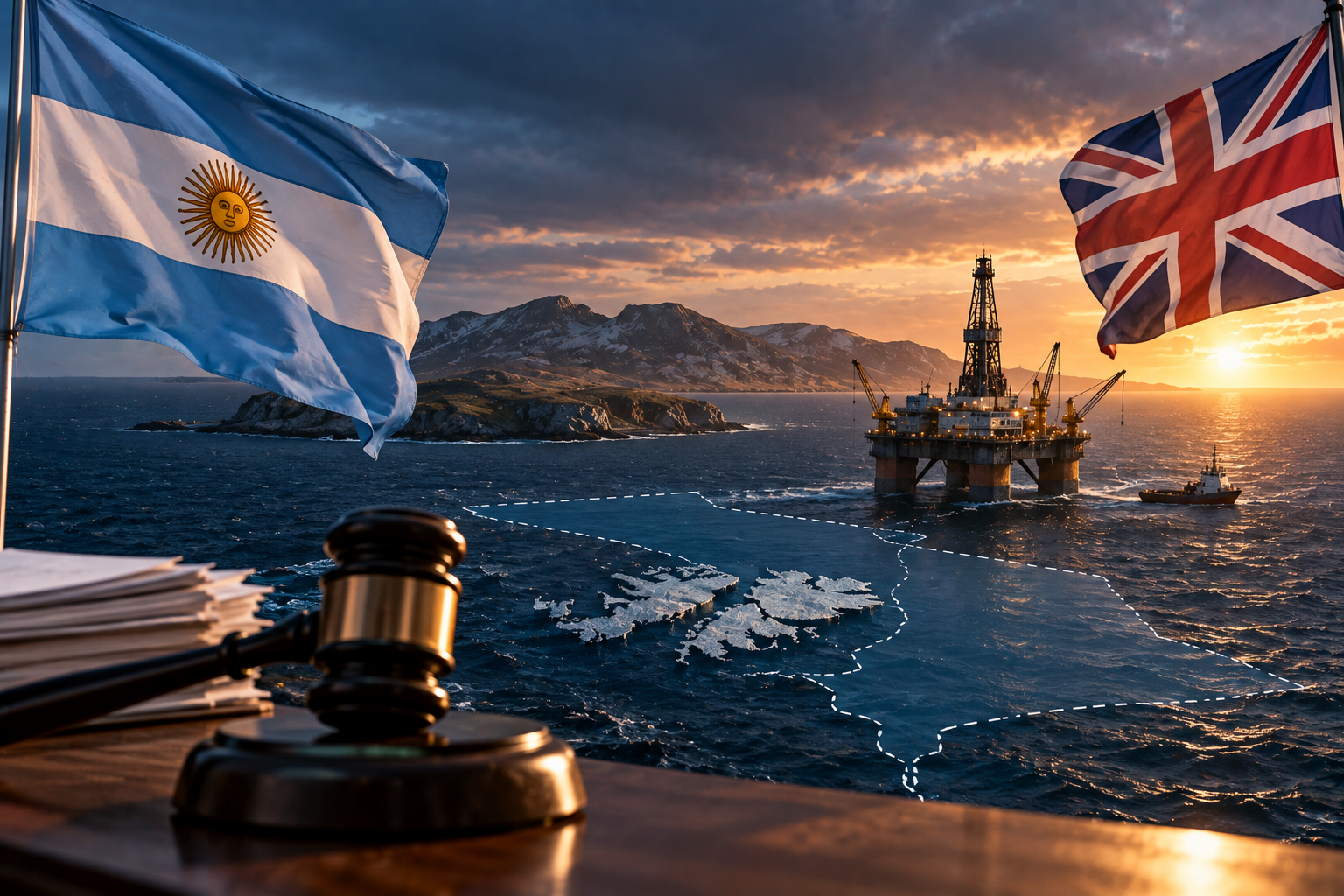
Otherwise, Buenos Aires will turn to the International Tribunal for the Law of the Sea in Hamburg. London has already rejected the demand, and the project participants continue work.
The essence in brief
- Argentina has initiated arbitration under Annex VII of the UN Convention on the Law of the Sea and demands that Sea Lion be stopped and that new licenses in the disputed zone not be issued.
- London rejected the demand; the British project participant Rockhopper Exploration said it would continue work.
- The tribunal in Hamburg may issue a binding decision to stop, but it cannot force the UK to comply.
- The first phase of Sea Lion, worth $1.8 billion, is supposed to produce oil in 2028.
Ultimatum from Buenos Aires
On September 28, Javier Milei instructed the Ministry of Foreign Affairs and government lawyers to initiate arbitration under the UN Convention on the Law of the Sea. Argentina considers the development of the field to be illegal exploitation of resources on its continental shelf. If London does not stop the work within two weeks, Buenos Aires will ask the International Tribunal for the Law of the Sea to impose provisional measures. This would make it possible not to wait for a decision on the merits, which could drag on for years.
Argentina's Foreign Minister Pablo Quirno called the president's decision a "historic and unprecedented step." International lawyers note, however, that the ultimatum itself does not stop the project. It is also unclear whether the arbitration will recognize its jurisdiction over Argentina's claims.
Pressure on the project has been growing for several weeks. On September 16, federal judge Mariel Borruto banned drilling and equipment installation pending an environmental assessment. The judge herself acknowledged that enforcement of the decision depends on international cooperation and the behavior of companies. A bill has also been introduced in the Argentine Congress on criminal liability for extracting resources around the islands without Buenos Aires' permission.
London's response
The UK rejected the arbitration. Parliamentary Under-Secretary of State for the Overseas Territories Uma Kumaran called the appeal to the maritime convention another attempt to undermine the rights of the archipelago's residents. The British side also questioned Argentina's reliability as a partner.
"The Falkland Islands are British," Uma Kumaran wrote on social media X.
Rockhopper Exploration called Argentina's claims illegitimate and confirmed that work would continue.
A project worth $1.8 billion
The Sea Lion field is located approximately 220 km north of the Falkland Islands. The operator is Israel's Navitas Petroleum with a 65% stake; the remaining 35% belongs to Britain's Rockhopper Exploration. The final investment decision on the first phase was made in December 2025, and financing is fully secured.
The Aoka Mizu floating production and storage unit is currently undergoing modernization at the Seatrium shipyard in Singapore. At the first stage, the project is expected to reach about 55 thousand barrels per day. That is about 6% of Argentina's entire current production, which in July reached a record 903 thousand barrels per day thanks to the Vaca Muerta shale formation. Navitas has already bought a second floating unit for the next phase.
The escalation coincided with domestic politics. Javier Milei is running for re-election next year, his ratings are falling, and the issue of the islands unites Argentines across party lines. The trigger for the offensive was Donald Trump's statement that the United States is reviewing its position on the sovereignty dispute.
What this means for the Caspian shelf
Kazakhstan is betting on offshore Caspian fields, but here too projects depend on decisions by partners and the state. On the Kalamkas-Sea and Khazar projects, which the republic is implementing together with LUKOIL, a decision has still not been made. This was reported on October 1 by Deputy Minister of Energy of Kazakhstan Yerlan Akbarov. According to him, the issue of attracting other investors is also being considered.
The legal regime of the Caspian differs from that of the Falklands. It is determined not by the UN Convention on the Law of the Sea, but by the 2018 Convention on the Legal Status of the Caspian Sea. The Caspian states divide the seabed by agreements between neighbors. But the Falklands case shows a general principle. An adopted investment decision and full financing do not protect an offshore project if a dispute over jurisdiction or political pressure arises around it.
The Caspian also knows the reverse conflict between national law and international law. In the dispute over a fine of 2.3 trillion tenge, the Kashagan operator refers to an UNCITRAL arbitration interim order, while the Ministry of Justice of Kazakhstan believes that it does not prevent the enforcement of Kazakh court decisions (in September, the Atyrau Region Court refused NCOC's request to cancel the recovery).
Conclusion
The Falklands dispute has lasted almost two centuries, but for the first time Argentine claims are running up against a specific oil project with clear timelines and money. Even if the tribunal in Hamburg sides with Buenos Aires, it will not be able to stop the work without London's consent. Therefore, the real effect of the ultimatum is more likely in the growth of legal and reputational risks for Sea Lion contractors and investors. It is precisely such risks that determine the cost of any offshore project, including in the Caspian.

Comments ()