From nature reserves to waste recycling — the ecological course «Ädilet
The "Ädilet" program's ecology section covers multiple areas — from protected territories and waste recycling to the energy transition.
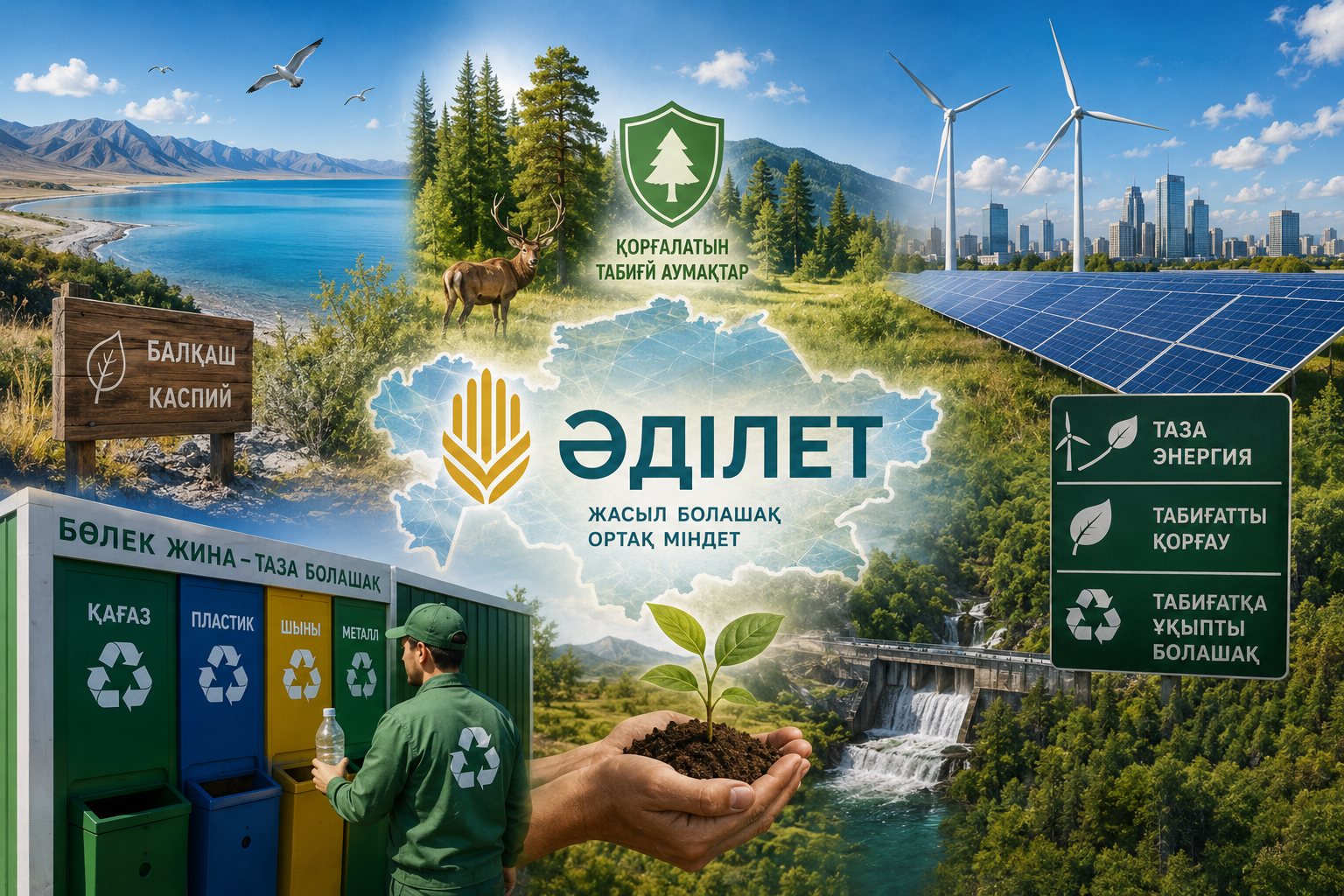
The general idea of the section is that care for nature should be enshrined not declaratively, but through specific laws, figures, and deadlines.
The essence in brief
- The Adilet party proposes increasing the forest area to 14.5 million hectares, creating a new specially protected natural area and expanding the existing one to 2 million hectares, as well as adopting a law on protected areas with increased liability for their damage.
- Separate legislation will establish a special status for Balkhash and the Caspian Sea — strict regulations for wastewater treatment and the elimination of historical pollution.
- The share of clean energy should grow to 15% by 2030 and at least 50% by 2050, with the commissioning of renewable energy capacity of at least 8.4 GW by 2035 through private investment.
- Recycling and disposal of municipal solid waste is planned to be increased to 40% by 2030, with the creation of at least 20 recycling collection points in every regional center.
Special status for Balkhash and the Caspian Sea
The idea of establishing a special legal regime for Balkhash and the Caspian Sea responds to a challenge whose significance will only grow as both water bodies develop. Kazakhstan is already building the scientific foundation for such decisions: since September 2025, a specialized Kazakh Research Institute of the Caspian Sea has been operating in the country, conducting regular observations on 50 parameters in the open waters and 26 parameters in the coastal zone. Meanwhile, Balkhash is becoming the site for another major project — the construction of Kazakhstan's first nuclear power plant, which makes the issue of its environmental protection particularly timely right now, while the plant is still at an early stage of implementation. The country already has the institutional readiness to work with such challenges: a Regional Competence Council for radioactive waste management of CIS countries has been established on the basis of the National Nuclear Center in Kurchatov, which Kazakhstan chairs on its own initiative — a practical foundation for the future when the plant near Balkhash will need its own spent fuel management system.
Protected areas and development — finding the balance in advance
The law on specially protected natural areas with increased liability for their damage addresses a situation Kazakhstan is already facing in practice. Burabay National Park, home to the Borovoe resort, is a territory with a strict protection regime where the creation of the international technology campus Network City is currently being discussed in parallel. Such projects show that clear legislative frameworks for development within protected area boundaries are needed in advance, not after the fact — the law proposed by the party closes precisely this gap by establishing uniform rules before a contradiction between economic development and territorial protection arises at specific sites.
Renewable energy — betting on private investment
The goal of commissioning at least 8.4 GW of renewable energy capacity by 2035 relies on a model that is already working: the program focuses on private investment rather than budget financing. A concrete example of this approach is already being implemented in the south of the country — a 1 GW wind farm worth $1.4 billion is being built in the Zhambyl region with the participation of the UAE's Masdar, equipped with an energy storage system of 600 MWh that addresses the problem of unstable renewable generation. Kazakhstan is already developing renewable energy through an auction mechanism in steppe regions with high insolation, and the industry is being supplemented with unconventional technical solutions — from Austrian foldable tracking panels that increase output by 40% to energy storage systems whose relevance for the Kazakh steppe grows along with the share of solar and wind generation in the energy balance. In parallel, the country is also developing its hydropower potential — the plan until 2035 provides for at least 500 MW of new capacity by 2030, relying on the digital water resources accounting system NISWR.
Waste — from landfills to recycling
The goal of increasing municipal solid waste recycling to 40% by 2030 is accompanied by a specific infrastructural measure — the creation of at least 20 recyclable material collection points in every regional center of the country, as well as bringing municipal solid waste landfills into compliance with established requirements. This is a systemic task requiring simultaneous solutions at two levels: changing household habits through accessible separate collection infrastructure and modernizing industrial sorting and recycling capacities in regions with the greatest infrastructure deficit.
Author's conclusion
The environmental section of the Adilet program links together several areas that at first glance belong to different agencies — territorial protection, energy, and waste management — but are united by a common logic: to establish rules in advance and systematically, rather than reacting to problems after they arise. For Kazakhstan, where issues such as development within protected area boundaries or the protection of Balkhash are already becoming practical rather than hypothetical, such a proactive approach looks particularly timely.
Comments ()