Ministry of Energy discussed cooperation in renewables and hydrogen with German diplomat
Kazakhstan's Energy Ministry officials met with Joachim Berthele, deputy head of the Asia-Pacific Department at Germany's Foreign Ministry.
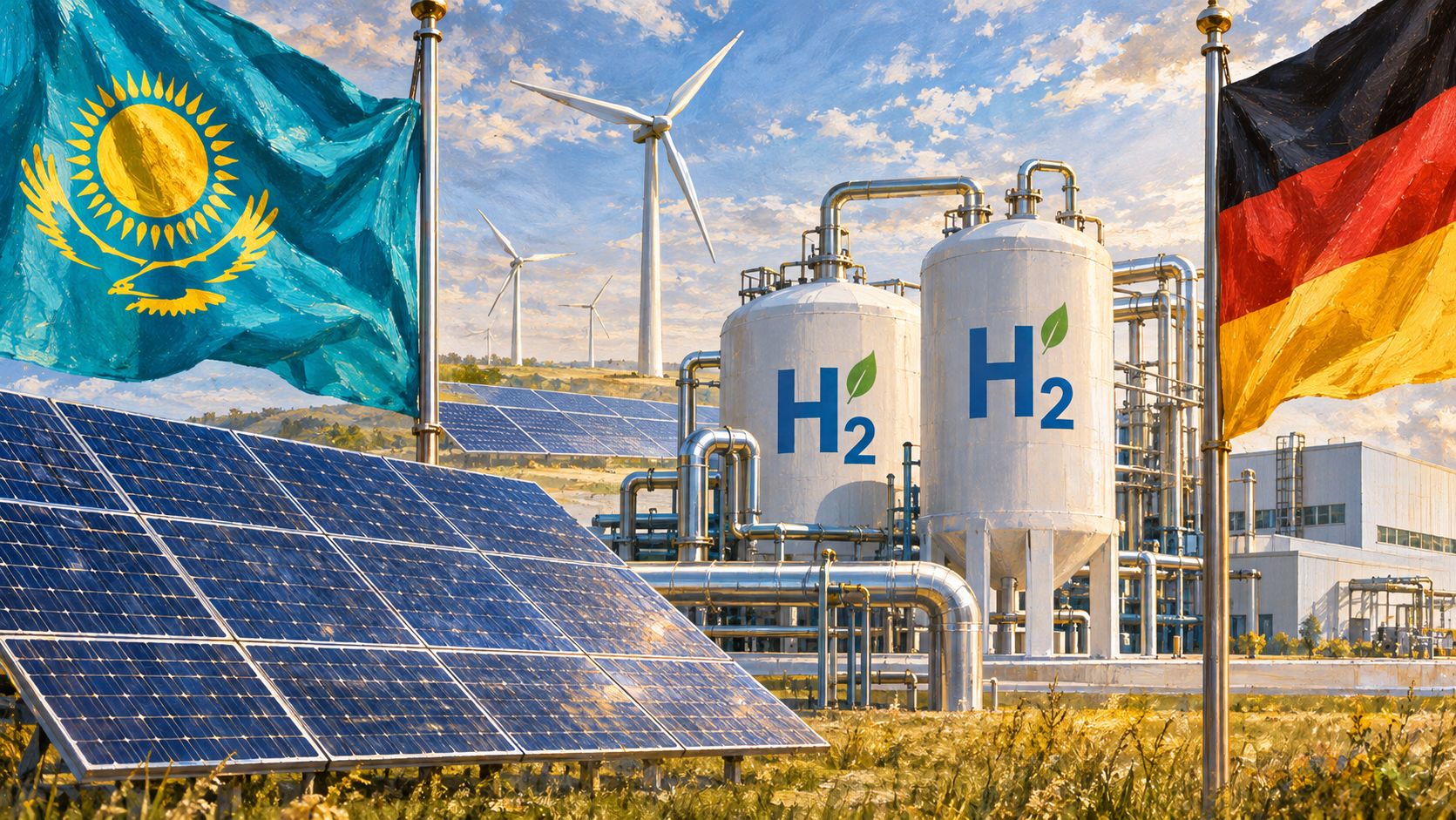
The parties discussed oil and gas cooperation, traditional energy, renewable energy sources (RES) and green hydrogen, reports the Ministry of Energy of Kazakhstan.
The gist in brief
- The Kazakh side presented RES projects that are being implemented together with German companies Goldbeck Solar GmbH and Solarnet Investment GmbH.
- On hydrogen, work is underway with Reiner Lemoine Institut, and with the company Linde possible cooperation on carbon capture, utilization and storage (CCUS) technologies is being discussed.
- Germany confirmed its interest in developing hydrogen energy in Kazakhstan and noted its potential in green hydrogen production.
What was discussed on renewable energy
Kazakh representatives spoke about the projects being implemented with Goldbeck Solar GmbH and Solarnet Investment GmbH. According to Inbusiness.kz, these are solar projects in the Karaganda region with a total capacity of 176 MW. The parties emphasized the importance of developing RES, introducing advanced technologies and exchanging experience in the energy transition.
What was discussed on green hydrogen
Hydrogen became one of the key topics of the meeting. Kazakhstan spoke about its interaction with German scientific institutes and technology companies. With Reiner Lemoine Institut, work is underway on digitalization of water resource data, research in the field of hydrogen energy and exchange of expert experience. With Linde, possible cooperation on CCUS is being discussed.
The Hydrogen Diplomacy Office in Astana, which operates with the support of the German Society for International Cooperation (GIZ), was mentioned separately. The German side confirmed its interest in further cooperation with Kazakhstan in hydrogen energy, noted the country's potential in the production and use of green hydrogen and the importance of developing technologies and infrastructure.
What is happening with hydrogen energy in the world
Germany, which is interested in Kazakh hydrogen, is itself growing the market at the expense of the state: the country's Ministry of Economics presented a package of measures worth at least EUR 1.5 billion for the transition of industry to low-carbon technologies, the budget for hydrogen projects is planned to be reserved in the 2027 competition, and EUR 4.2 billion is intended to be allocated for expanding the hydrogen pipeline network. This is still a plan, not a decision that has been adopted. Meanwhile, the supply of green hydrogen is growing in other countries: Spain is building the first phase of the "Andalusian Green Hydrogen Valley" worth over EUR 1 billion (300 MW, about 45,000 t per year) and plans to bring electrolysis capacity to 12 GW by 2030, while Saudi Arabia has completed construction of the NEOM complex for $8.4 billion with electrolyzers of about 2.2 GW, with commercial launch scheduled for 2027. Technologies are also still in development: Korean scientists from KAIST have created a ruthenium catalyst for producing hydrogen from water, which in a laboratory electrolyzer is close to platinum while using 75% less of the precious metal, but there is no industrial data yet.
Author's conclusion
The meeting confirms Germany's interest in Kazakh hydrogen, but demand for it is being shaped by its own programs: subsidies worth EUR 1.5 billion have yet to be implemented, and the first hydrogen power plants in Germany are planned no earlier than 2040. At the same time, the supply of green hydrogen is already emerging in Spain and Saudi Arabia, while Kazakhstan's cooperation with Reiner Lemoine Institut and Linde so far remains at the level of research and discussions. The timing of hydrogen supplies to Europe will depend on how quickly the German market and infrastructure are built.
Comments ()