Kazakhstan and Azerbaijan laid a cable along the Caspian seabed for high-speed internet between Asia and Europe.
While the Caspian seabed is being prepared for deepening the Middle Corridor fairway, another project has already finished there — submarine fiber-optic cable laying to link Kazakhstan's and Azerbaijan's digital infrastructure.
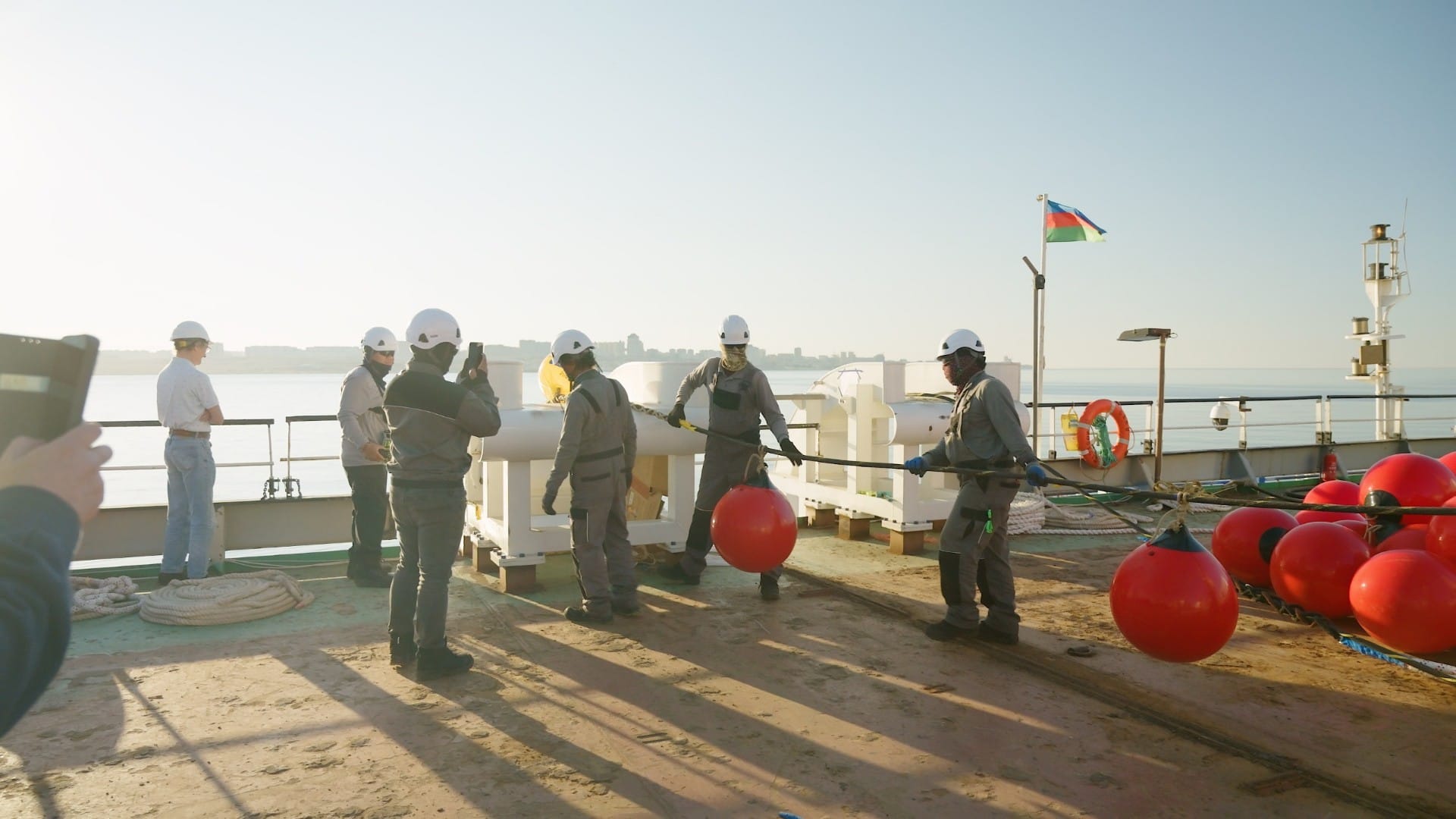
The submarine cable along the Aktau–Sumgait route has reached the Kazakh coast, completing the most challenging stage of construction, the government press service reports.
The gist
- The marine stage of the Trans-Caspian fiber-optic communication line (FOCL) construction has been completed — the cable along the Aktau–Sumgait route has reached the coast of Kazakhstan.
- The project is being implemented by Kazakhtelecom and AzerTelecom International through the joint venture CaspiLink B.V., entirely funded by the operators' own resources, with no budget financing.
- Marine cable laying was carried out around the clock since July 2026 using a cable-laying vessel with a displacement of over 20,000 tons, with 70 specialists involved in the project; the project itself started in 2025.
- In autumn 2026, the construction of onshore infrastructure is planned to be completed, followed by commissioning works and system launch.
What exactly has been built
The new route will connect the digital infrastructure of the two countries and is expected to become a direct high-speed data transmission corridor between Asia and Europe. CaspiLink B.V., a joint venture between Kazakhtelecom and AzerTelecom International, is responsible for the implementation and subsequent operation of the backbone. Before the marine cable laying began, specialists conducted engineering surveys, determined the optimal route along the seabed, and carried out cable tests; the Ministry of Artificial Intelligence and Digital Development of the Republic of Kazakhstan ensured the passage of regulatory, organizational, and customs procedures, allowing construction to start without administrative delays. The cable is now being connected to onshore infrastructure on both sides.
Why Kazakhstan needs another communication channel with the world
Deputy Prime Minister — Minister of AI and Digital Development Zhaslan Madiyev directly linked the project to the country's ambitions in artificial intelligence, cloud technologies, and data centers. This is not a casual formulation: the larger computing projects like the "Data Center Valley" in Ekibastuz, designed to host servers for international technology companies, become, the more important it is for the country to have reliable, low-latency communication channels with the rest of the world — otherwise, bringing computing capacity into the country means creating infrastructure isolated from global internet traffic. The direct submarine route across the Caspian reduces dependence on terrestrial transit routes through third countries and lowers signal latency — a parameter critical specifically for data centers and cloud services.
The third dimension of Caspian partnership with Azerbaijan
This project is not the first and likely not the last story of how Kazakhstan and Azerbaijan layer different types of infrastructure on the bottom of the same sea. We have already written that the countries are preparing a joint venture for dredging the Caspian to expand the capacity of the Middle Corridor — this is the freight, logistics layer of the partnership. In parallel, there is the "Green Energy Corridor" Caspian — Black Sea — Europe project, through which electricity from renewable sources is expected to flow in the future — this is the energy layer. The Trans-Caspian FOCL adds a third, digital layer to the same map: cargo, electricity, and data now physically or by plan move along the same corridor between the two countries, and each new project increases the aggregate value of the Caspian route for both sides.
Author's conclusion
Individually, each of the three Caspian projects would look like an ordinary infrastructure news item — dredging, power cable, fiber optics. But together they show that the partnership between Kazakhstan and Azerbaijan in the Caspian has ceased to be point-based and is turning into a systemic strategy: the countries are simultaneously building a transport, energy, and digital framework on the same stretch of sea. For Kazakhstan, this means not only the diversification of international communication channels but also the strengthening of its position as a transit point between Asia and Europe in several dimensions at once, not just in dry cargo logistics.

Comments ()