Four countries at COP31 signed a clean energy partnership agreement
The energy ministers of Turkey, Azerbaijan, Bulgaria and Georgia signed a strategic clean energy partnership agreement at the COP31 climate conference in Antalya.
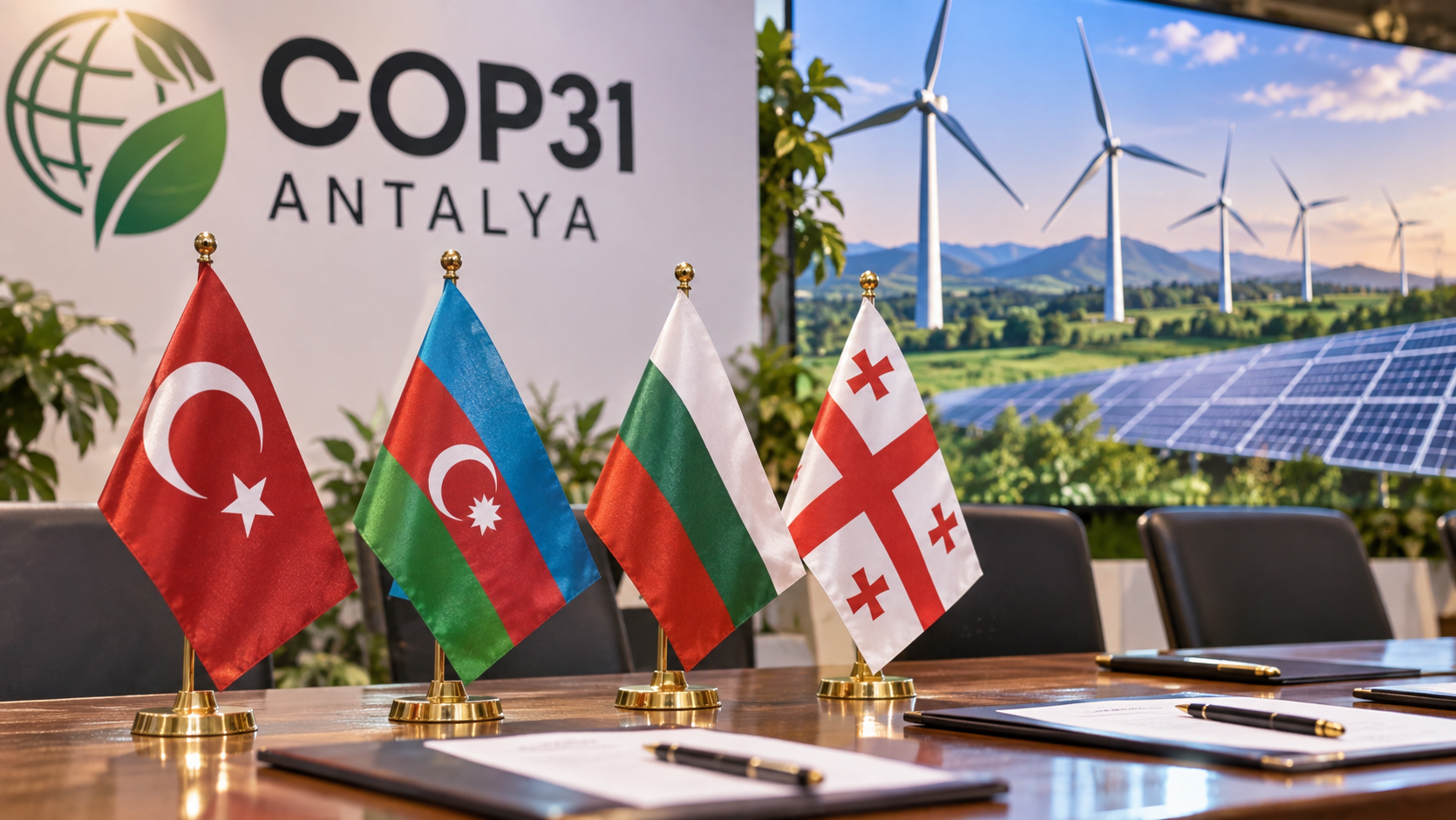
The agreement concerns the cross-border transmission, distribution, and trade of electricity from clean sources, reports the Anadolu agency.
The gist in brief
- The agreement was signed by Turkey's Minister of Energy Alparslan Bayraktar, Azerbaijan's Minister of Energy Parviz Shahbazov, Bulgaria's Minister of Energy Iva Petrova, and Georgia's Vice Prime Minister Mariam Kvrivishvili.
- The document covers the transmission, distribution, and trade of electricity from clean sources, the integration of energy systems, and fiber-optic communications for energy services.
- Bayraktar called the project "the TANAP of electricity," by analogy with the Trans-Anatolian Gas Pipeline, with the goal of supplying clean energy to European markets.
- The foundation was laid by cooperation since 2024 and a memorandum signed in Baku in April 2025.
What was signed
The document is titled the "Strategic Partnership Agreement in the Field of Clean Energy," writes the Azerbaijani agency APA. The parties agreed on the conditions for the safe and uninterrupted transmission of electricity between the four countries, on technical, commercial, and regulatory interaction, and on the integration of energy systems. A separate part concerns fiber-optic communication lines and data transmission, which are needed for the operation of energy services.
What the project's goal is
The agreement develops the Azerbaijan-Georgia-Turkey-Bulgaria energy corridor. Electricity from Azerbaijan's renewable sources is planned to be exported to the Turkish and European markets, and the country is to become an interregional energy hub.
Bayraktar stated:
"In the context of accelerating electrification, this step will strengthen energy ties between our countries."
He compared the project to TANAP, through which Azerbaijani gas flows via Turkey to Europe.
What came before
According to Bayraktar, the agreement builds on cooperation that began in 2024 and on a memorandum of understanding signed in Baku in April 2025.
Author's conclusion
For the project, this is a transition from the 2025 memorandum to an agreement between the governments of four countries. The comparison with TANAP shows how Turkey sees its role: not only as a consumer but also as a transit country for clean electricity between the Caspian and Europe. The scale of the project can be judged once the capacity of the lines, the route, and the construction timeline are determined.
Comments ()