Kazakhstan and FAO launched three projects: soil carbon, drones against locusts, and revival of Aport
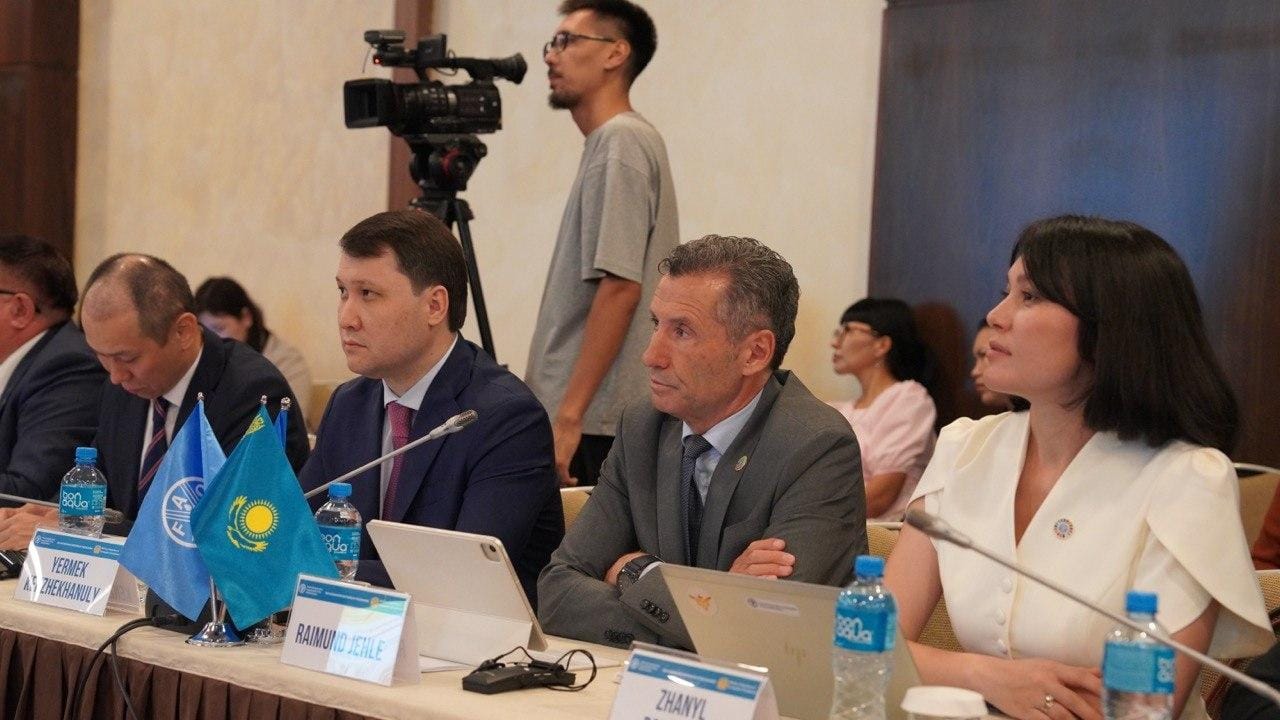
On July 23, 2026, Astana launched an introductory seminar on three new projects under the ten-year partnership program between Kazakhstan’s Ministry of Agriculture and FAO.
Three areas — soil carbon monitoring, AI-based locust forecasting, and the development of domestic plant breeding — seem different at first glance. In reality, they form a single picture: Kazakhstan is systematically building a scientific foundation for sustainable agricultural production. And the final chord is the revival of the legendary Almaty Aport variety.
In Brief
- An introductory seminar on three projects under the ten-year Partnership Program between the Ministry of Agriculture and FAO has started in Astana. Vice Minister Yermek Kenzhekhanuly stated that the projects meet international standards and national priorities of the agro-industrial complex.
- The first project will create a national system for monitoring, assessing, and verifying soil organic carbon — a foundation for land management, improving fertility, and developing the carbon market.
- The second project involves improving locust monitoring and forecasting using artificial intelligence and drones to enhance the accuracy of detecting infestation hotspots.
- The third project is the national initiative "Kazakhstan Varieties and Seeds": developing plant breeding, preserving genetic resources, and promoting domestic crops. Special attention is given to reviving the Almaty Aport apple variety.
- The seminar's focus is on innovation, climate-resilient agriculture, digitalization, and risk management.
Project One: Soil as a Carbon Market Asset
Monitoring soil organic carbon is one of the most promising, yet still underestimated, tools of agricultural policy. The essence is simple: living soils contain organic matter that sequesters carbon, improves structure, increases yields, and reduces the need for fertilizers. Degraded soils lose this capacity and themselves become a source of CO₂ emissions.
One of the most ambitious projects is the creation of a soil organic carbon monitoring system. The project is planned for 2026–2029. For Kazakhstan, this has a dual significance. Firstly, the Law "On Soil Protection" adopted in June 2026 creates a legal framework — now a measurement infrastructure is needed. Secondly, verified soil carbon data opens access to carbon credits — a growing market where agriculture can earn from carbon storage, not just food production.
Project Two: Locusts in the Crosshairs of AI
Locusts are one of the most dangerous pests for Kazakhstan's agro-industrial complex. In some years, they have destroyed crops on hundreds of thousands of hectares. The traditional approach — chemical treatment based on reports from field observers — is effective but delayed: by the time a hotspot is recorded and equipment is prepared, the infestation has already spread.
Kazakhstan and FAO are betting on AI and drones to combat locusts. The new approach will improve the accuracy of detecting hotspots and the effectiveness of decisions. Satellite imagery, temperature and humidity data, migration routes — all of this is processed by algorithms that predict the appearance of pests several weeks before they become visible. Drones complement the picture: rapid overflights of suspicious areas without needing to deploy people in hard-to-reach regions.
Project Three: The Aport Returns
The most unexpected and most resonant of the three projects. The national initiative "Kazakhstan Varieties and Seeds" is aimed at developing plant breeding, preserving genetic resources, and promoting domestic crops. Special attention is given to reviving the legendary Almaty Aport apple variety.
The Aport is a symbol of Soviet and pre-Soviet Almaty: large, aromatic apples with a unique taste, which became the city's calling card. In Soviet times, Aport orchards covered thousands of hectares in the foothills. After 1991, the orchards were cut down for development, and the variety was on the verge of extinction.
The role of AI in reviving the Aport is not a metaphor. Modern methods of genomic analysis and machine learning make it possible to identify authentic specimens of the variety among thousands of clones and mutations, optimize growing conditions, and accelerate the breeding process. This is not romance, but a very specific agro-biotechnology.
Context: Ten Projects for $9.5 Million
The three new projects are part of a broader cooperation. Kazakhstan is implementing 10 projects worth $9.5 million with FAO. A new impetus to the partnership was given by President Tokayev's visit to FAO headquarters in Rome in 2024, and in 2025, FAO Director-General Qu Dongyu personally visited Kazakhstan.
This fits into the overall logic of the country's agricultural policy in recent months: Kazakhstan is consistently building a scientific and digital foundation to transform into a leading agro-industrial hub in Central Asia — this is exactly what President Tokayev spoke about at a meeting with Chinese tech companies in Beijing.
Author's Conclusion
The three projects with FAO are not disparate initiatives, but links in one chain. Carbon monitoring will allow earning from soil health. AI against locusts will protect crops more accurately and cheaply than chemicals. The revival of the Aport is simultaneously the preservation of genetic heritage and the creation of a premium product with a history. If all three are implemented on time and with the stated results, by 2029, Kazakhstan's agro-industrial complex will have tools it has never had before.


Comments ()