Kazakhstan joins global technology alliance Pax Silica — first in Central Asia
On June 25, 2026, Kazakhstan joined the Pax Silica initiative in Washington—a tech alliance uniting nations around AI, critical minerals, semiconductors, and data centers.
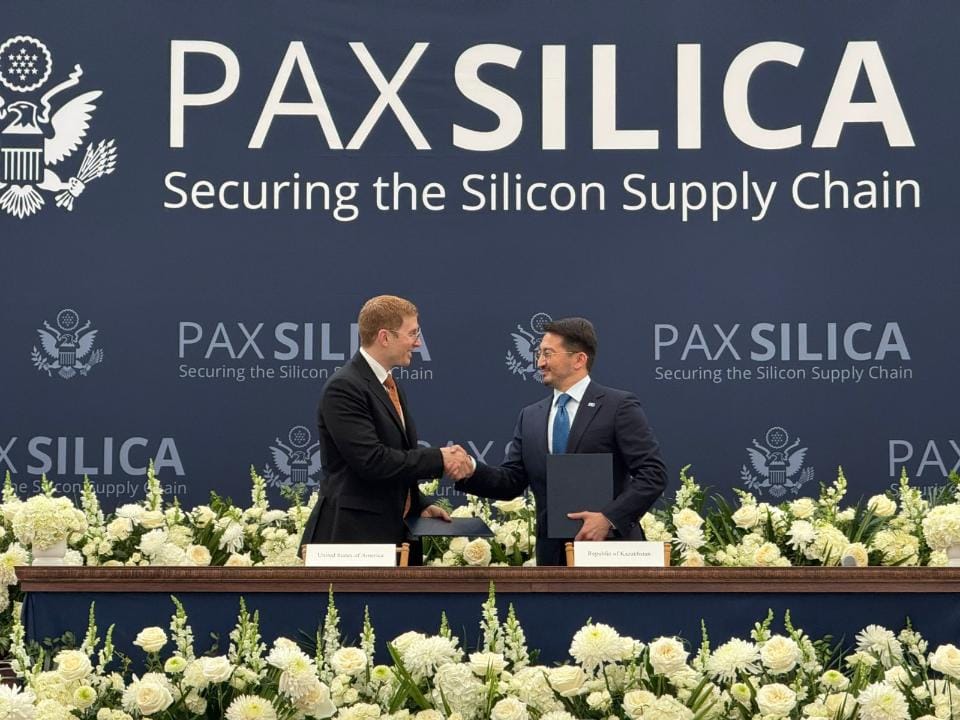
The Republic became the first country in Central Asia to join the alliance. The Declaration of Accession was signed by the Deputy Prime Minister – Minister of Artificial Intelligence and Digital Development of the Republic of Kazakhstan Zhaslan Madiyev, according to the Press Service of the Ministry of AI and Digital Development of the Republic of Kazakhstan.
The Gist
- The signing ceremony took place at the Donald Trump Institute for Peace with the support of the U.S. State Department. Kazakhstan signed the Declaration of Accession to Pax Silica and a joint statement on the AI Opportunity Partnership.
- Pax Silica unites 16 states, including Australia, the United Kingdom, India, Japan, the UAE, South Korea, Singapore, Israel, and several others. Kazakhstan is the first country from the region in the alliance.
- The initiative aims to form trusted supply chains for the new AI economy: from critical minerals to data centers, semiconductors, and the training of engineering personnel.
- The AI Opportunity Partnership defines three areas of cooperation: innovative AI regulation, joint R&D and infrastructure projects, and the mobilization of private venture capital.
- The United States and Stanford University signed a memorandum to create a network of Foundry Schools in participating countries – to train specialists in computational materials science, industrial AI, and data center engineering.
What is Pax Silica and Why is it Needed
Pax Silica is an international initiative for technological cooperation launched with the support of the United States. Its logic is simple: artificial intelligence is not just software code, but also a physical system requiring energy, rare earth metals, computing power, and secure supply chains. Countries capable of providing at least one of these components become strategically significant players in the new technological architecture.
The alliance unites states ready to build this system together – as a counterbalance to technological dependence on unfriendly jurisdictions. It is in this context that the presence of countries such as Japan, South Korea, Israel, Singapore, and the UAE in the list is no coincidence: they all possess either the technologies, the resources, or both.
What Kazakhstan Brings to the Alliance
Kazakhstan enters Pax Silica not empty-handed. The country is among the world's largest producers of uranium, chromium, titanium, rare earth metals, and other critically important minerals – precisely the raw materials without which the production of semiconductors, batteries, and AI chips is impossible. Add to this its advantageous geographical position between Europe and Asia, a growing digital infrastructure, and the political will for technological transformation – and the strategic significance of joining becomes obvious.
"Behind every AI solution are energy, critical minerals, computing power, data centers, semiconductors, engineering talent, and secure supply chains," stated Zhaslan Madiyev.
Kazakhstan, according to him, seeks to move beyond the role of a raw material supplier and create technological added value domestically – by developing mineral processing, localizing high-tech production, building data centers, and participating in R&D platforms.
The Three Directions of the AI Opportunity Partnership
The joint statement signed in Washington structures cooperation along three axes. The first is creating an innovative regulatory environment for AI, startups, and cloud platforms. The second is expanding cooperation in R&D, energy and computing infrastructure, critical minerals, and workforce training. The third is attracting private capital: venture investments, R&D partnerships, next-generation data centers, and access to trusted AI models.
Education is a separate track. The memorandum between the U.S. government and Stanford University provides for the creation of a network of Foundry Schools in Pax Silica participating countries. The programs will cover computational materials science, the application of AI in mineral extraction and processing, data center engineering, and industrial AI.
Author's Conclusion
Joining Pax Silica is not a ceremonial step, but a strategic positioning. Kazakhstan takes its place in the club of states shaping the rules of the new AI economy before they are finally established. A country with the largest reserves of critical minerals, but without developed processing, gains partners interested precisely in this link of the chain. Now the main task is to convert the signed documents into concrete investments, factories, and trained engineers. Declarations in Washington are signed in a single day. Ecosystems are built over years.

Comments ()