Kazakhstan modernizes thousands of kilometers of irrigation canals — but is it keeping pace with the scale of the problem?
The Ministry of Water Resources and Irrigation reported accelerating canal reconstruction: 962 km of upgraded mains are planned by end of 2026, improving water supply for nearly 200,000 hectares.
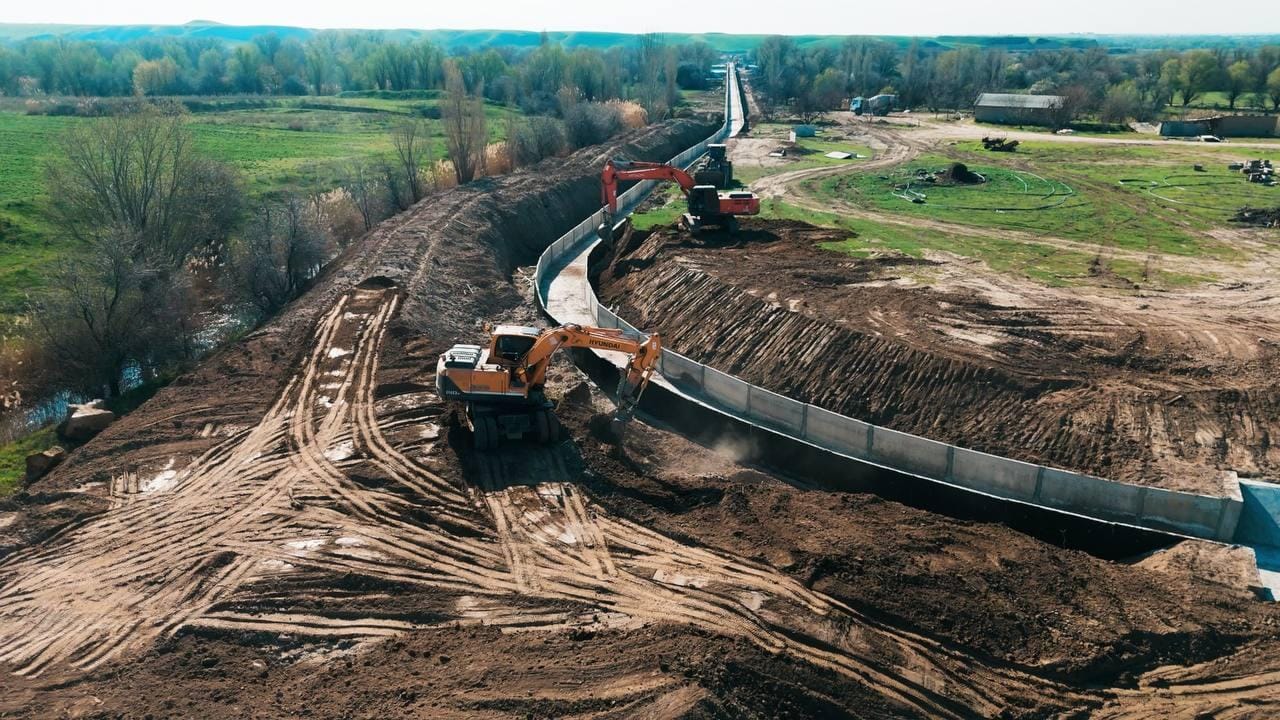
As DKNews.kz reports, the program overall covers 4,600 km of canals across the country — a scale unprecedented in Kazakhstan's post-Soviet history. But the progress figures must be read against the degradation figures: the country is losing water faster than it is building, and solving the infrastructure issue is currently outpacing the solution to the systemic issue.
The Gist
- The reconstruction program covers 4,600 km of irrigation canals. By the end of 2026, 962 km will be commissioned, improving irrigation for 200,000 hectares of farmland.
- During 2024–2025, 1,500 km of canals have already been reconstructed. With the EBRD, 46 projects have been completed; with the Islamic Development Bank, 600 km out of 635 planned have been reconstructed.
- In the southern regions, 103 canals stretching 968 km, supplying 65,000 hectares of irrigated land, are being automated. Simultaneously, automation is underway for 270 previously reconstructed canals.
- A roadmap for modernizing the Satpayev Canal is being implemented: replacement of 19 pumping units and 17 transformers.
- The "Development of Climate-Resilient Water Resources" program has been launched: in 2026, construction and installation work began on 88 projects.
What is Being Built and Why It Matters
Kazakhstan's irrigation infrastructure is a Soviet legacy that has not received systematic maintenance for the last 30 years. Most canals were built in the 1960s–80s; over the past decades, water losses during transportation in some systems have reached 40–60%. This means: for every cubic meter pumped from a river or reservoir, less than half reaches the field.
The reconstruction program, implemented with the support of the EBRD and the Islamic Development Bank, addresses precisely this loss: canal lining, replacement of gates, installation of metering equipment. Priority is given to the southern regions — Turkestan, Kyzylorda, Zhambyl, and Almaty regions — where irrigated agriculture is the backbone of agricultural production.
'Smart' Canals: The Next Level
Alongside physical reconstruction, digitalization is underway. The automation of 103 canals in the southern regions is a transition from manual gate control to remote real-time monitoring: volume, pressure, flow rate, deviations from the norm — all of this is recorded by systems and transmitted to dispatchers.
Vice Minister of Water Resources and Irrigation Zhandos Salimov reported that design and estimate documentation is being developed for 264 projects featuring automation elements and modern water accounting systems. This means that the digitalization of irrigation is transforming from a pilot direction into a systemic approach.
How Much Water is Lost — and Where
The canal modernization program is necessary — but it addresses the symptom, not the cause. The main cause of water scarcity in southern Kazakhstan is more complex.
Snowpack in the upper reaches of the Syr Darya has been below normal for the third consecutive year, and the Shardara Reservoir started 2026 with a fill level at 79% of the norm. This means that even a perfectly reconstructed canal will carry less water than before — because less water enters the system from the mountains.
Concurrently, a study published on ScienceDirect showed that the flow of the Amu Darya in its lower reaches has dropped by 77% — and the main cause is not climate change, but irrigation water withdrawal in the middle reaches. Kazakhstan is at the bottom of a similar chain on the Syr Darya: how much water reaches the country is determined not only by the condition of Kazakhstan's canals, but also by the water policies of Kyrgyzstan and Uzbekistan.
Official data confirms this: in the current growing season, 5.9 billion m³ of water has already been withdrawn against a planned volume of 11 billion m³ — and this is with incomplete coverage of irrigated areas. Minister Nurzhigitov directly called for strict adherence to limits.
Modernization and New Investments — at Different Paces
Notably, simultaneously with the state canal reconstruction program, a private investor — Harvest Agro — is independently laying new irrigation facilities. In the Zhalagash district of the Kyzylorda region, two canals totaling 23 km in length from the Kara-Ozek River have already been built. This demonstrates a situation uncommon for Kazakhstan's agricultural sector: private capital is going where the state is only just getting to.
This is not competition, but parallel tracks that ideally should connect: the state reconstructs the main system, private investors build the last mile to the field. How well this connection happens in reality is a question of coordination, about which nothing has been publicly reported.
Kazakhstan Officially in a Water Scarcity Zone
All these initiatives are unfolding against the backdrop of an officially recorded fact: the level of stress on Kazakhstan's water resources is 34.6% — above the threshold at which the UN identifies water scarcity. Agriculture consumes 65% of all water in the country. Meanwhile, water losses due to mismanagement and corruption in the irrigation sector amount to billions of tenge annually, and an audit of the water sector's effectiveness records unrealized reforms and corruption risks.
Author's Conclusion
4,600 kilometers of reconstructed canals represent real and necessary progress. But Kazakhstan's water issue is not solved by pipes and gates alone. It is solved by snowpack in the mountains of Kyrgyzstan, water withdrawal policies in Uzbekistan, consumption limits on its own farms, and the state's readiness to systematically combat losses — including corruption. Canal modernization is a necessary condition for the country's water security. But not a sufficient one.

Comments ()