Kazakhstan sent nearly 500 specialists abroad for water management training.
Since the creation of the specialized ministry, Kazakhstan systematically invests not only in reservoirs and canals, but also in the people who manage them.
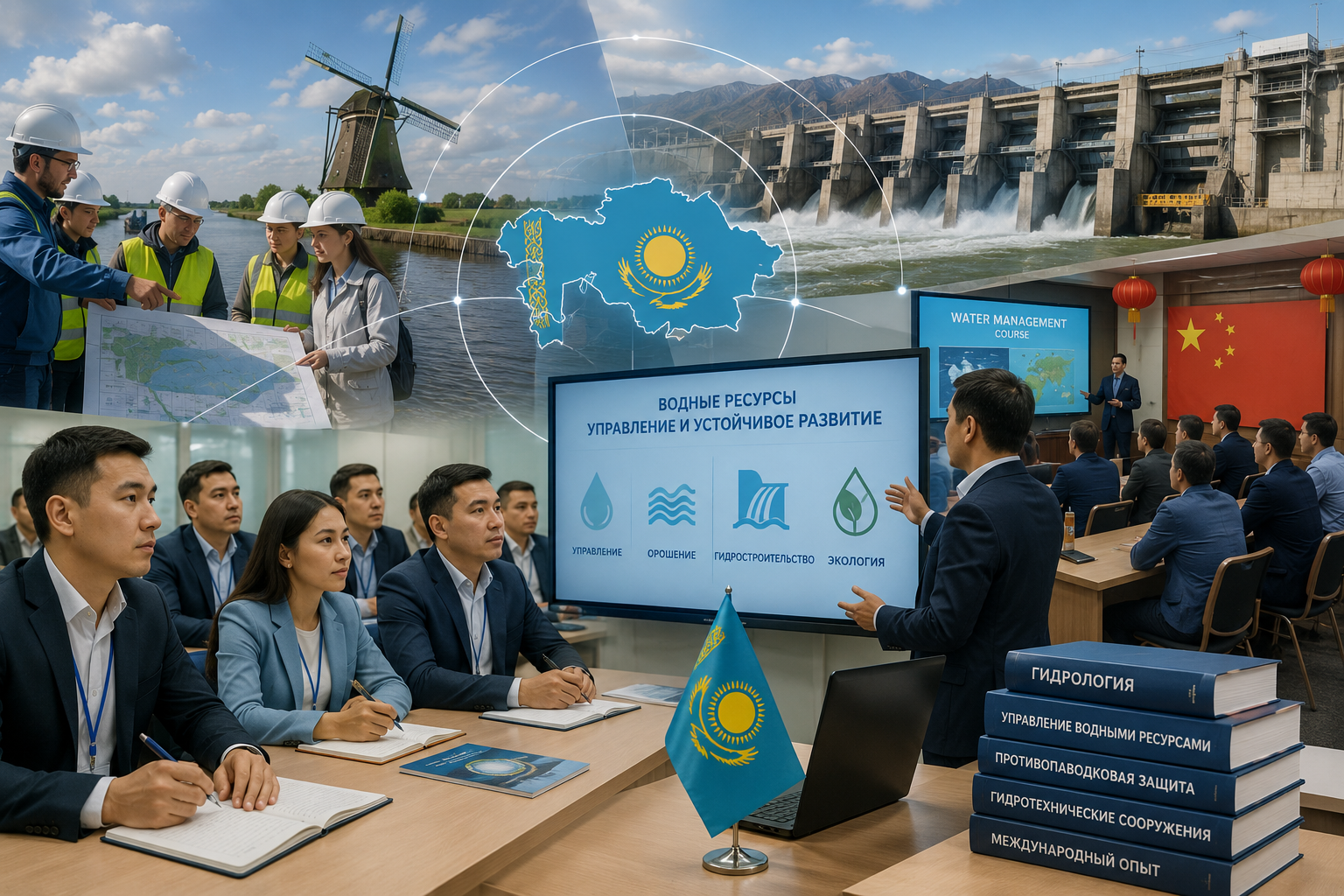
Over three years, nearly 500 water industry specialists have completed foreign internships — from flood control courses in the Netherlands to hydropower construction programs in China, Kapital.kz reports.
The gist
- Since the establishment of the Ministry of Water Resources and Irrigation in September 2023, 498 Kazakhstani water industry specialists have completed foreign internships and professional development courses.
- The geography of training is extensive — from South Korea, Germany, and Israel in the first year to Uzbekistan, India, Turkey, the USA, Finland, Switzerland, and Japan in subsequent years; a separate two-year flood control program is being implemented with the Netherlands, which more than 70 specialists have completed.
- The largest flow of personnel goes to China — 125 specialists have been trained with the support of PowerChina, with about 40 more already in 2026.
- Acting Minister of Water Resources and Irrigation Nurzhan Nurzhigitov linked the program to the active development of bilateral cooperation with foreign partners in the water resources sector.
How the program was developed
Training started modestly: in 2023, only 14 specialists improved their qualifications in the Republic of Korea, Germany, and Israel. A year later, a much larger initiative was launched — flood control courses organized by the Dutch Institute for Water Education IHE Delft under a bilateral memorandum; over two years, more than 70 Kazakhstani specialists completed this program. In 2025, the geography expanded sharply: over 30 specialists received training in Uzbekistan, India, Turkey, China, the USA, the Netherlands, South Korea, and Russia, while another 156 industry workers participated in seminars by the Islamic Organization for Food Security (IOFS) and the German Agency for International Cooperation (GIZ).
Nurzhigitov emphasized: "The Ministry is actively building cooperation with foreign partners in the water resources sector. Within the framework of bilateral interaction, joint programs are being developed to improve the qualifications of Kazakhstani water specialists. By participating in them, our personnel gain relevant knowledge and advanced skills that they can apply in their daily work."
Why these particular countries
The choice of countries for training is not accidental but revolves around specific national competencies. The Netherlands is a historic global leader in flood management and protecting territories below sea level, which is why Kazakhstan is adopting flood control technologies from there. China, where 125 specialists have been trained with the support of PowerChina — one of the world's largest companies in hydropower facility construction — is becoming a source of expertise specifically in hydropower engineering, which is logical given Kazakhstan's small hydropower plant construction program. Israel, where Kazakhstani specialists completed internships in both 2023 and 2026, is known for advanced desalination and water conservation technologies in conditions of water scarcity — an area highly relevant for the southern regions of Kazakhstan.
Part of a broader picture
Personnel training logically complements several areas we have been tracking this year. Kazakhstan is conducting intensive negotiations with neighbors on transboundary water, developing the institution of irrigation condominiums for more efficient management of irrigation canals, and simultaneously launching a program to build small hydropower plants at existing water management facilities. All these initiatives require not only funding and political will but also specialists capable of applying modern international practices at specific Kazakhstani facilities — and it is precisely this skills gap that the ministry appears to be trying to close through a large-scale foreign training program. The contrast with another industry is also telling: when Kazinform asked the Atomic Energy Agency for details on workforce training for the Balkhash NPP, the response was far more evasive — the agency did not disclose either the budget of the personnel program or where the 4,500 nuclear specialists trained over 25 years currently work. Against this backdrop, the detailed and transparent statistics from the Ministry of Water Resources by year, country, and number of trained specialists looks more like the exception than the rule for Kazakhstani government agencies.
Author's conclusion
Investment in specialist training is a far less visible part of Kazakhstan's water reform than the construction of reservoirs or the signing of interstate agreements, but it is precisely what determines how well the decisions already made will be implemented. Nearly 500 specialists trained abroad is not a guarantee of results in itself, but it is a necessary condition: without people who understand modern flood management, hydropower construction, and water conservation technologies, even the most well-thought-out reforms risk hitting a wall of insufficient qualified personnel on the ground.

Comments ()