Kazakhstan to extend moratorium on private ownership of agricultural land until 2031
The ban expiring this year will be extended for another five years.
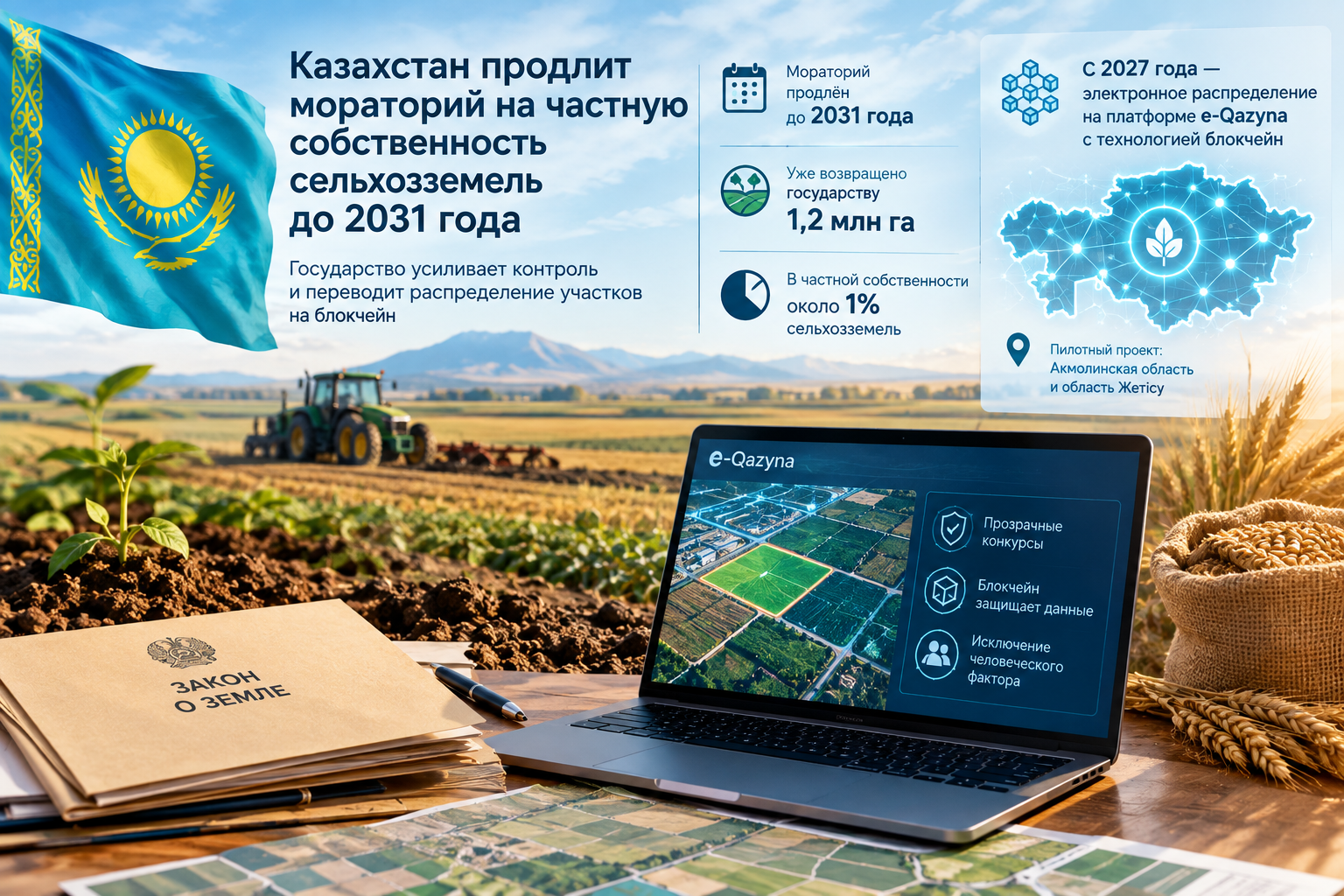
Simultaneously with the extension of the moratorium, the Ministry of Agriculture reported overfulfillment of the annual plan for returning unused land to the state and announced the transition of the entire plot distribution system to blockchain.
The essence in brief
- Chairman of the Committee for Land Resources Management of the Ministry of Agriculture of the Republic of Kazakhstan Murat Temirzhanov said at a briefing at the Central Communications Service: due to the expiration in 2026 of the moratorium on granting agricultural land into private ownership, amendments have been prepared to extend it until the end of 2031.
- With an annual plan for the return of unused and illegally issued land of 1 million hectares, 1.2 million hectares have already been returned to the state — the plan has been overfulfilled; currently only about 1% of all agricultural land in the country is in private ownership.
- This year, more than a thousand unscheduled inspections were conducted over an area of more than 1 million hectares, resulting in 715 orders to eliminate violations on 884 thousand hectares, while materials on the forced seizure of another 211 thousand hectares are being considered in courts.
- From January 1, 2027, the distribution of agricultural plots will fully switch to an electronic format on the e-Qazyna platform using blockchain technology — pilot testing of the system will take place in Akmola Region and Zhetisu Region by the end of this year.
Where the returned lands go
As of early September 2026, the volume of land redistributed by the state reached 13.5 million hectares: 5.5 million hectares were allocated for common use by the local population for livestock grazing, and 8 million hectares were transferred to agricultural sector entities on a competitive basis. Particular attention is being paid to bringing large land tracts of from 10 to 50 thousand hectares into circulation — according to the ministry, it is precisely such plots that create conditions for the formation of new jobs in rural areas, including year-round ones. Temirzhanov emphasized that the return of land to the state is not an end in itself — the main task is the further effective use of the returned plots in order to obtain concrete results from them in the interests of rural residents and agricultural producers.
Blockchain against the human factor
The transition to electronic competitions is not simply digitalization for the sake of digitalization.
According to Temirzhanov, "holding electronic competitions will make it possible to eliminate the human factor and abandon the institutional work of land commissions."
The system will be implemented on the Ministry of Finance platform e-Qazyna using blockchain technology — so that making any adjustments to the competition process would be technically impossible, and every official who applies an electronic digital signature would bear personal responsibility for the decision made. Before launching the new procedure nationwide, it will be technically tested and its functionality assessed as part of a pilot project in Akmola Region and Zhetisu Region.
Part of an already familiar picture of land reform
The extension of the moratorium and the transition to blockchain logically continue several areas of land policy that we have been following this year. In parallel with the work on returning and distributing land, the Ministry of Agriculture lowered the pasture load standard at which a plot is recognized as unused — from 50% to 30% of the maximum permissible norm, trying to find a balance between stimulating rational land use and avoiding overgrazing. Since September, the law "On Soil Protection" has also been in force, obliging owners and users of plots to preserve the fertile layer during construction and prevent land degradation under threat of fines up to criminal liability — that is, the land that the state redistributes through the new electronic system simultaneously receives stricter requirements for how exactly it may be treated going forward. We also wrote about the proposal to unite farmers into irrigation condominiums to reduce water losses in worn-out canals — all these initiatives, like the current reform of plot distribution, reflect a common vector: the state is simultaneously tightening control over inefficient land use and trying to reduce bureaucratic and corruption risks in its subsequent redistribution.
Author's conclusion
The extension of the moratorium until 2031, given that only about 1% of agricultural land is currently in private ownership, shows that the state is not yet ready for large-scale privatization of this resource, instead betting on more effective management of the existing state land fund. The overfulfillment of the annual land return plan is an encouraging indicator of the ministry's activity, but the real test of the reform will not be the statistics of seizures, but whether blockchain technology can in practice eliminate the corruption risks in plot distribution that have been discussed for years in relation to the former, less transparent system of land commissions.



Comments ()