Kazakhstan to merge agricultural digital systems into a single platform by 2028
Russia’s Agriculture Ministry presented the government with a full picture of its digitalization, from subsidies to livestock tracking and land monitoring.
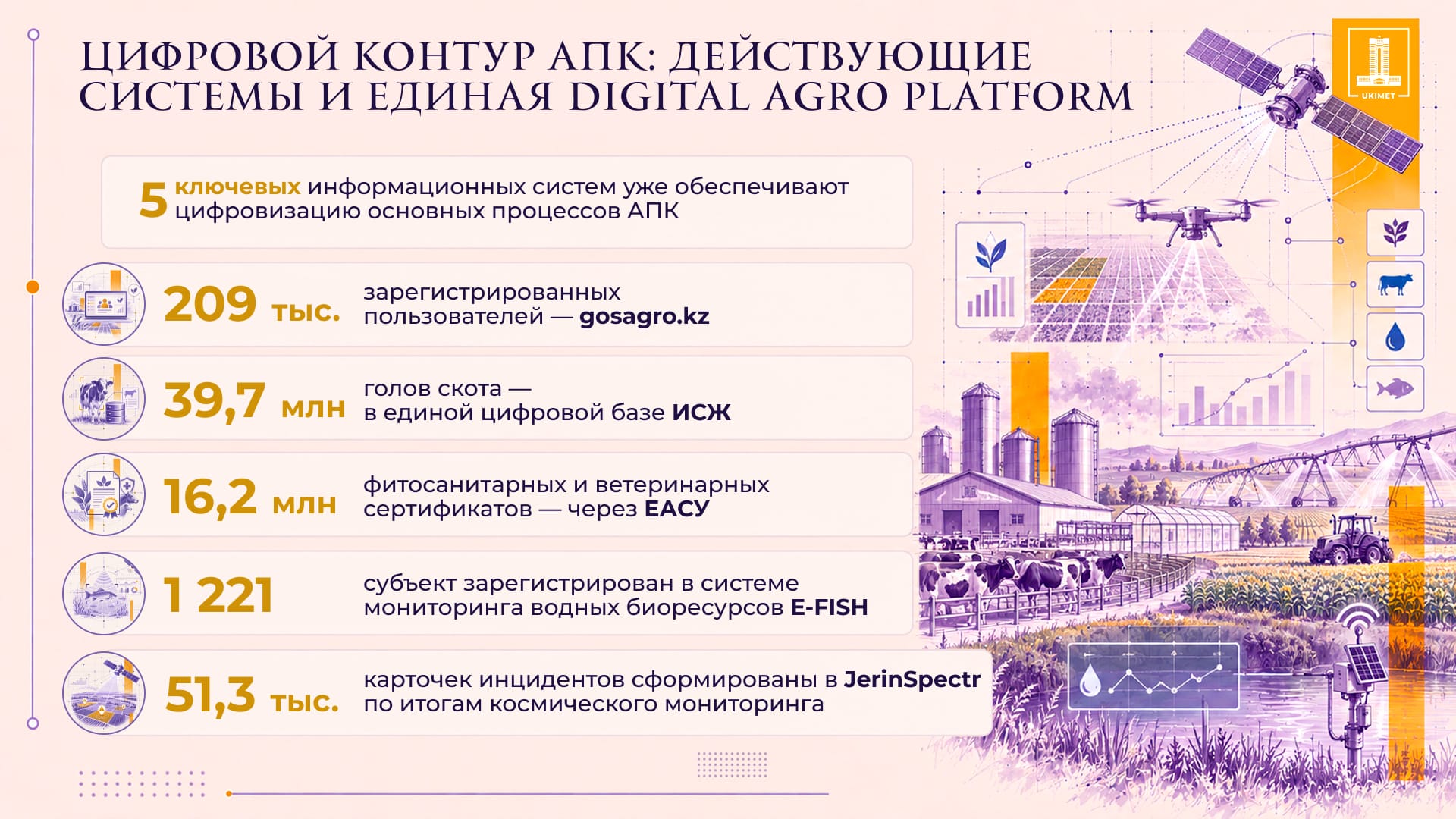
Scattered systems, some of which have been running for several years, must now merge into a single ecosystem.
The gist in brief
- The government, chaired by Deputy Prime Minister — Minister of National Economy Serik Zhumangarin, presented the current digital systems of the Ministry of Agriculture: subsidies, livestock traceability, phytosanitary and veterinary certificates, agricultural land monitoring, and fish resource accounting.
- The farm animal identification system (ISZh) already covers more than 39 million animals with detail down to rural districts; each is assigned a unique number, and its history is traced from birth to slaughter.
- The JerInSpectr platform for monitoring land use has been operating since 2023 on remote sensing data and has already generated over 50,000 incident cards regarding violations of land legislation; it is now being modernized jointly with JSC "Qazaqstan Gharysh Sapary" using AI.
- By the end of 2028, all industry systems are planned to be combined into a single digital ecosystem, the Digital Agro Platform, including a digital map of land resources and data consolidation in Smart Data Agro.
What already works
The state digital subsidy system GSDS (gosagro.kz) allows receiving state support measures electronically across 20 areas — from crop production and livestock breeding to processing and aquaculture, with automatic calculation of amounts based on submitted documents and integration with the Unified State System of Cadastres and electronic invoices. A separate system, E-Fish, tracks the movement of fish products from the water body to the end consumer — 1,221 entities are registered in it, and by the end of 2025, thanks to this, the shadow turnover of fish products decreased by 7%.
JerInSpectr and land control
The JerInSpectr platform is one of the most illustrative elements of the system: it uses Earth remote sensing data to track whether agricultural plots are actually being used for their intended purpose. During its operation, the system has accumulated more than 50,000 incident cards — recorded facts or signs of possible violations of land legislation. The platform is now being modernized jointly with the national space operator "Qazaqstan Gharysh Sapary," adding artificial intelligence technologies for deeper data analysis, including assessment of the qualitative condition of agricultural land. Zhumangarin specifically instructed to minimize the influence of the human factor in decision-making processes within this part of the system.
Where the system is heading
In parallel with the existing services, the Ministry of Agriculture, together with Halyk Bank, is working on optimizing and digitalizing industry processes, starting with livestock breeding: specialists analyzed the processes of identification, accounting, movement, and disposal of animals and are forming new models with reduced manual operations and elimination of data duplication. At the same time, an industry data warehouse, the target architecture for digital transformation of the agro-industrial complex, and the first services on the QazTech platform are being created. All of this should converge into a single system, the Digital Agro Platform — with a digital map of land resources, data consolidation in Smart Data Agro, end-to-end product traceability, and modern BI analytics.
Connection to the already familiar digitalization picture
The digitalization of the agro-industrial complex fits logically into the broader trend we have been following this year. We have already written that the Ministry of Agriculture previously publicly criticized the regions for the slow development of veterinary digitalization — in particular, for incomplete registration of livestock in the Tort Tulik application, closely linked to the same animal identification system that has now been reported on to the Deputy Prime Minister. A similar logic has already been implemented in the water sector: Kazakhstan recently put the National Information System of Water Resources into commercial operation, uniting data on rivers, lakes, and hydraulic structures into a single platform for management decisions. The Digital Agro Platform essentially repeats the same architectural idea as applied to agriculture — a single database as the basis for managing an entire industry, rather than scattered departmental records.
The lesson of the water sector — not all digital claims are equally transparent
Before taking claims about AI implementation and forecast accuracy at face value, it is worth recalling a similar experience in the same water sector, closely linked to the agro-industrial complex. We have already written that the Tasqyn flood forecasting system was put into commercial operation, but representatives of the Ministry of Water Resources at a relevant briefing could not name the criteria by which the system was approved for operation — and according to data from FBRK, out of 182 settlements classified by the system as high-risk zones, floods actually affected only 16. This precedent does not mean that the Digital Agro Platform or the updated JerInSpectr will face the same problems, but it serves as a reminder: a claim about the use of AI technologies in a state digital system does not in itself guarantee transparency or verifiable accuracy — these parameters should be requested separately, rather than taken on faith along with the presentation.
Author's conclusion
The stated horizon of the end of 2028 is a realistic but not near-term deadline for merging systems, each of which developed separately and at different times. Individual elements already show a measurable effect — a 7% reduction in the shadow turnover of fish products, tens of thousands of identified land violations through JerInSpectr — but it is precisely the integration of scattered systems into a single ecosystem, rather than the operation of each of them separately, that will determine whether it will actually be possible to reduce the administrative burden on farmers mentioned in the presentation. The experience with Tasqyn shows that claims about AI implementation in such systems should be accompanied not only by optimistic wording in presentations but also by concrete, verifiable accuracy criteria — otherwise there will simply be no way to assess whether the new functionality of JerInSpectr works as claimed.

Comments ()