Kazakhstani developments go for export to ten countries, from Azerbaijan to China
Thirty-one Kazakhstani science commercialization projects export to 10 countries, with eight exceeding 1 billion tenge in sales.
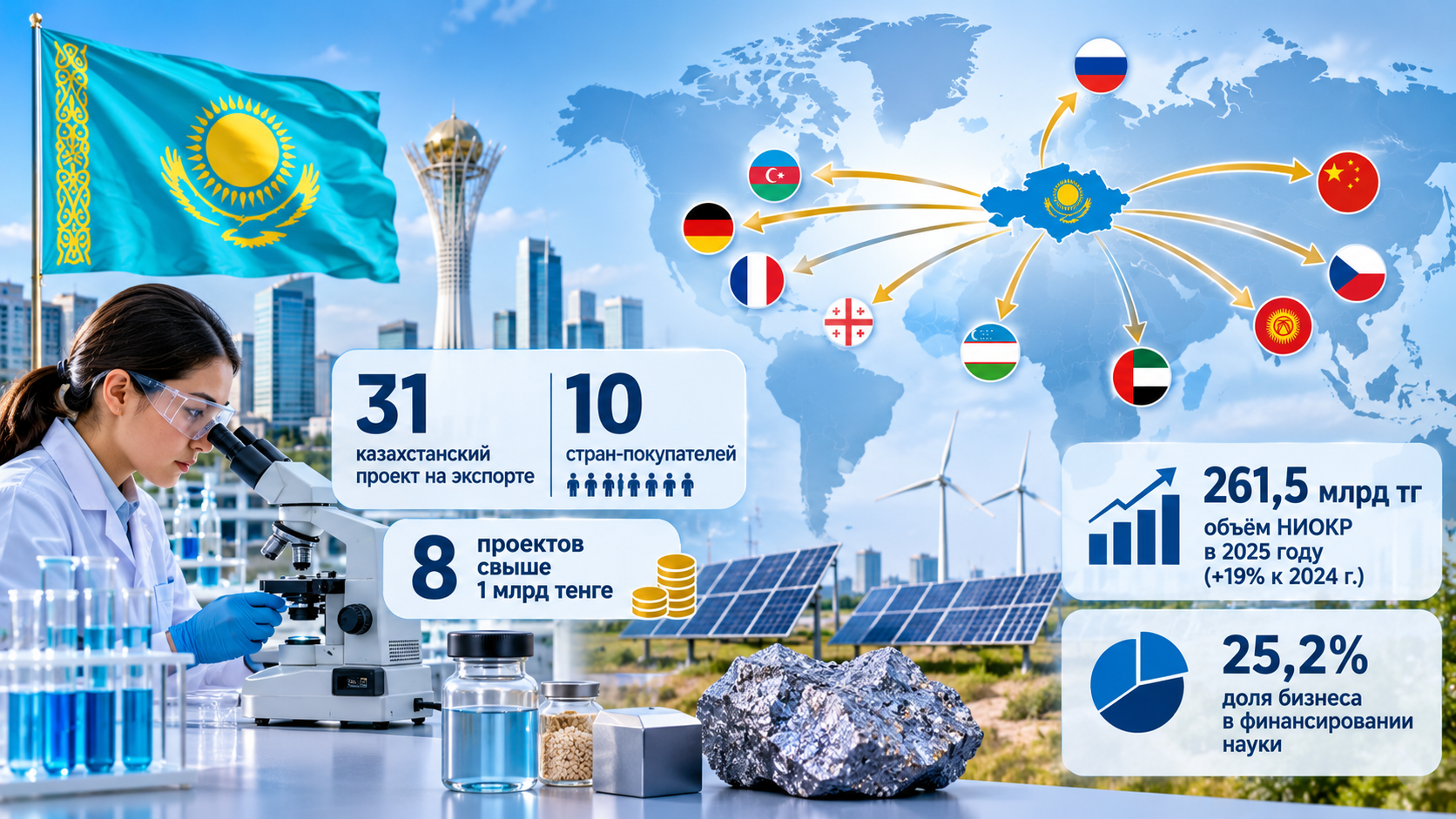
Among the buyers are Russia, China, Austria, Azerbaijan, Uzbekistan, Georgia, Serbia, the UAE, Kyrgyzstan and the Czech Republic, according to data from the Ministry of Science and Higher Education, which National Business cites.
The essence in brief
- 31 commercialization projects export products or services to 10 countries; sales of eight projects exceeded 1 billion tenge.
- Kazakh cobalt-57 is purchased by companies from Russia, Germany and France; brucellosis vaccines by Azerbaijan; artemia cysts by China.
- R&D (research and development) spending grew from 72.2 billion to 261.5 billion tenge over seven years.
- Business invested 66 billion tenge, or 25.2%, in R&D in 2025, against the state's target of 28%.
What is bought abroad
The Institute of Nuclear Physics produces cobalt-57: these are radiation sources for testing medical equipment, including gamma cameras. The buyers are Russia's RITVERTS, Germany's Eckert & Ziegler Chemotrade and France's Orano, and through European intermediaries the product also reaches the United States. Some of the preparations go to Kazakh hospitals. According to Forbes.kz data cited by hunn, exports of cobalt-57 in 2025 amounted to about 200 million tenge, that is approximately 5 curies per year at a base capacity of 10 curies, and increasing output is difficult because the same cyclotron is needed for the higher-priority production of fluorine-18 (a preparation for early cancer diagnosis). The bulk of the institute's revenue comes from radiopharmaceuticals, which account for 85-90% of the domestic market, and it also earns from irradiating topazes.
The Antigen research and production enterprise in the Almaty region produces BRUVAC and BRUCON vaccines against brucellosis in sheep, goats and cattle. They are registered and supplied to Azerbaijan; sales of the two vaccines by April 2025 amounted to 33.5 million tenge, with no more recent data available. Vostok-Aquaculture LLP in the Pavlodar region grows artemia cysts, live feed for juvenile fish and shrimp: since 2025 it has been sold domestically, and now it is exported to China. The ministry did not confirm whether these three projects are among the eight with sales above 1 billion tenge.
How much is invested in science
R&D spending over seven years grew from 72.2 billion to 261.5 billion tenge; in 2025 the growth was about 19%. Three areas — engineering developments (86.3 billion), natural sciences (85.2 billion) and agricultural sciences (30.9 billion tenge) — account for about 77% of spending. The budget of the Ministry of Science and Higher Education for 2026 is 220.7 billion tenge. The share of commercialized projects among completed applied research in 2025 was 35.8% against a target of 35%; by 2029 they want to bring it to 50%.
Why developments do not always reach the market
An example is the emissions purification technologies of the Sokolsky Institute of Fuel, Catalysis and Electrochemistry. The team of Bolatbek Khusain started with catalytic converters for automobiles; its production site can produce up to 5,000 units per year. In 2025, a comprehensive industrial emissions purification system was tested at Almaty CHPP-2: dust is removed at 99.8%, and some harmful gases are reduced by 87-94%.
Business assesses the economics, reliability and payback period, and sometimes it is easier for enterprises to pay for violations than to invest in purification. According to the scientist, conditions are needed under which preventing pollution is more profitable than fines, and cooperation with customers should begin at the stage of setting tasks. Testing, he believes, should be financed together with business.
What else is happening with Kazakh developments
Another development that could leave the laboratory is a PCR test from the Saken Seifullin Kazakh Agro Technical Research University. It detects 17 species of animals and birds in raw materials, sausages, ham and canned goods; it was developed under the food safety program of the Ministry of Agriculture for 2024-2026 and patented as a utility model.
In the North Kazakhstan region, Kozybaev University is testing the possibility of producing sustainable aviation fuel from camelina (false flax) together with Hong Kong's Henderson Land Group. The project is at the experimental stage: the crops must first be tested, and only then are they planning to build a processing complex.
Science about the Caspian is also developing: the Kazakh Research Institute of the Caspian Sea, the country's first specialized institution for studying the Kazakh sector of the water area, has been operating since September 2025. The government allocated it 1.1 billion tenge for marine monitoring equipment and laboratories.
Author's conclusion
The export of Kazakh developments exists, but so far these are isolated products with a clear buyer: isotopes, vaccines, aquaculture feed. What speaks most is not the number of projects but the ratio: 31 projects are export-oriented and 8 have sales above 1 billion tenge, while business invests 25.2% of spending in science against a target of 28%. The state counts on a long-term effect, while enterprises need quick payback, which is why even working technologies such as emissions purification with an efficiency of 99.8% are waiting for a customer. Until this gap is closed, exports will remain a set of successful examples rather than a system.

Comments ()