64.8 million tonnes of oil shipped via CPC in 2025: Energy Ministry names five export routes
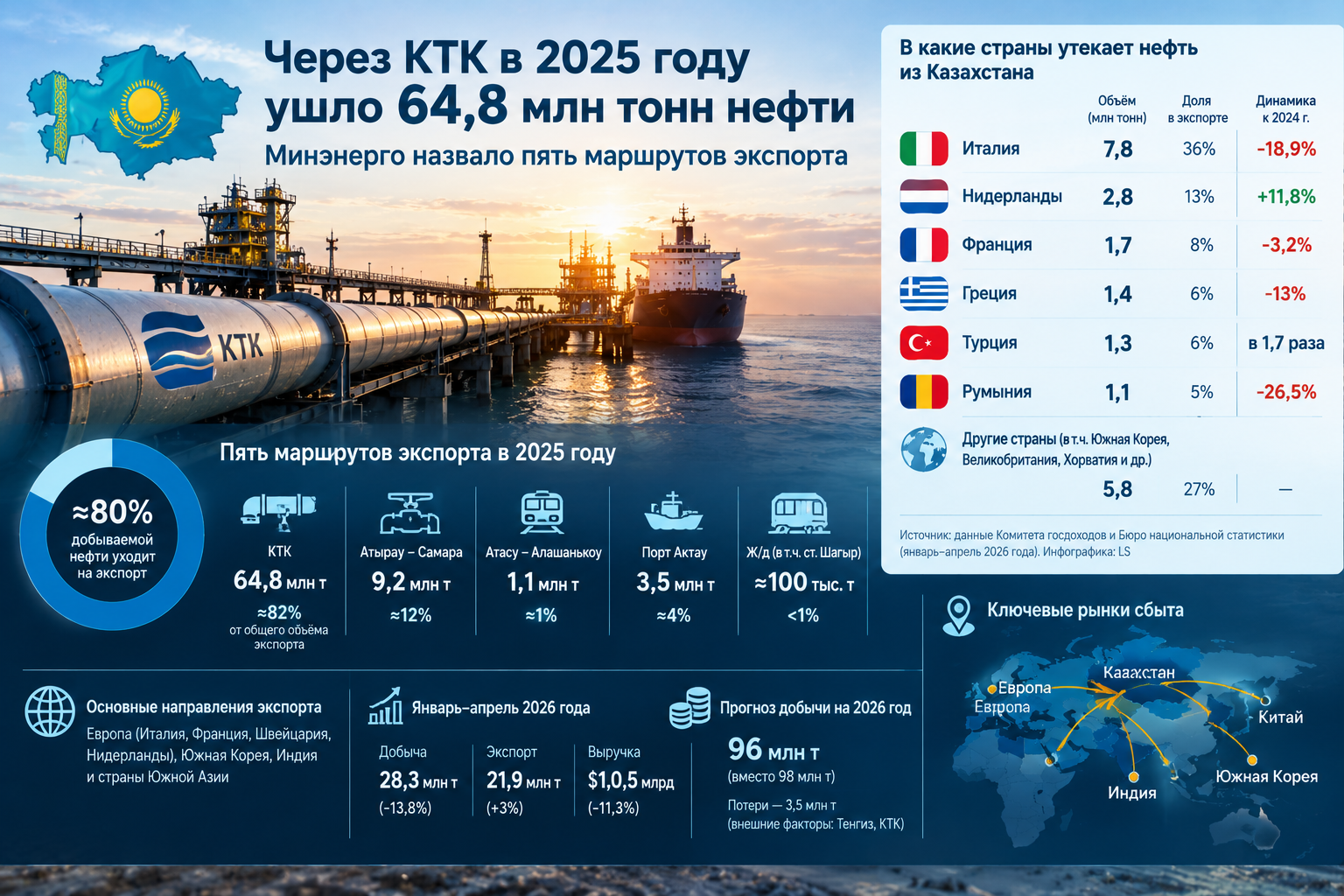
About 80% of Kazakhstan's oil goes to export. The Energy Ministry named five routes and 2025 volumes for each: the main one is CPC.
The ministry also explained why it lowered its 2026 production forecast to 96 million tonnes, LSM.kz reports.
The gist in brief
- About 80% of produced oil is shipped abroad. In 2025, 64.8 million tonnes were sent via the CPC, 9.2 million via the Atyrau - Samara pipeline, 1.1 million via Atasu - Alashankou, 3.5 million through the Aktau port, and about 100 thousand tonnes by rail.
- The main supplies go to Europe (Italy, France, Switzerland, the Netherlands), South Korea, India and some countries of South Asia.
- According to LS data for January-April 2026, oil and gas condensate production fell by 13.8% to 28.3 million tonnes, exports rose by 3% to 21.9 million tonnes, while revenue dropped by 11.3% to $10.5 billion; the largest buyer is Italy (7.8 million tonnes).
- The 2026 production forecast was lowered from 98 to 96 million tonnes: losses amounted to 3.5 million tonnes due to external factors, including transformer fires at Tengiz and restrictions on oil intake at the CPC.
- Scheduled maintenance at Kashagan and Tengiz has been postponed to 2027 in order to make up the shortfall.
Where the oil goes
In 2025, Kazakhstan sent 64.8 million tonnes of oil via the CPC. 9.2 million tonnes went through the Atyrau - Samara pipeline, including in the direction of Ust-Luga, Novorossiysk and Adamova Zastava, and 1.1 million via Atasu - Alashankou. 3.5 million tonnes were sent through the Aktau port, including to Makhachkala and Baku, and about 100 thousand tonnes by rail, including the Shagyr loading rack towards Uzbekistan and Kyrgyzstan.
In total, these routes account for about 78.7 million tonnes, or roughly 79% of 2025 production, with the CPC accounting for about 82% of that volume. This is our (HUNN.kz) calculation; the ministry did not state the total export volume. It is consistent with the ministry's statement that about 80% of produced oil goes to export.
The ministry makes the question of new buyers dependent on the economic attractiveness of the route and agreements between the parties, and describes work on diversifying routes as ongoing.
Who buys: data for January-April 2026
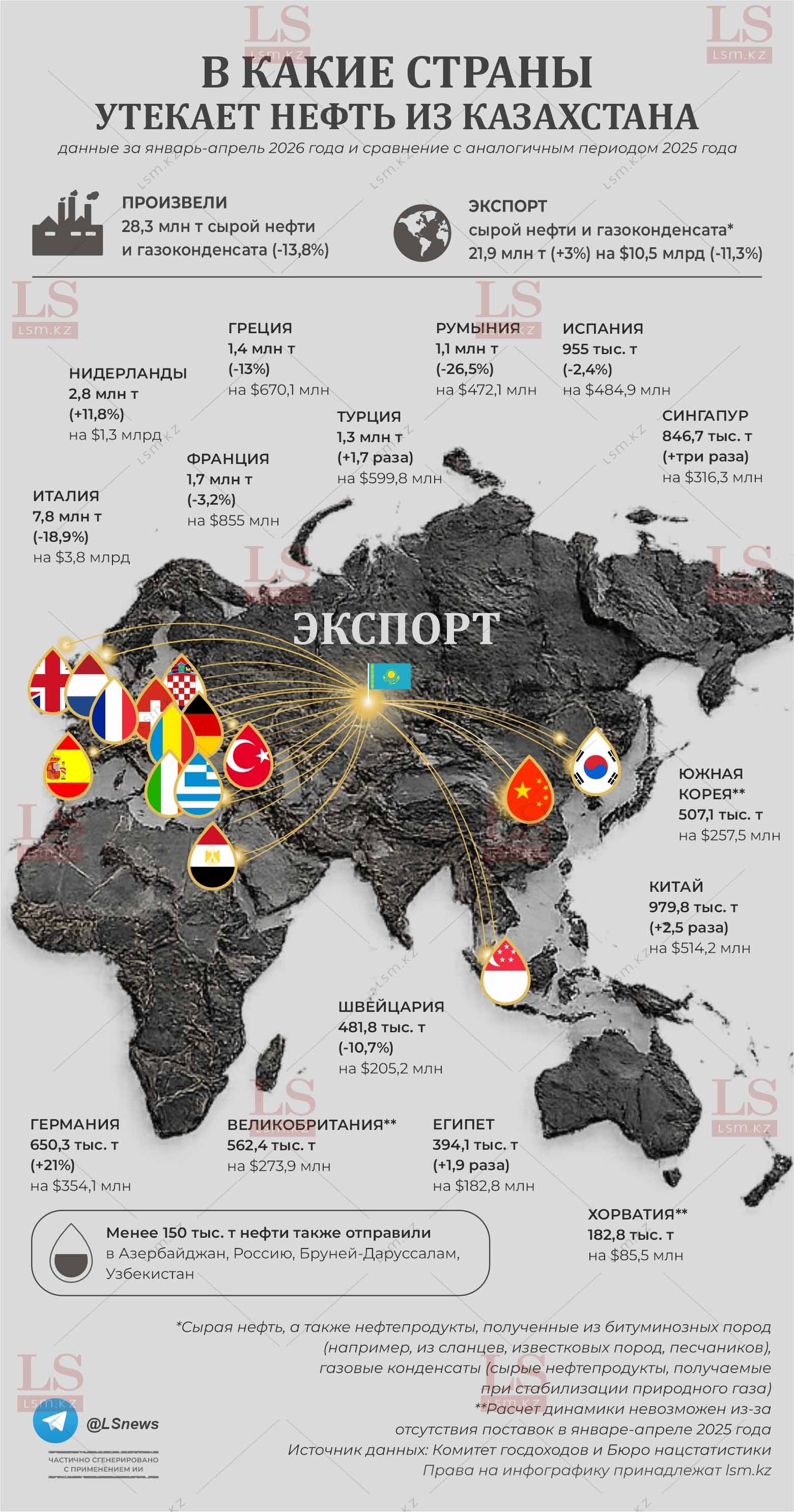
The breakdown by country is shown in an LS infographic based on data from the State Revenue Committee and the Bureau of National Statistics. Over four months, oil and gas condensate production fell by 13.8% to 28.3 million tonnes, while exports rose by 3% to 21.9 million tonnes, with revenue from them falling by 11.3% to $10.5 billion. The reasons for this discrepancy are not explained in the infographic; this period also included the January shutdowns at Tengiz.
The largest buyer is Italy: 7.8 million tonnes (-18.9%) worth $3.8 billion. Next come the Netherlands (2.8 million tonnes, +11.8%), France (1.7 million, -3.2%), Greece (1.4 million, -13%), Turkey (1.3 million, up 1.7 times) and Romania (1.1 million, -26.5%).
Supplies to Singapore (by 3 times), China (by 2.5 times), Egypt (by 1.9 times) and Turkey grew fastest, while supplies to Romania, Italy and Greece declined the most. For South Korea, the United Kingdom and Croatia, the dynamics cannot be calculated: there were no supplies there in January-April 2025. Less than 150 thousand tonnes went to Azerbaijan, Russia, Brunei Darussalam and Uzbekistan. India is not among the recipients in the infographic, although the ministry names it among the main buyers.
What changed in the production forecast
The economic development plan for 2026 envisaged 100.5 million tonnes of oil and gas condensate. At the beginning of the year, the forecast was lowered to 98 million tonnes: in January, transformers caught fire at Tengiz and production was suspended, while the infrastructure of the Caspian Pipeline Consortium (CPC) came under attack. According to Neftegaz.ru, production at Tengiz was fully restored only in March. For comparison, 99.6 million tonnes were produced in 2025.
On 25 August, Energy Minister Yerlan Akkenzhenov announced a new reduction to 96 million tonnes. He attributed the losses to drone attacks on CPC facilities.
"The losses from the attacks on the CPC will amount to 3.5 million tonnes. These are losses in production," he said, as reported by Orda.kz.
In the Energy Ministry's response to LS, the same 3.5 million tonnes are described as losses from external factors, including transformer fires at Tengiz and restrictions on oil intake at the CPC. The wording differs, and it is not clear from the publications what share of the losses falls on Tengiz and what share on the CPC.
Maintenance postponed to 2027
The Energy Ministry reported that scheduled maintenance at Kashagan and Tengiz has been postponed in order to make up the shortfall. According to the minister, Tengizchevroil and the North Caspian Project have postponed major repairs to next year. The ministry does not specify how this will affect production in 2027. Neftegaz.ru links the postponement of maintenance at Tengiz to the expected decline in production next year.
The domestic market and related topics
According to the ministry, the volume of export supplies is determined by actual production and the needs of the domestic market: first of all, oil goes to the country's needs, including domestic refineries, and the rest is sent for export. At the same time, the country's refining capacity is planned to be increased to 39 million tonnes per year.
Tengiz remains at the centre of several topics: negotiations on extending the contract and environmental claims against the operator.
Author's conclusion
The export structure shows how dependent supplies are on a single route: according to the figures cited, the CPC accounts for about 82%. This is consistent with the fact that the minister directly links restrictions on the consortium to production losses. The ministry has not yet specified how the repairs at the two largest fields will be handled in 2027.

Comments ()