Kazakhstan's industry will be required to switch to circulating water supply
Starting next year, special water use permits will require a five-year water conservation plan.
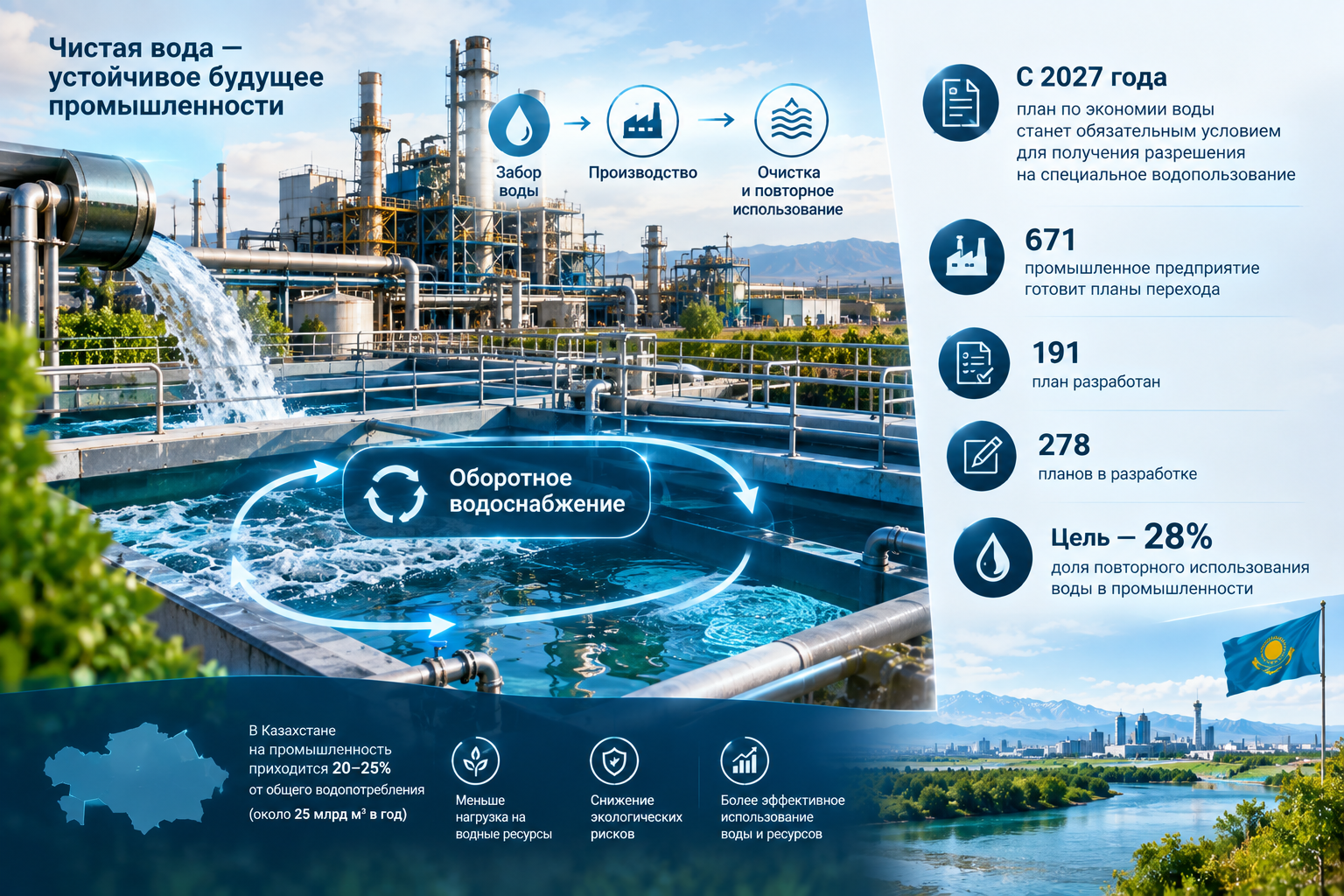
More than 670 industrial enterprises in the country are already preparing such plans — some voluntarily, but most will soon be forced to do so by law.
The essence in brief
- In Kazakhstan, 671 industrial enterprise is preparing to switch to repeated or recirculating water supply — according to the Water Code, such companies and heat-producing organizations are obliged to develop five-year plans for a phased transition and to modernize existing systems using the best available technologies.
- To date, 191 transition plans have been developed, of which 91 are at the approval stage; another 278 plans are still being drafted.
- Starting in 2027, such documents will become a mandatory condition for obtaining a special water use permit — if the requirements are not met, a reduction in the permitted water intake volumes is envisaged.
- Annual water consumption in Kazakhstan is about 25 billion cubic meters, with industry accounting for 20–25% of this volume; the goal of the reform is to bring the share of water reuse in industry to 28%.
How compliance will be checked
Vice Minister of Water Resources and Irrigation Talgat Momyshev outlined the ultimate goal softly but specifically: the rate of water reuse in industry must rise to 28% in accordance with the targets of the Concept for the Development of the Water Resources Management System. To monitor compliance, the ministry has compiled a list of water users that withdraw water for production needs and is already conducting a repeat review of enterprises' statistical data for the past three years — during which cases were identified where water reuse was mistakenly counted as recirculating. This is a telling detail: even the basic accounting terminology — "repeated" and "recirculating" water supply differ technically — is not always applied correctly on the ground, which forces the agency to recheck the source data before demanding compliance with new standards.
Part of an already familiar water policy picture
The requirement for industry logically continues several tracks we have been following this year. In parallel with preparing industrial enterprises for water reuse, the state is expanding subsidies for water-saving technologies for farmers, commissioning the National Water Resources Information System for accurate accounting of the state of water bodies, and proposing to unite farmers into irrigation condominiums to reduce water losses in worn-out canals. The overall vector of all these initiatives is the same — a transition from extensive, weakly controlled water consumption to a system in which both the agricultural and industrial sectors are obliged to report on the efficiency of water use, rather than simply obtaining permits for water intake without subsequent oversight.
Author's conclusion
The transition of 671 enterprises to water reuse is a scale sufficient for a noticeable effect against the overall backdrop of the country's industrial water consumption, but the success of the reform will be determined not by the number of plans developed, but by their actual implementation once the requirement becomes a mandatory condition for obtaining permits in 2027. The discovered cases of confusion between "repeated" and "recirculating" water supply in past years' reporting are an alarming signal that even with plans formally in place, real monitoring of their implementation will require the ministry to carry out far more thorough verification work than simply collecting documents from enterprises.


Comments ()