Kazzinc expects to receive about $4.4 billion from gold mining at Vasilkovskoye
Altyntau Kokshetau, part of the Kazzinc holding, plans to develop the Vasilkovskoye gold deposit in the Akmola region until 2042.
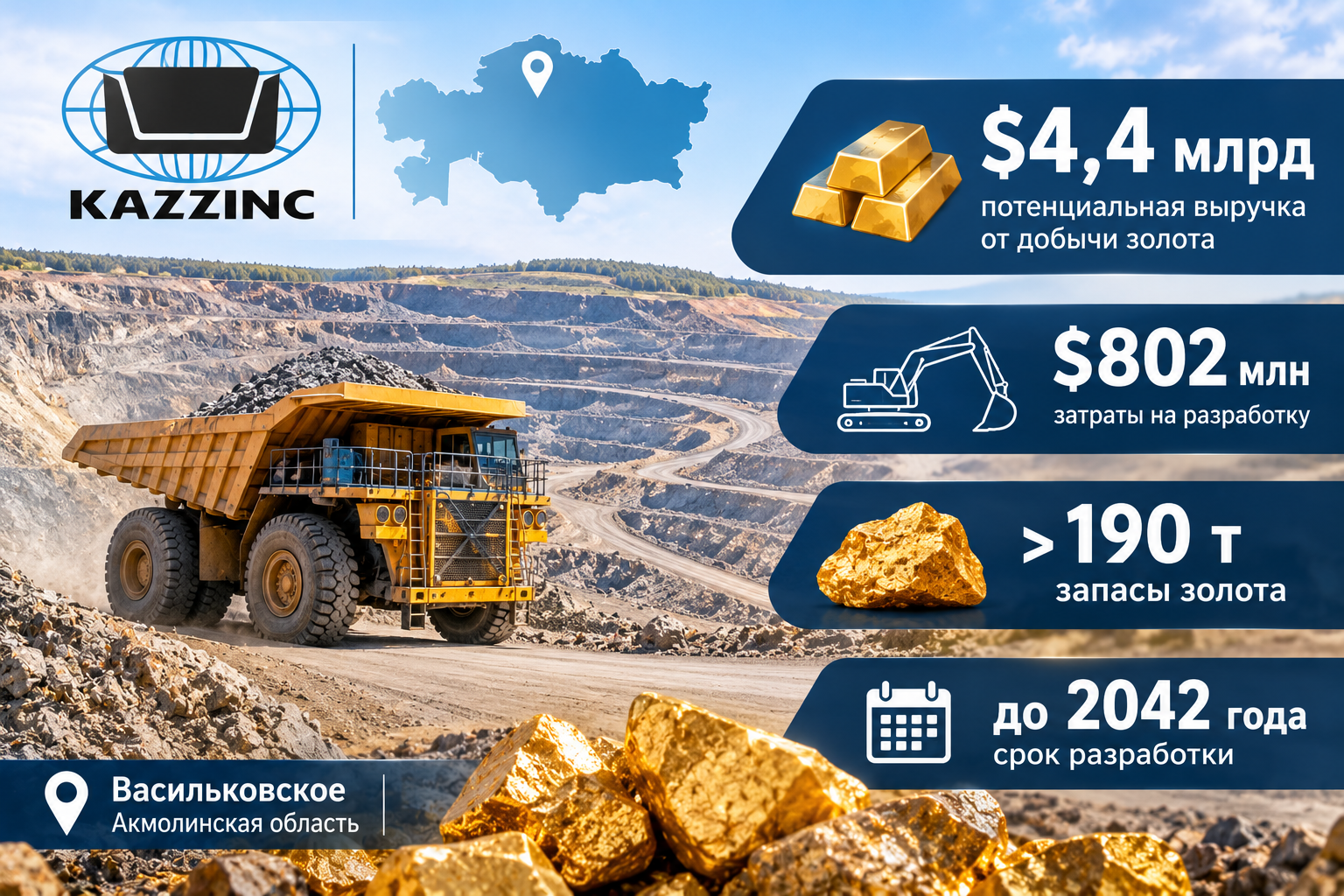
Development costs are estimated at $802 million, revenue at about $4.4 billion, reports National Business. Exploration has shown gold reserves of more than 190 t.
The essence in brief
- Development costs for Vasilkovskoye are $802 million, revenue is about $4.4 billion, 5.5 times more.
- Net cash flow is estimated at $951 million.
- Mining will begin in 2027, by 2029 it will reach 1 million t of ore per year, with a peak in 2033 of 2.5 million t.
- Over the entire life of the project, they plan to process 22.4 million t of ore and produce 2-5 t of gold per year.
What kind of deposit this is
Vasilkovskoye is located in the Akmola region near Kokshetau. In addition to gold, the ore contains silver, uranium, tellurium, selenium, bismuth and arsenic. Mining will be open-pit, that is, quarry-based. According to exploration results, gold reserves exceed 190 t.
How it will be developed
Mining will begin in 2027, initially at small volumes of about 7 thousand t of ore per year, and by 2029 it will reach 1 million t. The peak will come in 2033: 2.5 million t of ore with an average gold grade of 2.39 g per tonne. Mining is planned to be completed in 2042. Over the entire life of the project, the company expects to process 22.4 million t of ore and produce 2-5 t of gold per year.
How much gold the company produces now
According to Kazzinc, Altyntau Kokshetau on average produces up to 15 t of gold per year. The 2-5 t per year forecast for Vasilkovskoye is below this level.
What is happening with gold and Kazzinc in Kazakhstan
Gold output in the country is declining: in the nine months of 2026, they produced 84.7 t of unrefined and semi-refined gold versus 95.2 t a year earlier, that is, 11% less. Searches for new deposits are also underway in other areas. In the same Akmola region, the company Kazakhstan Atasu Mining at the Atasu site with an area of 26.6 km² will search for gold from the first quarter of 2027 to the fourth quarter of 2032, and in the Aktobe region at the Borlinskoye-2 site they are searching for gold, copper, tungsten and cobalt until the end of 2032.
Kazzinc also has environmental issues. The Department of Ecology of the East Kazakhstan region detected exceedances of emission standards at the metallurgical site in Ust-Kamenogorsk: the enterprise was held liable and issued orders. Earlier, on May 5, 2026, bag filters exploded there, three people died, and in the first half of the year the company paid 190.7 million tenge for environmental violations.
Author's conclusion
According to the plan, the project looks profitable: revenue is 5.5 times higher than the $802 million in costs. But in terms of volumes it is modest: 2-5 t of gold per year versus up to 15 t that Altyntau Kokshetau, according to Kazzinc, produces on average, and 84.7 t produced by the entire country in the nine months of 2026.
Comments ()