Meta plans to lay a 1 petabit-per-second cable between the US and France
Meta announced Project Petal—a ~7,000 km subsea cable between the US and France with 1 Pb/s capacity, i.e. 1,000 Tb/s.
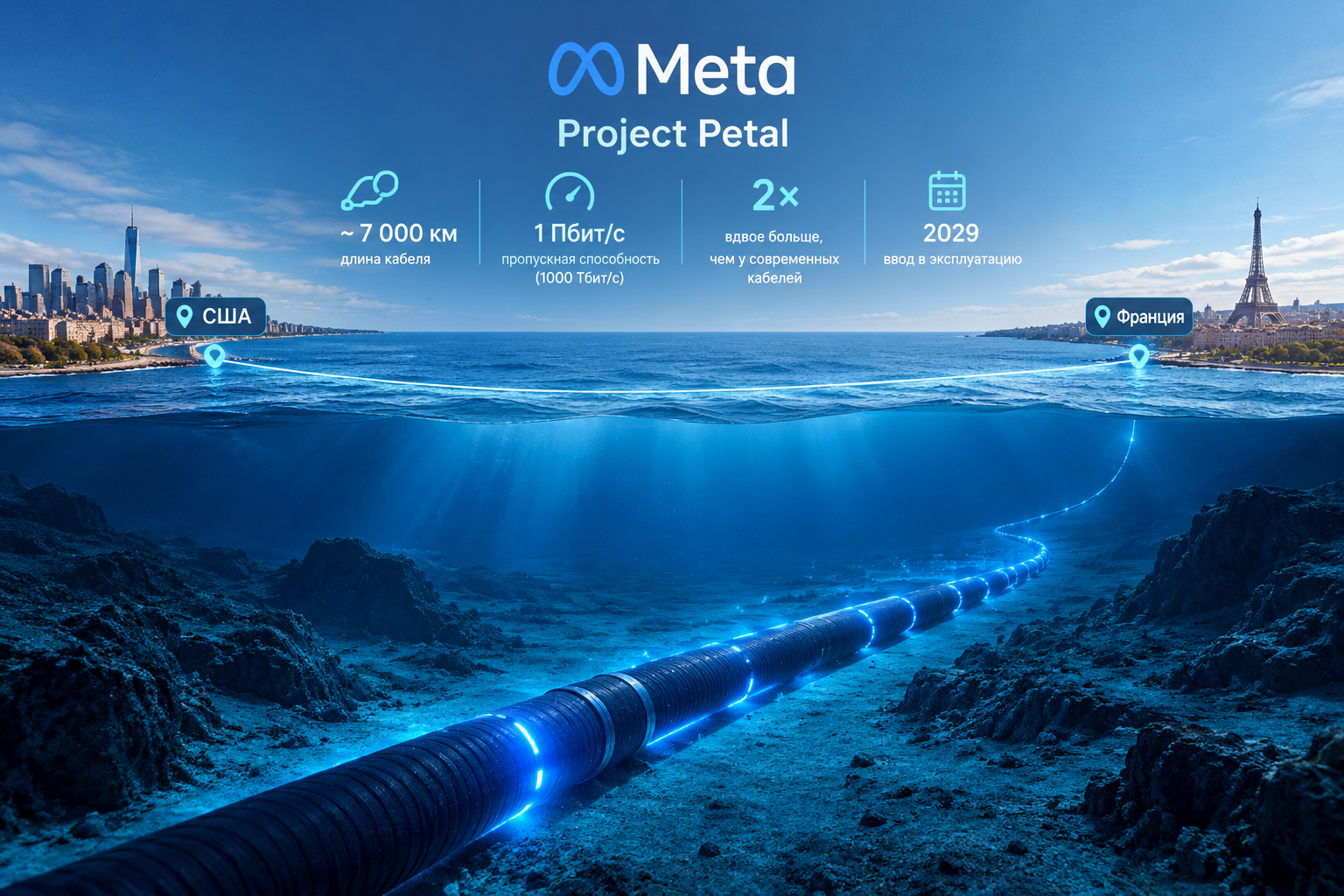
According to the company, this is twice as much as modern transoceanic cables. Commissioning is expected in 2029.
The gist in brief
- Petal's capacity is 1 Pbit/s (1000 Tbit/s), length is about 7 thousand km.
- The cable has 24 pairs of dual-core fibers, equivalent to 48 pairs of conventional ones.
- The cable is being developed together with NEC, the fiber is supplied by Sumitomo Electric Industries, and the French part is supported by Orange.
- Launch is planned for 2029, according to the company's forecast. The project cost has not been disclosed.
What kind of cable it is
Petal will connect the US and the Atlantic coast of France. The French landing point of the cable is being prepared together with Orange, after which the signal will go into Europe's terrestrial network. Meta did not name the US landing point.
Meta calls Petal the first submarine cable with petabit capacity over transoceanic distances. A petabit per second is 1000 terabits per second. This is the company's own estimate; there has been no independent verification yet.
How this was achieved
The main innovation is multicore fiber. A conventional fiber has one light guide inside the cladding, whereas here there are several. In Petal, each fiber is dual-core: the cable has 24 pairs of such fibers, which corresponds to 48 pairs of conventional ones. Inside the housing of a single repeater, a device for amplifying the signal along the route, there are 96 amplifiers, one for each core. The supply voltage is up to 18 kV, that is, within the limits of existing equipment.
For a cable of this length, according to Meta, about a hundred repeaters are usually required. The company does not name the total number on the line.
Who is involved
NEC is a manufacturer of submarine cable systems and Meta's partner in the development. Sumitomo Electric Industries supplies the optical fiber, and Orange supports the landing on the French coast. Meta's explanation is simple: demand for digital services and global connectivity is growing, and the company has already invested in more than 20 submarine cable projects.
What this means for Kazakhstan
Submarine lines are important for the region as well. On the bottom of the Caspian Sea, an optical fiber line was recently launched between Kazakhstan and Azerbaijan: the cable has 64 fibers, and the design capacity exceeds 400 Tbit/s. The project is being implemented by Kazakhtelecom and AzerTelecom International through the CaspiLink B.V. joint venture at the operators' expense, without budget funds. The line connects Kazakhstani networks that have access to China with Azerbaijan's infrastructure, and further with the networks of the Caucasus and Europe. Transit traffic through Kazakhstan is forecast to more than double, to 21.6 Tbit/s.
Author's conclusion
For now, Petal remains a project with declared parameters: capacity, the 2029 launch date, and the comparison with modern cables are all Meta's own data. How well multicore fiber will live up to expectations will become clear after the line is laid and launched.



Comments ()