Ministry of Water Resources reported almost a threefold increase in areas with water-saving technologies
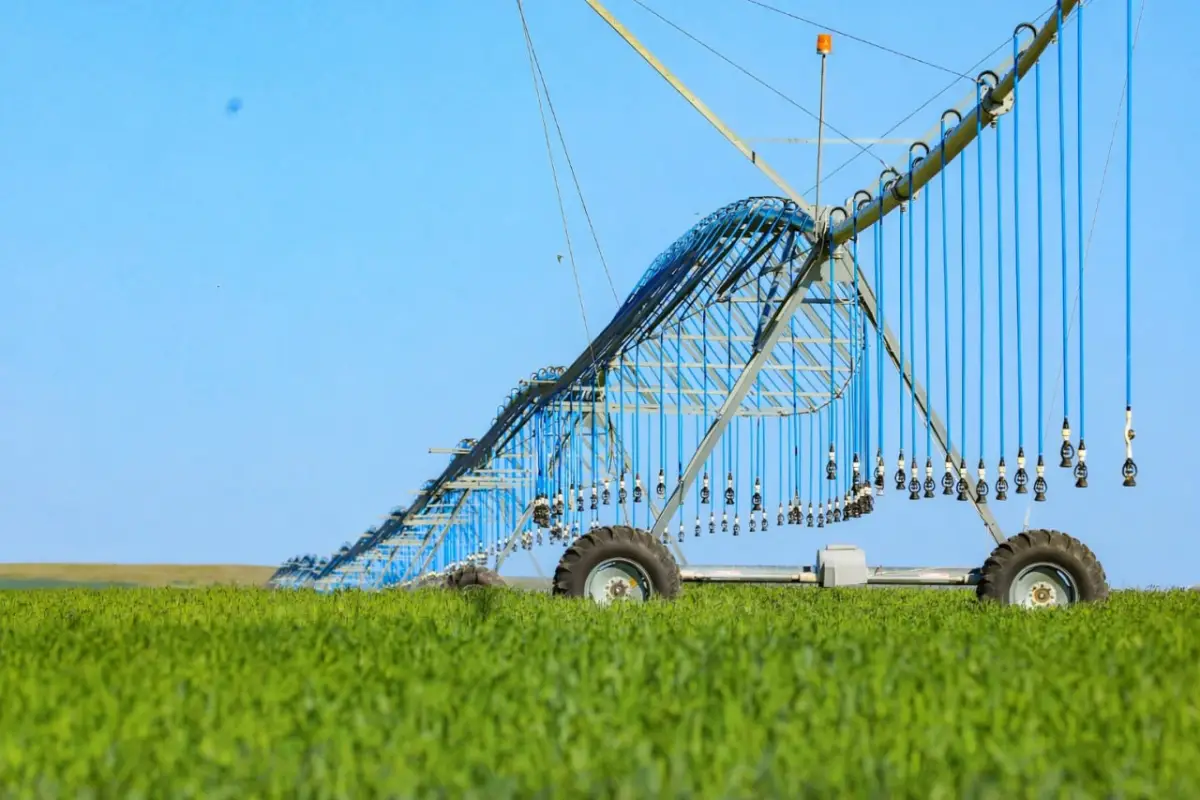
From 237,000 to 702,000 hectares — that's the three-year trend reported by the ministry.
This is the ministry's own data, not an independent assessment, so it should be treated as an official position that has yet to be tested in practice.
The gist in brief
- According to the Ministry of Water Resources, the coverage of irrigated land with water-saving technologies grew from 237,100 hectares in 2023 to 702,300 hectares by September 1, 2026 — nearly threefold; the ministry estimates this as 36% of all irrigated land in the country (1.9 million hectares), Inform.kz reports.
- The ministry reports that drip irrigation grew almost 6-fold (from 42,500 to 254,300 hectares), while sprinkler irrigation doubled (from 188,300 to 379,000 hectares).
- According to the ministry's own calculations, in 2025 modern irrigation systems saved about 874 million cubic meters of irrigation water; by 2030, with coverage of 1.3 million hectares, the claimed savings should reach 2.2 billion cubic meters.
- 214.6 billion tenge is allocated for investment subsidies in 2026–2028 — according to the ministry, almost 4 times more than in the previous three-year period (54.6 billion tenge).
What the ministry reports
The ministry distributes the budget of 214.6 billion tenge across years as follows: 58.5 billion in 2026, 74.6 billion in 2027, 81.5 billion in 2028, with priority for Zhambyl, Kyzylorda, and Turkistan regions. The ministry also reported growth in the number of domestic plants producing irrigation equipment — from four to seven over two years, with a combined capacity of 3,390 sprinkler machines per year. According to the ministry's own assessment, this production is already sufficient to cover the annual domestic demand for 1,000–1,200 machines.
One detail worth clarifying separately
This report states that reimbursement of farmers' costs for purchasing and installing water-saving systems has been increased from 60% to 80%. This diverges from the figure in an earlier article about the same 214.6 billion tenge program — there, citing the same ministry, it was about an increase from 50% to 80%. The exact reason for the discrepancy could not be established from available sources; it is possible that different support measures are meant. This is a good example of why even official figures from the same ministry should be cross-checked by dates and specific wording, rather than accepted as mutually consistent statistics.
Subsidizing the cost of the water supply service itself, according to the ministry, has grown from 50% to 85% — this figure has not previously appeared in this form.
Author's conclusion
The ministry's report presents an impressive picture: nearly threefold growth, hundreds of millions of cubic meters of saved water, a tripling in the number of domestic plants. But this is precisely one ministry's report on the results of its own program, and such a format deserves the same skepticism with which Kazakhstan habitually treats agricultural sector statistics in general. Until these figures are backed by independent verification — by the Accounts Committee, on-the-ground journalistic investigations, or at least consistency between the ministry's own various communications — they should be treated as a stated position, not as an established fact.
Comments ()