New Rules for Trade in Agricultural Goods in Kazakhstan
Kazakhstan's Ministry of Trade and Integration has amended the rules for trading certain agricultural goods.
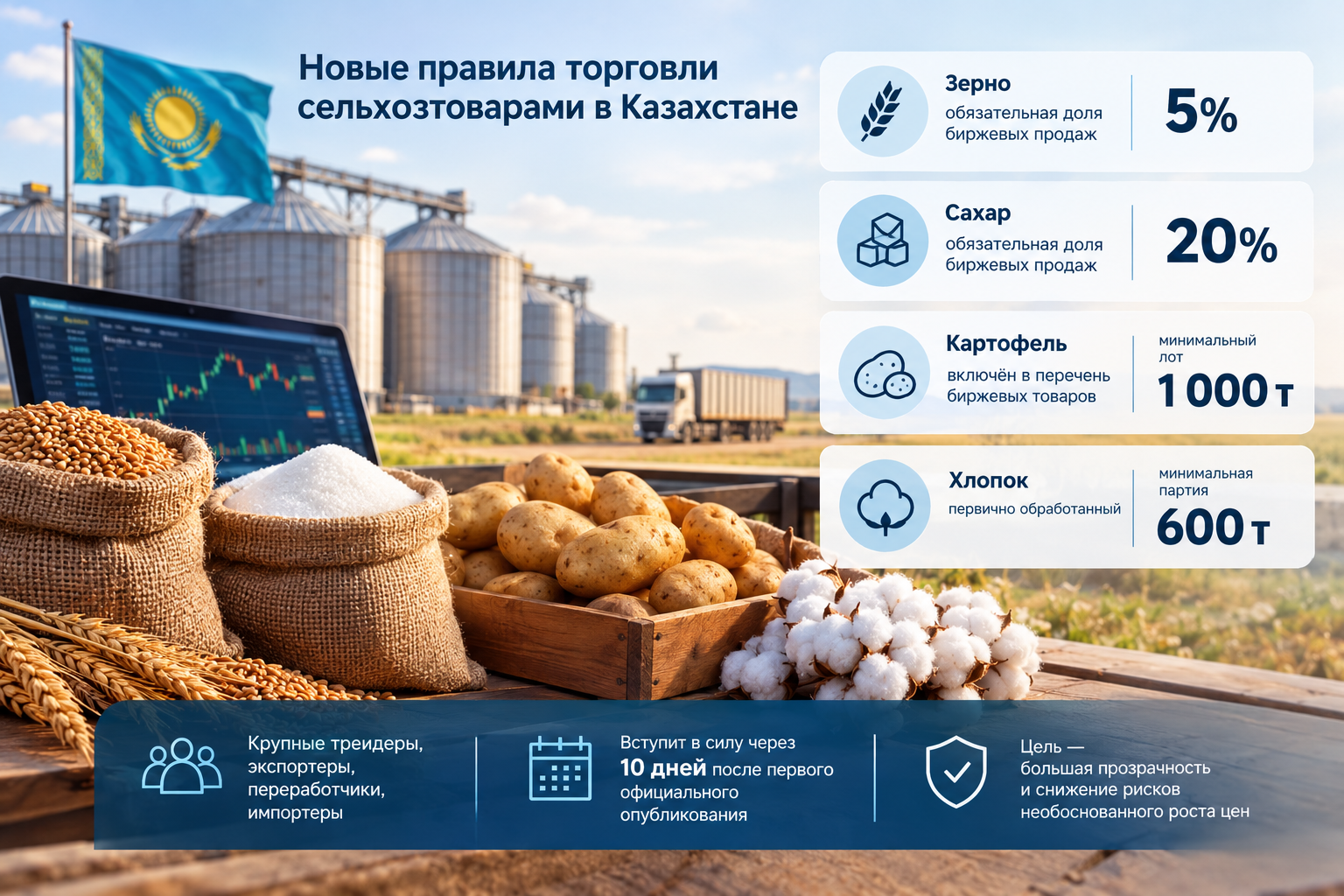
Fresh and chilled potatoes have been included in the list of exchange-traded commodities. Mandatory shares of exchange sales have been introduced for grain and sugar. The new rules will primarily affect large traders, exporters, processors, and importers.
The gist in brief
- A mandatory share of exchange sales has been set for grain at 5%, and for sugar at 20%.
- Potatoes have become an exchange-traded commodity with a minimum lot of 1,000 tonnes.
- For primary-processed cotton, the minimum exchange lot will be 600 tonnes.
- The order will enter into force 10 calendar days after its first official publication.
What changed in the list
The order was signed by the Minister of Trade and Integration of the Republic of Kazakhstan, Arman Shakkaliyev, after coordination with the Ministry of Agriculture of the Republic of Kazakhstan and the Agency for Protection and Development of Competition of the Republic of Kazakhstan, inbusiness.kz reports. The main innovation concerns potatoes: fresh and chilled potatoes are now classified as exchange-traded commodities. The minimum exchange lot size for them has been set at 1,000 tonnes, so the requirement primarily affects large wholesale suppliers and retail chains. For cotton that has undergone primary processing, the minimum exchange lot volume will be 600 tonnes.
Who will be required to sell grain through the exchange
Exporters of wheat and barley, as well as large participants in the domestic market, will be required to sell at least 5% of the volume of grain they sold outside the exchange in the previous month through commodity exchanges. Farmers and agricultural producers are exempt from this rule. According to the authorities' plan, such a measure will make it possible to see real transaction volumes and price benchmarks on the market.
Why the requirements for sugar are stricter
For sugar, the mandatory share of exchange sales has been set at 20%. The rule applies to both Kazakhstani producers and importers. Producers calculate the share from the volume of sugar produced, while importers calculate it from the volume of imported products. For importers, this is a significant condition, because their share of the domestic market has grown from 49.8% in 2022 to 70.4% in 2025.
What the ministry expects
The Ministry of Trade and Integration of the Republic of Kazakhstan believes that trading through the exchange will make wholesale transactions more public and price formation more transparent. It is also expected to reduce the risks of unjustified increases in product costs on the path from supplier to end buyer. The new rules will enter into force upon the expiration of 10 calendar days after the first official publication of the order.
Author's conclusion
The authorities are betting on transparency: the exchange should reveal real volumes and prices in a market where a significant portion of transactions takes place outside trading. The burden of the new rule will fall on large players, while farmers are exempt from it. How this will affect prices for the end buyer is still impossible to say: the ministry speaks only of reducing the risks of unjustified growth, and the date the order enters into force depends on its official publication, which is not indicated in the source.

Comments ()