Outstanding debt to farmers on subsidies of 140 billion tenge is planned to be repaid in 2027
Kazakhstan plans to fully repay the remaining 140 billion tenge in agricultural subsidy arrears by 2027.
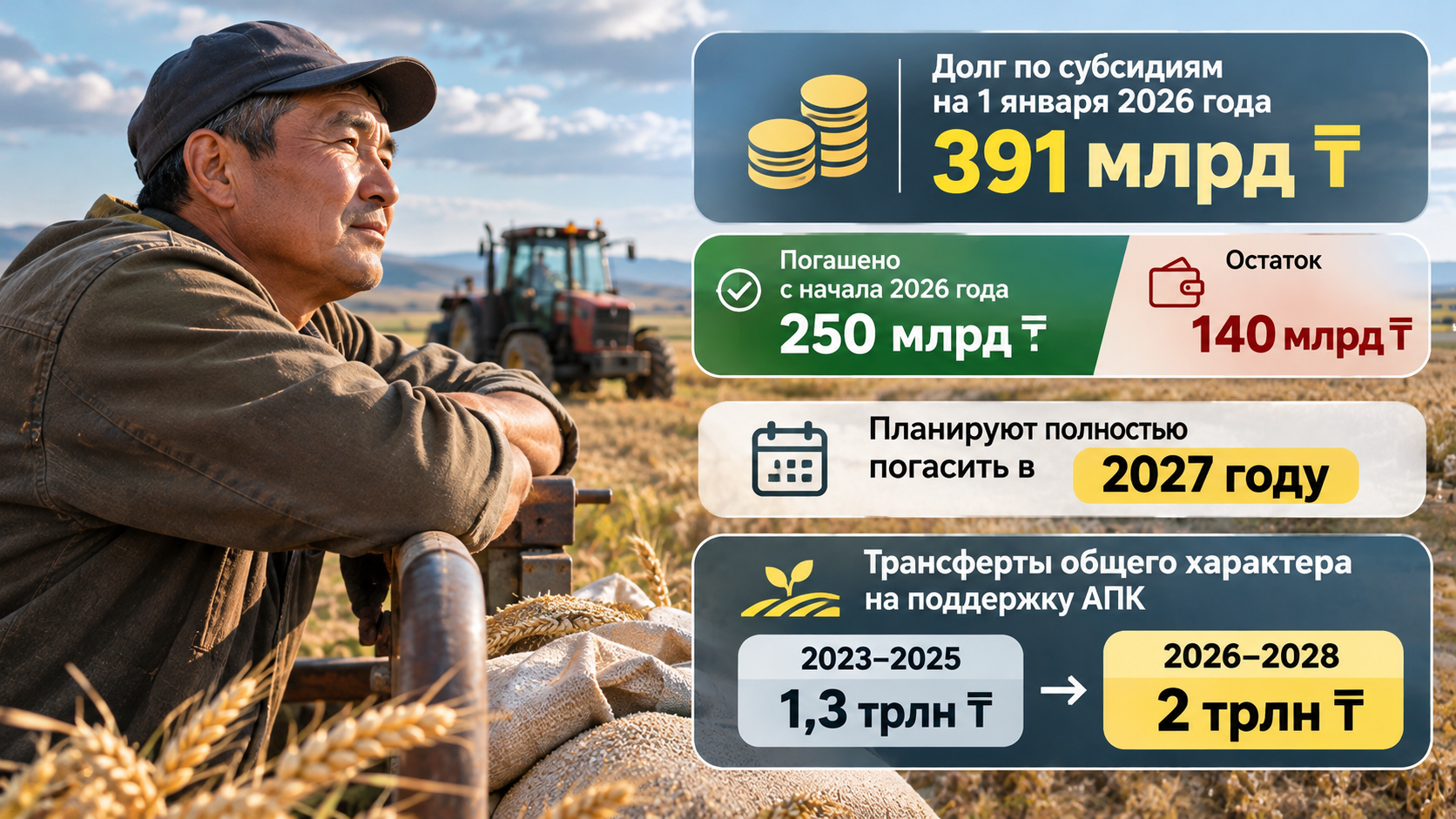
Since the beginning of 2026, 250 billion tenge has already been allocated to obligations from previous years, reports Kazinform.
The essence in brief
- As of January 1, 2026, the obligations of local executive bodies for subsidy payments amounted to 391 billion tenge.
- Since the beginning of the year, 250 billion tenge has been allocated to repay them, with the remaining balance from previous years at 140 billion tenge.
- The remaining balance is planned to be covered from the 2027 budget, with funds earmarked for this purpose.
- For 2026-2028, 2 trillion tenge has been allocated in general-purpose transfers, compared to 1 trillion 300 billion tenge allocated for the previous three-year period.
How much remains to be repaid
Vice Minister of Agriculture Nazgul Khatepova spoke about the timeline for the final repayment of the debt during a press tour for journalists. According to her, as of January 1, 2026, the obligations of local executive bodies for subsidies amounted to 391 billion tenge, and they were planned to be fully covered from the current year's budget. Of this amount, 250 billion tenge has been repaid, and the remaining balance of debts from previous years stands at 140 billion tenge.
Why the debt was not closed in one year
Closing such a large debt in one year is difficult given the budget's capacity, the vice minister explained. Therefore, for 2026-2028, 2 trillion tenge has been provided as part of general-purpose transfers instead of 1 trillion 300 billion tenge for the previous three-year period. For this year, 588 billion tenge has been allocated in transfers, and for 2027 — 695 billion tenge. The remaining debt is planned to be covered from next year's budget, and all obligations assumed by the state, according to Khatepova, will be fulfilled.
Who pays subsidies to farmers
Subsidies to agricultural producers are paid by local executive bodies, i.e., akimats. Funds for these purposes are provided as part of general-purpose transfers that the republican budget sends to the regions.
What else is happening with subsidies
Payment debts are not the only issue. In October, the types of subsidies in the agro-industrial complex were reduced from 54 to approximately 30: schemes with low efficiency or high corruption risks were removed. The Prime Minister instructed the Ministry of Agriculture to consolidate industry data into a single system so that state support could be assigned automatically. In addition, farmers in the Kostanay region cannot obtain subsidized fertilizers: plants reject their applications and send the products for export.
Author's conclusion
The debt from previous years could not be closed in one year as planned at the beginning of 2026, and farmers will receive the final payments only in 2027. Now everything depends on next year's budget: it is from there that the remaining balance is planned to be covered, and if the budget is executed as planned, the money will come in 2027.

Comments ()