Potato exports from Kazakhstan increased more than 10 times
Infographic on vegetable exports. In six months, Kazakh vegetables reached neighbors in volumes that a year ago would have seemed fantastic.
The biggest growth was in potatoes — its exports to Tajikistan grew by multiples measured in the hundreds, lsm.kz writes.
The gist in brief
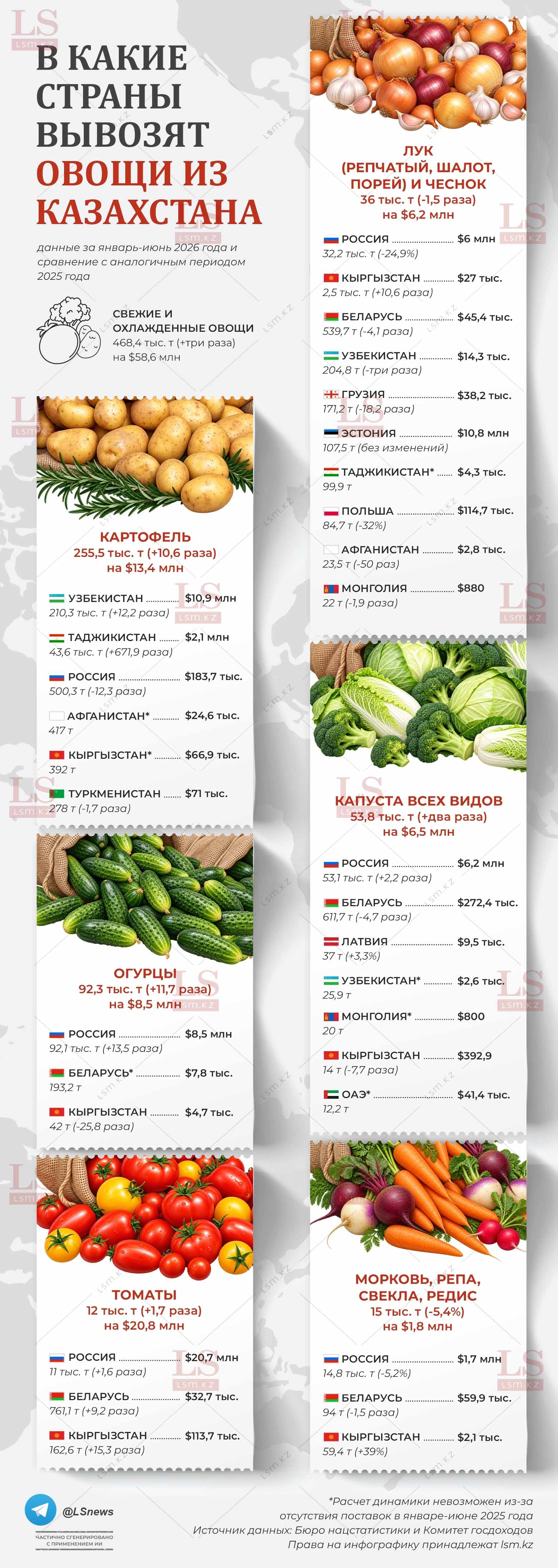
- In January–June 2026, Kazakhstan exported 468,400 tonnes of fresh and chilled vegetables — three times more than in the same period last year; exporters earned $58.6 million from the supplies.
- Potato exports grew the most — 10.6 times, to 255,500 tonnes; the bulk (210,300 tonnes) went to Uzbekistan, while supplies to Tajikistan grew 671.9 times, to 43,600 tonnes.
- Cucumber exports grew 11.7 times, to 92,300 tonnes — almost the entire volume was purchased by Russia; cabbage supplies doubled, to 53,800 tonnes, with Russia also leading here.
- Not all categories showed growth: exports of onions and garlic fell 1.5 times, to 36,000 tonnes, while carrots, beets and radishes declined by 5.4%, to 15,000 tonnes.
Potatoes found new buyers
The geography of potato exports has changed noticeably over the year. While Uzbekistan remains the largest buyer with purchases up 12.2 times, an even sharper jump occurred specifically in the Tajik direction — growth of 671.9 times turns Tajikistan from a secondary player into one of the key markets almost from scratch. At the same time, Russia cut purchases of Kazakh potatoes 12.3 times, to just 500.3 tonnes — meaning the growth in potato exports is almost entirely driven by a reorientation toward Central Asian markets rather than by expanding the already familiar destinations. Small batches were also supplied to Afghanistan, Kyrgyzstan and Turkmenistan.
Cucumbers and cabbage — an almost Russian monopoly
Unlike potatoes, cucumbers and cabbage show an almost opposite geographic structure — the overwhelming majority of exports of these crops goes specifically to Russia. Of the 92,300 tonnes of exported cucumbers, 92,100 tonnes were purchased by Russia (growth of 13.5 times), and of the 53,800 tonnes of cabbage — 53,100 tonnes (growth of 2.2 times), although cabbage was also supplied to Belarus, Latvia, Uzbekistan, Mongolia, Kyrgyzstan and even the UAE. Tomato exports increased more modestly — 1.7 times, to 12,000 tonnes — but purchases were noticeably increased by Belarus (9.2 times) and Kyrgyzstan (15.3 times).
Not everything grows equally
Onions and garlic turned out to be the only major category with a steady decline in exports across most destinations at once — Russia cut purchases by 24.9%, Belarus by 4.1 times, Uzbekistan threefold, Georgia by 18.2 times. But even here there was an exception: supplies to Kyrgyzstan grew 10.6 times, to 2,500 tonnes, and small batches also went to Estonia, Poland, Tajikistan, Afghanistan and Mongolia — meaning that even in a category with an overall decline, individual new markets continue to grow.
Author's conclusion
The half-year statistics show two parallel stories at once: steady, diversified growth in supplies to Central Asian countries — primarily in potatoes — and an almost monopolistic dependence of cucumber and cabbage exports on a single Russian market. Such concentration creates an obvious risk: as long as demand in Russia remains high, cucumber and cabbage exports will continue to grow, but any change in conditions in this single large market could hit these crops far harder than the more geographically distributed potato direction.


Comments ()