Robots on ultraviolet: California startup cuts pesticide use by 70% without chemicals
California startup TRIC Robotics deployed nine tractor-sized autonomous robots in strawberry farms, working at night to kill pests with UV light instead of chemical pesticides.
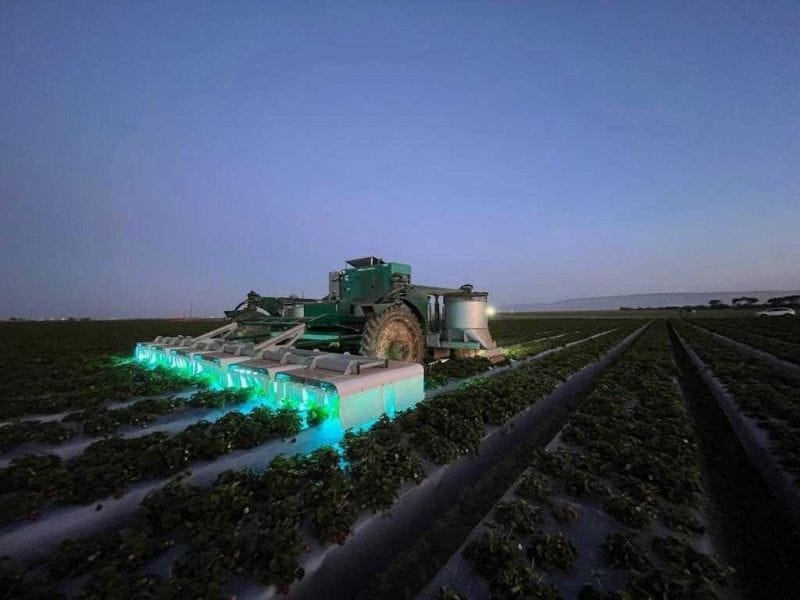
Each robot processes about 30 acres per night, collectively covering more than 1,000 acres of strawberry fields. Pesticide use has been reduced by 70% — without loss of yield, reports MeetInc. For Kazakhstan, where the chemical load on soil in agricultural regions is increasing, this is a technological benchmark for the next decade.
In Brief
- TRIC Robotics has deployed 9 autonomous robots on California strawberry fields, covering more than 1,000 acres. Each machine processes about 30 acres per night.
- Instead of chemical pesticides, the robots use UV-C radiation — ultraviolet light damages the DNA of pests (mites, mold, insects) and prevents their reproduction.
- Pesticide use has been reduced by 70% while maintaining yield. The technology is positioned not as a complete replacement for chemicals, but as a tool to significantly reduce their volume.
- The UV-C approach reduces harm to beneficial insects — bees and other pollinators — compared to traditional chemical treatments.
- TRIC Robotics is expanding its deployment across California. The potential effect is a reduction in labor and chemical costs while increasing the environmental sustainability of production.
Why at Night and Why Ultraviolet
The logic behind the robots' nighttime operation is no coincidence. At night, most beneficial insects, including bees and other pollinators, are inactive. This allows UV-C radiation to be applied with minimal collateral damage to the field's ecosystem. Pests — mites, whiteflies, powdery mildew — are, on the contrary, vulnerable to ultraviolet light around the clock.
The mechanism is simple from a biological standpoint: UV-C radiation with a wavelength of about 254 nm destroys the DNA of microorganisms and small pests, disrupting their ability to reproduce. This is not instant destruction, but a gradual suppression of the population — which is why the technology is used as a supplement to chemical treatments, not a complete replacement.
Economics: More Profitable Than It Seems
Behind the environmental rhetoric lies a very pragmatic calculation. Chemical pesticides are not only an environmental burden but also a significant expense item: purchasing agents, application equipment, personnel, and compliance with quarantine periods. Robotic UV-C treatment reduces three out of four of these components.
For large commercial farms, where thousands of acres require regular treatments, reducing pesticide costs by 70% is direct savings, measurable in hundreds of thousands of dollars per season. Add to this the reduction in health risks for workers and fewer claims regarding pesticide residues in exported products — and the commercial attractiveness of the technology becomes obvious.
Kazakhstan Context
Kazakhstan is actively developing its greenhouse and berry production — primarily strawberries, raspberries, and other berries in the Almaty and Zhambyl regions. In these crops, the chemical load is traditionally high: mites, aphids, and powdery mildew require multiple treatments per season.
At the same time, the country faces a growing problem of soil degradation and accumulation of pesticide residues in agricultural lands — directly pointed out by the "Soil Protection Law" adopted in June 2026. UV-C robotization offers a practical answer to this challenge: reducing the chemical load without losing yield.
The technology is not yet directly available in Kazakhstan — TRIC Robotics operates only in California. However, its commercialization horizon of 3–5 years is quite realistic for the emergence of analogs or partnership offers. Domestic agricultural technology parks and venture structures, including the newly announced Ministry of Digital Development fund, should be monitoring this direction now.
Author's Conclusion
A nighttime robot with ultraviolet light in a strawberry field is not science fiction, but a commercial product with measurable results: minus 70% pesticides, a thousand acres covered, nine machines in the field. For the global agricultural sector, which simultaneously pressures ecological systems and seeks ways to reduce costs, such technologies are part of an inevitable transformation. Kazakhstan, building greenhouses and expanding berry production, should watch this direction closely.



Comments ()