Scientists tested a 50,000-volt fog water harvesting system in the Namib Desert.
In one of the driest regions on Earth, an unusual method of obtaining drinking water was tested—not from underground or the sea, but literally from the air.
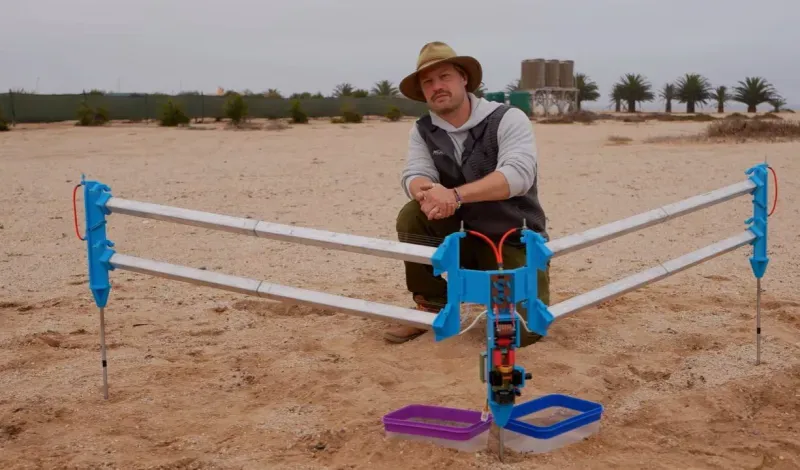
The technology showed promising results in laboratory conditions but faced the harsh reality of the desert.
The gist
- Blogger Jay Bowles, author of the YouTube channel Plasma Channel, transported an experimental device 14,000 km to test electrostatic fog water harvesting technology on the coast of Namibia with support from the University of Namibia in Swakopmund.
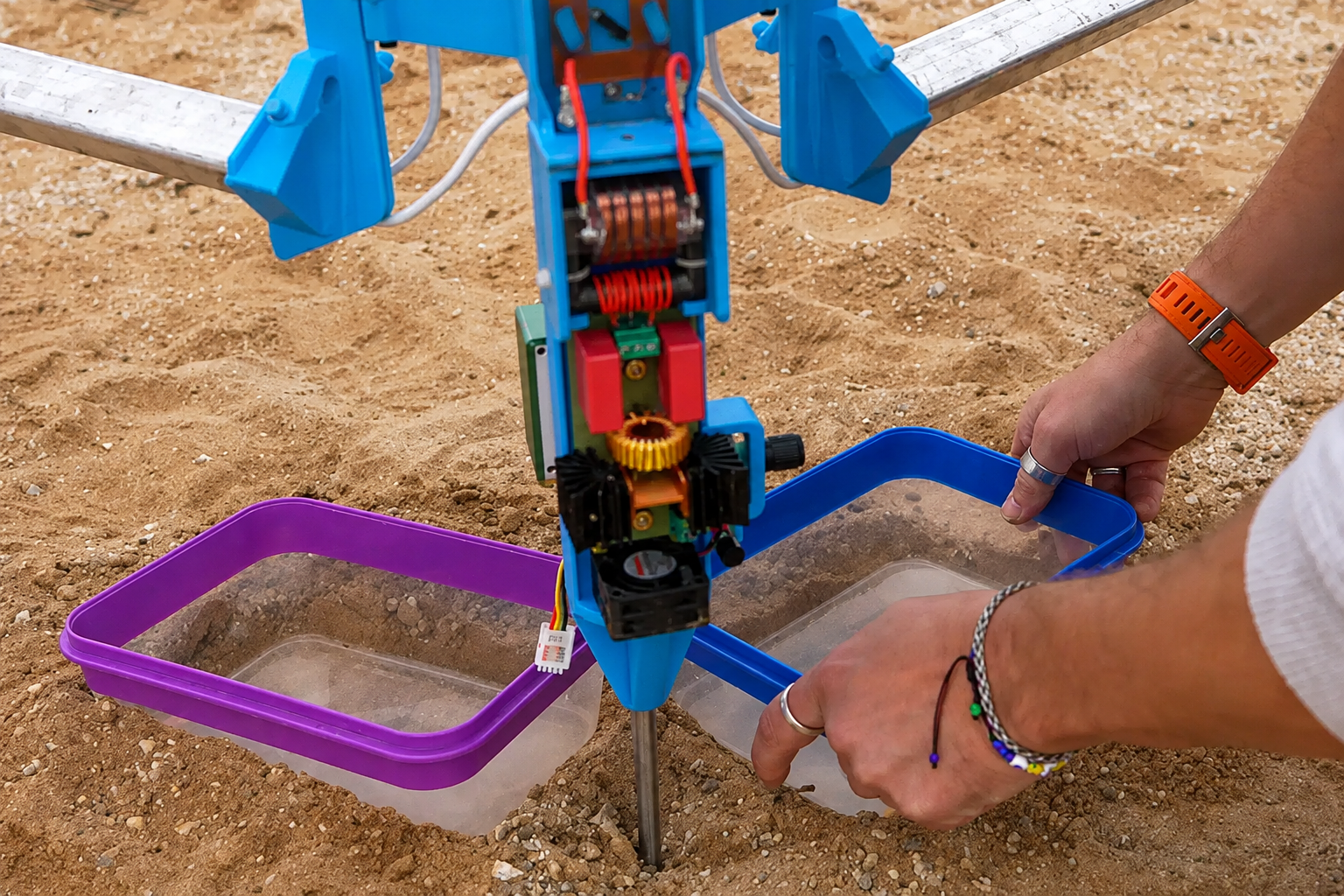
- The device uses a high-voltage wire (50,000 volts) to ionize microscopic fog droplets, which are then attracted to a grounded mesh and condensed into a collector; in laboratory conditions, the system produced about 42 ml of water per minute at a power of 120 watts.
- In real desert conditions, the technology faced serious challenges: forecasts of dense fog did not materialize, salty spray from the Atlantic caused short circuits in the high-voltage electronics, and wind broke structural elements of the device.
- Existing passive fog collectors — simple mesh screens without electricity — have been working in the same desert for years with virtually no maintenance, although they capture a smaller fraction of moisture from the air.
How the electrostatic system works
The principle of the device is relatively simple: a high-voltage wire ionizes microscopic water droplets suspended in fog, after which the charged droplets are attracted to a grounded mesh or metal rods, where they condense and flow into a collector. The project started with a compact prototype on two rods consuming just 39 watts, but was later scaled up to a system with three rods four times wider, adding solar recharging and an operation timer. In controlled laboratory conditions, the device showed an efficiency of about 21 milliliters of water per watt-hour — meaning roughly 48 watt-hours of electricity were needed to produce one liter.
The desert proved harder than the garage
Real field trials exposed the gap between laboratory results and practical application. Weather forecasts promised up to eight hours of dense fog, but actual conditions regularly failed to match the forecast — fog often dissipated shortly after sunset. Salty spray from the Atlantic Ocean, which reached even the test site about a kilometer from the coast, penetrated the high-voltage electronics and transformer, causing electrical arcing and equipment failure. Wind added mechanical stress, and some of the structure's rods eventually broke under the weight of replacement components.
Why passive mesh screens still win for now
Notably, the authors of the piece do not try to embellish the result: despite the theoretical ability to capture more moisture than conventional mesh screens, the electrostatic system still loses to them in practicality. Passive fog collectors have been operating in the same desert for years without electricity and with virtually no maintenance — it is this reliability, not peak efficiency, that proves to be the decisive factor in truly extreme conditions. Even a fully charged laptop battery may not be enough to produce one liter of water in real field conditions.
Author's conclusion
The story of the Namibian experiment is an honest example of how a technology that works impressively in controlled conditions faces a completely different set of challenges in a real environment: salt, wind, unpredictable weather. This is not a reason to consider the development a dead end — the authors explicitly mention further work on protecting the electronics and improving structural durability — but it is a good lesson for any new water-harvesting technology in arid regions: laboratory efficiency and practical field applicability are entirely different metrics, and confirming the latter through reliability and ease of operation will require many more seasons of testing.



Comments ()