Second attempt in five years: will Valley succeed in building an irrigation equipment plant in Kazakhstan
U.S. irrigation equipment maker Valley eyes Kazakhstan again. $17M and 500 units per year—are its localization plans realistic?
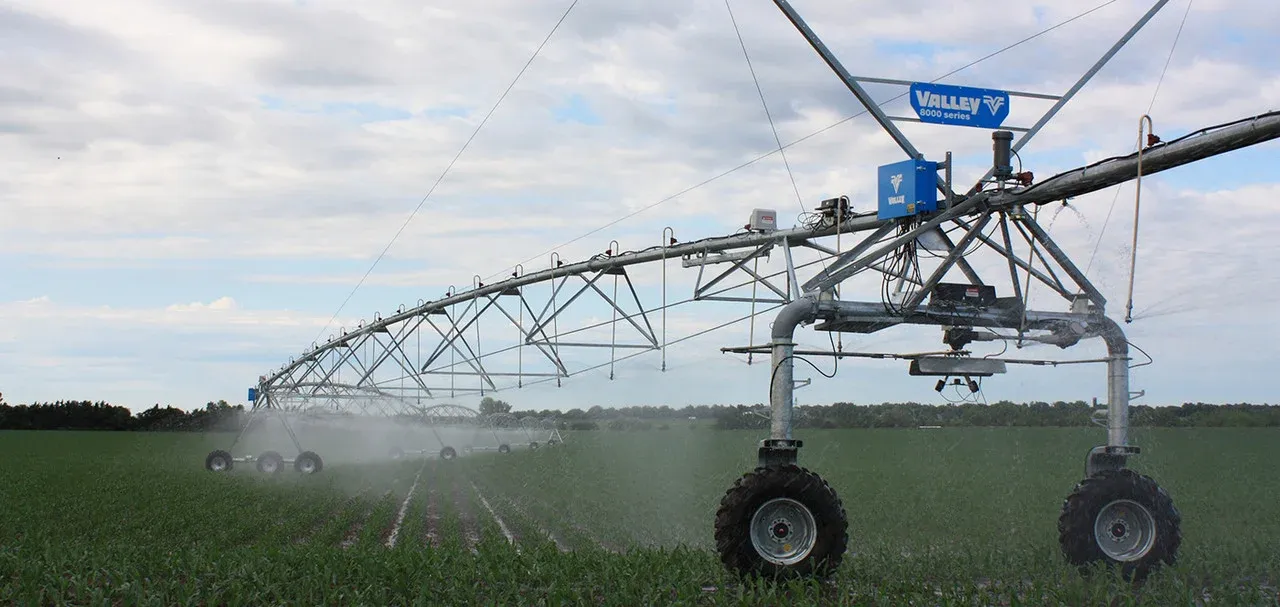
In April 2026, the American company Valmont Industries (brand Valley) announced its intention to localize the production of irrigation machines in Kazakhstan, reported the Ministry of Agriculture of the Republic of Kazakhstan. Investment — $17 million, capacity — up to 500 machines per year, partner — JSC "Imstalkon". For those following this story, the news sounds familiar: five years ago, the same company announced a plant worth $50 million and 1000 machines per year in partnership with Kusto Group. The plant was never built. We examine what has changed — and whether it has changed enough.
The Gist Briefly
- In April 2026, Valmont Industries (brand Valley) confirmed its intention to localize the production of irrigation machines in Kazakhstan: $17 million in investment, 300–500 machines per year, partner — JSC "Imstalkon", locations — in the Karaganda, East Kazakhstan, Pavlodar, Almaty, and Turkestan regions.
- This is the company's second attempt in the country. In 2021, Valmont signed an agreement with Kusto Group for a plant worth $50 million for 1000 machines — the project was not implemented.
- Kazakhstan objectively needs irrigation equipment: by 1989, 2.5 million hectares were irrigated, today — 1.5 million hectares. The state aims to increase the area of irrigated land to 3 million hectares by 2030.
- Key risks — farmers' effective demand, competition from cheaper equipment from China and Russia, and the systemic problem of localization in Kazakhstan: assembly instead of production.
What Happened in 2021 — and Why It Didn't Work Out
In January 2021, Prime Minister Askar Mamin held negotiations with the President of Valmont Industries, Stephen Kaniewski. Following the meeting, the Ministry of Agriculture, Kusto Group, and Valmont signed an investment agreement. The parameters were ambitious: a plant worth up to $50 million, 1000 irrigation machines per year, target market — the entire CIS, profitability expected within 5 years.
Valmont Vice President Joshua Dixon explained the choice of Kazakhstan simply at the time: the government plans to increase irrigated areas by 1 million hectares, benefits in SEZs, positive experience of GE and Chevron in the country, political stability after the transfer of power to Tokayev.
However, the plant was never built. No public explanation was given. Kusto Group — a diversified holding with assets in mining, construction, and the agricultural sector — never became the anchor partner in a production project of this scale. Valley irrigation machines are still imported into Kazakhstan, not produced here.
What Changed in 2026
The new attempt looks more modest and pragmatic. The investment amount has been reduced threefold — from $50 to $17 million. The planned capacity is half: 300–500 machines versus 1000. The new partner — JSC "Imstalkon" — is a fundamentally different player: it is a large Kazakh manufacturer of metal structures with its own production facilities in several regions of the country. Unlike Kusto Group, Imstalkon has a real industrial base — workshops, equipment, competencies in metalworking.
Valmont's Regional Vice President Philipp Schmidt-Holtzmann emphasized at a meeting with Minister of Agriculture Aidarbek Saparov: cooperation with local industrial partners is a key condition for the effective implementation of the project. This sounds like a direct conclusion from the failure of 2021: then the partner was financial, now it is industrial.
Why Kazakhstan Objectively Needs This Production
The argument in favor of the project is not marketing-based, but hydrological. By 1989, the irrigation system in Kazakhstan had reached high levels — 2.5 million hectares were under irrigation, of which 664 thousand hectares were irrigated using sprinkler systems. Today, this figure is only 1.5 million hectares. The degradation of the Soviet irrigation infrastructure continues, while the state aims to increase irrigated areas to 3 million hectares by 2030 — that is, to double the current figure.
Kazakhstan is among the countries with a high level of water stress: it has no rivers of its own; they only flow through the country's territory from neighboring states. According to a World Bank forecast, by 2030, the volume of water available for the agricultural industry will decrease. Under these conditions, transitioning to efficient irrigation methods — sprinkler and drip irrigation — becomes not a choice, but a necessity.
The efficiency of sprinkler irrigation is 90–95% compared to surface irrigation, and the yield of corn on irrigated lands is 10.7 t/ha versus 4.1 t/ha on non-irrigated lands. The economics are obvious. The question is whether Kazakh farmers can afford it.
Three Reasons Why the Project Might Fail Again
First — the price of the machine and farmers' solvency. In its basic configuration for 80–100 hectares, one Valley irrigation machine costs $80–90 thousand. For an average Kazakh farm, this is an unaffordable amount without subsidies. The state program of concessional lending through KazAgroFinance exists, but its scale and accessibility for small and medium-sized farms remain limited. If demand is not backed by accessible financing, the plant will produce machines that no one can buy.
Second — competition. The irrigation equipment market in Kazakhstan is not empty. Chinese analogues of irrigation machines are on average 1.5–2 times cheaper than American ones. Russian manufacturers are also present in the market. Valley competes on quality and precision farming technologies — but the Kazakh farmer, especially in small farms, often chooses price over functionality.
Third — the risk of "screwdriver assembly". Kazakhstan's history of localization knows many examples where the label "production" concealed final assembly from imported components with minimal added value. How deep the localization by Valley will be has not yet been disclosed. If it is only about welding and painting frames, then no real technology transfer will occur, and the project will remain vulnerable to logistical and currency risks.
Three Reasons Why the Project Might Succeed
First — a partner with a real base. Imstalkon has production facilities in five regions of Kazakhstan, competencies in metalworking, and experience working with government customers. This is not a financial holding, but an industrial enterprise — and this is exactly the kind of partner needed for production localization.
Second — the reduced scale lowers the entry barrier. $17 million and 300–500 machines per year is a realistic starting point that can be scaled as the market grows. In 2021, the project with $50 million and 1000 machines required an immediate large sales market, which did not exist. The current parameters allow working in a niche segment, gradually expanding.
Third — the state demand is real. The irrigated agriculture development program in Kazakhstan is backed by budget commitments. The Ministry of Water Resources and Irrigation, established separately from the Ministry of Agriculture in 2023, is carrying out a large-scale reconstruction of irrigation networks. If the state not only declares the goal of 3 million hectares but is also ready to subsidize the purchase of equipment, Valley gets a guaranteed anchor market.
Author's Conclusion
Valley's second attempt in Kazakhstan looks more sober than the first: fewer ambitions, a more suitable partner, a more realistic scale. The country's objective need for irrigation equipment has not disappeared — it has only grown. The question is not whether Kazakhstan needs irrigation machines. The question is whether the state is capable of building a mechanism for affordable financing for farmers, and whether Valmont can ensure a real transfer of technology, rather than an imitation of localization. If both conditions are met — the project will succeed.



Comments ()