The Middle East holds almost half of the world's oil reserves, Kazakhstan has 30 billion barrels
Global proven oil reserves stood at about 1.8 trillion barrels at end-2025, according to Eni's World Energy Review 2026 report.
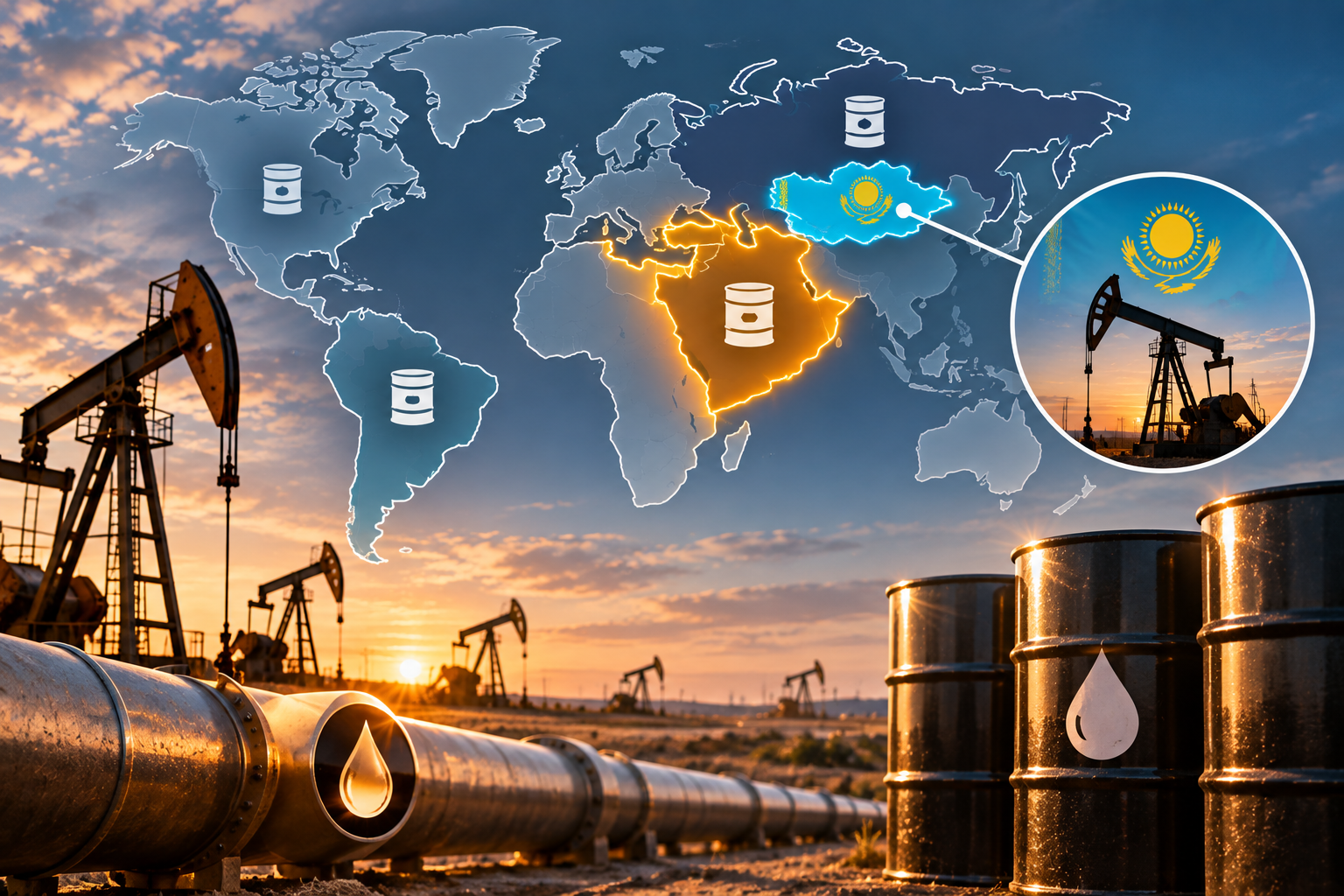
The Middle East accounts for 870.9 billion barrels, Central and South America for 354.8 billion, Russia and Central Asia for 145.8 billion, according to a report by Eni. Kazakhstan's share in this region is about 29.8 billion barrels.
The essence in brief
- Proven oil reserves in the world at the end of 2025 - 1.8 trillion barrels.
- The Middle East - 870.9 billion barrels, which is 48.3% of world reserves.
- Central and South America - 354.8 billion, North America - 246 billion, Russia and Central Asia - 145.8 billion.
- Kazakhstan has about 29.8 billion barrels.
Where reserves are concentrated
Proven reserves are those that can be extracted with existing technologies and prices. Almost half of world reserves, 48.3%, are in the Middle East. The largest holders there are Saudi Arabia (267.2 billion barrels), Iran (208.6 billion), Iraq (145 billion) and the UAE (113 billion).
Second place is held by Central and South America with 354.8 billion barrels, or 19.7% of the world total. The main part is in Venezuela. In North America, reserves amount to 246 billion barrels (13.6%), and about 82% of them, 201.3 billion, belong to Canada, mainly in the form of oil sands.
Why reserves do not equal production
Large reserves by themselves do not guarantee leadership in daily production. Venezuela, for example, is constrained by the difficulty of extracting extra-heavy oil, worn-out infrastructure and economic factors. According to data from Ak Zhayyk, in 2025 the Middle East produced about 31 million barrels per day, of which 9.6 million came from Saudi Arabia. North America produced more than 31 million barrels per day, almost 30% of world supply, even though it has fewer reserves.
What place Kazakhstan occupies
Russia and Central Asia together possess 145.8 billion barrels, or 8.1% of world reserves. The main part belongs to Russia, followed by Kazakhstan with approximately 29.8 billion barrels. The Statistical Review of World Energy estimates the country's reserves at 30 billion barrels.
What is happening with oil in Kazakhstan and exploration in the region
The country's reserves are being converted into production not without losses. The production forecast for 2026 has been lowered to 96 million tonnes due to losses of 3.5 million tonnes linked to attacks on the CPC and transformer fires at Tengiz. In 2025, 64.8 million tonnes of oil passed through the CPC, and about 80% of produced oil goes abroad. At the same time, refining capacity is growing: there are plans to increase it from 18 to 29.2 million tonnes per year at existing plants and to 10 million tonnes at a new complex that is due to start operating by 2033. Production at KazMunayGas's 12 main fields, which account for about 90% of the company's output, is to be increased with the help of digital twins by the end of 2028.
The country's largest projects are currently at the center of disputes. According to Bloomberg, Kazakhstan wants to receive about $10 billion and increase the state's share from 20% to 35% in exchange for extending the Tengiz contract, which expires in 2033. International arbitration is reported to have rejected part of Kazakhstan's claims against Kashagan worth about $12 billion. Neither piece of information has been officially confirmed.
Reserve exploration is also underway among neighbors. Uzbekneftegaz discovered five gas fields in the first nine months of 2026, and the volume of 3D seismic exploration in the country increased fivefold, to 7,430 km².
Author's conclusion
The Middle East holds 870.9 billion barrels, Russia and Central Asia together 145.8 billion, and Kazakhstan accounts for about 29.8 billion. At the same time, North America, with reserves of 246 billion barrels, produces more than 31 million barrels per day, as much as the Middle East with reserves of 870.9 billion. That is precisely why a place in the reserves ranking says something about a country's resource base, but not about how much oil it brings to the market.
Comments ()