The Soviet Megaproject Returns? Why Interest in Diverting Siberian Rivers Has Resurfaced
The idea of diverting part of Siberian rivers' flow to Central Asia, considered dead nearly 40 years ago, is back in the spotlight.
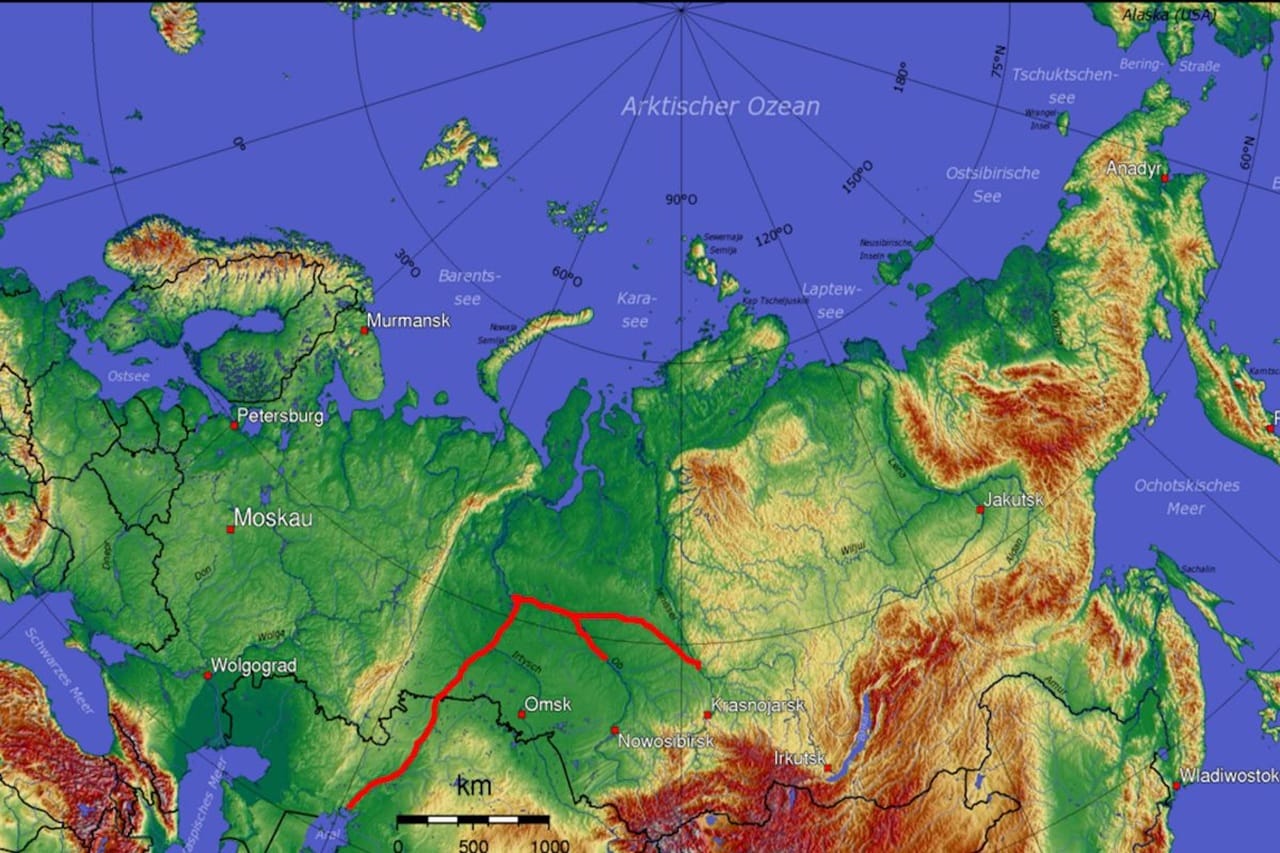
Over the past year, the initiative has been consistently supported by representatives of Kyrgyzstan, then by scientists from the Russian Academy of Sciences, and now it involves joint research with specialists from Central Asian countries. There is no talk of construction yet, but the very fact of returning to one of the most ambitious engineering ideas of the USSR indicates a growing water deficit in the region.
The Gist in Brief
· Scientists from Russia and Central Asia plan to study the possibility of diverting part of the flow of Siberian rivers.
· Last year, the Russian Academy of Sciences proposed officially launching a scientific study of the project.
· The reason was the growing reduction of water resources in Central Asia.
· So far, only scientific research is being discussed, not the construction of hydraulic structures.
· For Kazakhstan, the topic is of strategic importance, as water scarcity is becoming one of the key constraints for the development of agriculture and energy.
From Political Statement to Scientific Research
The return to the topic did not happen overnight.
In the spring of 2025, the Secretary of the Security Council of Kyrgyzstan Marat Imankulov proposed revisiting the Soviet project to divert part of the flow of Siberian rivers to Central Asia. According to him, amid climate change and shrinking freshwater reserves, the region needs to study all possible options for long-term water supply.
The next step was taken in Russia. In the fall of 2025, the Department of Earth Sciences of the Russian Academy of Sciences (RAS) proposed including the study of the possibility of diverting part of the Ob River's flow into the state plan for scientific research. As Academician Viktor Danilov-Danilyan noted, modern technologies require a reassessment of the idea that was rejected back in Soviet times.
Now the initiative has received new development. As Central Asian media report, scientists from Russia and the region's countries intend to jointly study the technical, economic, and environmental feasibility of the project.
At the same time, all participants emphasize: this is exclusively about a scientific assessment, not a decision made on construction.
Why Interest in the Project Has Resurfaced
The main reason is the growing water deficit.
Central Asia has been facing reduced river flow, shrinking glaciers of the Tien Shan and Pamir mountains, increased water consumption in agriculture, and population growth for several years.
According to international organizations, water scarcity could become one of the main factors of economic and food instability in the region in the coming decades.
Against this backdrop, the idea of using part of Siberia's water resources has ceased to look like merely a historical curiosity.
The Project the USSR Never Implemented
The project to divert northern rivers is considered one of the most ambitious engineering concepts of the Soviet Union.
In the 1960s–1980s, specialists proposed directing part of the flow of the Ob and Irtysh rivers through a system of canals and pumping stations to Kazakhstan and the republics of Central Asia.
It was intended to use the additional water resources to irrigate millions of hectares of farmland, supply industry, and provide water to populated areas.
However, in 1986, the Council of Ministers of the USSR officially abandoned the project. The reasons were its high cost, technical complexity, and scientists' concerns about possible environmental consequences for Siberia.
What Scientists Say Today
Modern research differs significantly from Soviet approaches.
While previously it was about implementing large-scale hydraulic engineering construction, today scientists propose first assessing:
· possible changes to the hydrological regime of the Ob and Irtysh;
· the impact on Siberian ecosystems;
· the economic efficiency of the project;
· the consequences for Central Asian countries;
· the possibilities of applying modern engineering solutions.
Without such research, specialists consider it premature to talk about the practical implementation of the project.
What This Means for Kazakhstan
For Kazakhstan, the topic is of particular importance.
The country is already facing a growing water deficit, especially in the southern regions, where agriculture directly depends on transboundary rivers.
Previously, Hunn.kz reported that scientists have recorded a significant reduction in the flow of the Amu Darya, attributing it more to human activity than to climate change and glacier degradation.
At the same time, Kazakhstan is closely monitoring the implementation of the region's largest hydropower projects. Hunn.kz previously wrote in detail about the construction of Kambar-Ata-1 and the construction of the Kazarman HPP Cascade in Kyrgyzstan.
As well as the continued construction of the Rogun HPP in Tajikistan with the support of the World Bank.
Against this backdrop, the discussion of diverting part of the Siberian rivers is further evidence that the problem of water supply is gradually becoming one of the key issues for the development of all Central Asia.
Author's Conclusion
Just a few years ago, the idea of diverting Siberian rivers was perceived more as a forgotten Soviet megaproject. However, climate change, glacier retreat, and the growing water deficit are gradually bringing it back onto the scientific agenda.
So far, it is only about research, and the likelihood of implementing such a large-scale project remains uncertain. But the very fact that Kyrgyzstan, the Russian Academy of Sciences, and scientists from Central Asia are simultaneously addressing the topic shows that the region is beginning to seek solutions that until recently seemed like a mere page from history. The question is no longer whether a giant canal will be built, but what long-term water sources can ensure the sustainable development of Central Asia in the coming decades.

Comments ()