Uranium production at Inkai is planned to be reduced to 7,600 tonnes by 2029
The South Mining and Chemical Company JV, 70% owned by Rosatom and 30% by Kazatomprom, has released an updated development plan for the Inkai deposit.
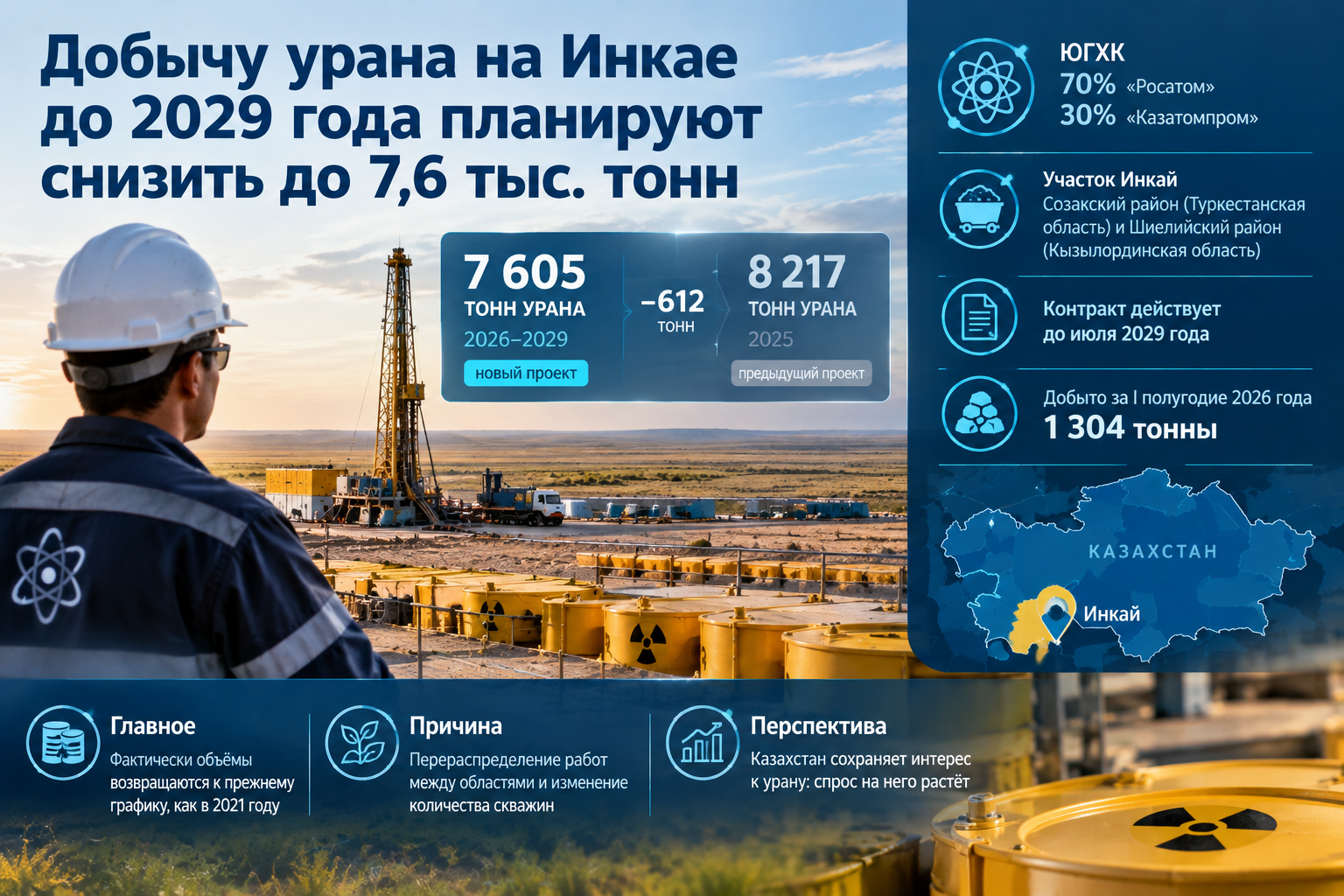
According to new data for 2026-2029, it is planned to extract 7,605 tonnes of uranium instead of 8,217 tonnes under the 2025 project. The changes will be discussed at hearings in November.
The gist in brief
- The new project provides for 7,605 tonnes of uranium for 2026-2029, 612 tonnes less than under the 2025 project.
- This amount coincides with the schedule of the previous work programme, so in effect the volumes have been returned to the previous plan.
- The reason lies in the distribution of work: the 2025 project envisaged the main work in the Kyzylorda region, while the new one returns the work to the 2021 project.
- The subsoil use contract for the site is valid until July 2029; in the first half of 2026, SUGK extracted 1,304 tonnes.
What has changed in the project
Under the 2025 project, SUGK was to extract 2,350 tonnes in 2025, 2,400 tonnes each in 2026-2028, and 1,017 tonnes in 2029. The new project gives a total of 7,605 tonnes for 2026-2029. This exactly coincides with the schedule of the previous work programme: 2,400 tonnes per year in 2026-2028 and 405 tonnes in 2029. There are no monthly or annual figures for the new project in the published materials, only the total.
The site is located in the Sozak district of the Turkestan region and the Shieli district of the Kyzylorda region. For uranium joint ventures, a deviation of 20% from the approved level is permissible.
Why it was revised
The changes are related to the number of wells (uranium at Inkai is extracted by in-situ leaching) and the distribution of work between the regions. SUGK documents state that the 2025 project envisaged the main work on the territory of the Kyzylorda region, but now the enterprise continues to work under the 2021 project. This required a repeat state environmental review and new environmental permits in both regions.
There is another reason as well: in 2023-2024, SUGK did not extract part of the uranium. The participants decided to compensate for the shortfall in subsequent periods, until the contract ends in July 2029. In addition, the Central Commission for the Development of Uranium Deposits approves amendments to contracts only until the end of 2027, until unified norms and rules for project documents are approved. Therefore, according to the partnership, further changes to the project with a contract term until 2029 are unprofitable.
What is happening with Rosatom's participation
This is not the only signal regarding Russian assets in the uranium industry. In December 2024, Kazatomprom reported that Uranium One Group, a subsidiary of Rosatom, had sold almost 50% of the shares in the Zarechnoye JV to the Chinese SNURDC Astana Mining and intends to exit the Khorasan-U and Kyzylkum JVs, where it holds 30% each. The buyer is the Chinese China Uranium Development Company, whose ultimate beneficiary is CGN. The Akdala deposit, which was previously developed by SUGK, came under Kazatomprom's management this year, Inbusiness.kz reports.
What this means for Kazakhstan
For Kazatomprom, the question is how to maintain volumes as old sites are depleted. The company has received an exclusive licence to explore for uranium at the Kyzyltu site in the Kyzylorda region for six years, with a preliminary resource of up to 10,000 tonnes, but it requires confirmation through exploration. Demand for Kazakh uranium is meanwhile growing: in January-April 2026, France tripled its purchases and took first place among buyers, overtaking China.
Author's conclusion
The new project does not mean a sharp drop in extraction: in essence, SUGK is returning to its previous schedule, and the difference from the 2025 project is related to the distribution of work across the regions. The main question is whether the enterprise will be able to compensate for the shortfall of previous years before 2029, when the contract ends.
Comments ()