Water without losses — this is how "Ädilet" sees the future of Kazakhstan's canals
The water section of the “Ädilet” program is detailed—and for good reason: water scarcity in Kazakhstan is no longer a distant threat.
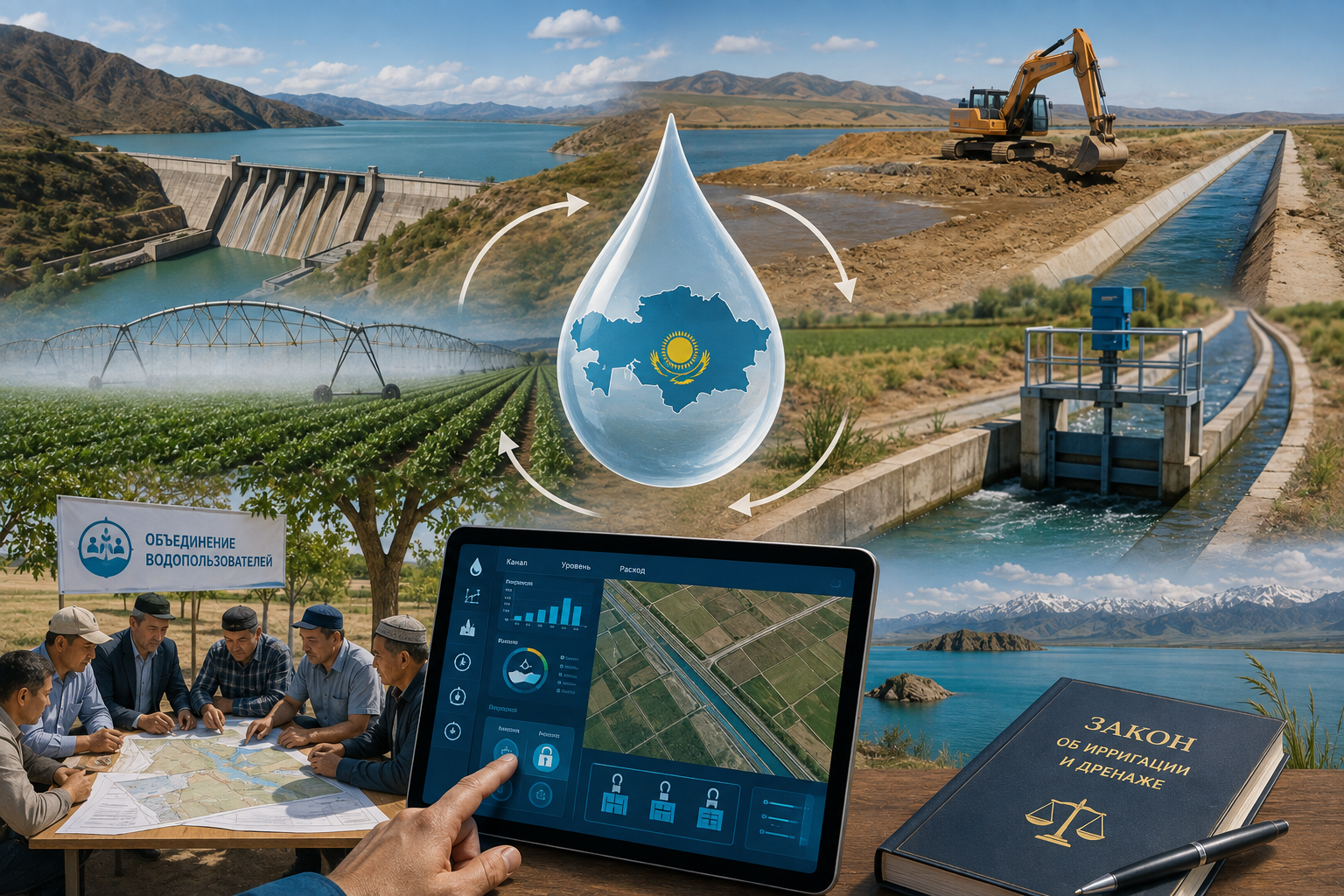
The "Adilet" party proposes not piecemeal measures, but a comprehensive restructuring of the entire system — from main reservoirs to the last irrigation canal on a specific field.
The gist in brief
- The party proposes expanding irrigated land to 2.5 million hectares and increasing the area using water-saving technologies — drip irrigation and sprinkler irrigation — to 1.36 million hectares by 2030.
- Plans include building 42 new reservoirs and reconstructing another 37 existing ones — total capacity will increase to 2.6 billion cubic meters.
- Reconstruction of 14,500 km of irrigation canals is envisaged, of which 3,500 km will be digitized and equipped with automated gate control systems.
- A separate law on irrigation and drainage will formalize the participation of water user associations in system management, while Balkhash, the Northern Aral Sea, and the Caspian Sea will receive a special legal protection regime.
A response to an already confirmed problem
The scale of the proposed measures is commensurate with the scale of the problem itself. The strain on Kazakhstan's water resources already exceeds the UN-established water scarcity threshold of 34.6%, and quotas for the Syr Darya for 2026 had to be cut by nearly half due to insufficient filling of cascade reservoirs in the previous season. It is against this backdrop that the promise to build 42 new reservoirs and increase total capacity to 2.6 billion cubic meters looks not like an abstract figure, but a direct response to the very deficit the country has faced in practice literally this year.
Betting on water user associations
One of the most substantive points of the program — a law on irrigation and drainage based on water user associations — aligns with the direction already being developed by the relevant ministry. The Ministry of Water Resources has put forward for public discussion the concept of irrigation condominiums — a model of joint management of irrigation systems modeled on successful global practices in Spain and Turkey, where transferring day-to-day operations to water users themselves made it possible to increase payment collection rates and accelerate repairs. Support for this direction in the Adilet program is a bet on a solution that has already proven effective abroad and is gaining a legal foundation in Kazakhstan itself.
Canals are losing water right now
The promise to reconstruct 14,500 km of irrigation canals addresses a specific and well-documented problem: a significant portion of Kazakhstan's irrigation canals are so dilapidated that they lose most of their water before it even reaches the fields, while agriculture remains the country's largest water consumer. The digitalization of 3,500 km of canals with automated gate control systems is precisely the technological leap needed to move from piecemeal repairs to systematic control over where and how much water actually reaches its destination.
Special status for Balkhash and the Caspian Sea
Separate legislation on the protection and restoration of Balkhash, the Northern Aral Sea, and the Caspian Sea responds to a challenge whose significance will only grow. Balkhash is already in the spotlight due to the construction of Kazakhstan's first nuclear power plant on its shore, where water balance issues are being examined at the level of specific engineering solutions. Establishing a special legal regime for the lake at the legislative level is a timely measure that will ensure the water body's protection precisely during the period when the pressure on it will increase.
Author's conclusion
The water section of the Adilet program stands out for its systematic approach: instead of scattered promises, it builds a chain from main infrastructure — new reservoirs — down to the last meter of irrigation canal on a specific field, along with institutional reform through water user associations and separate protection for the country's strategic water bodies. This is a rare case where an election program does not invent solutions from scratch but relies on directions that have already proven their viability and are gaining a legal foundation in Kazakhstan itself — meaning the stated goals have a real basis for implementation.

Comments ()