What Kazakhstanis breathe and where enterprises emit the most harmful substances per person
In 2025, Kazakhstan averaged 111.9 kg of pollutant emissions per capita from stationary sources such as factories and power plants.
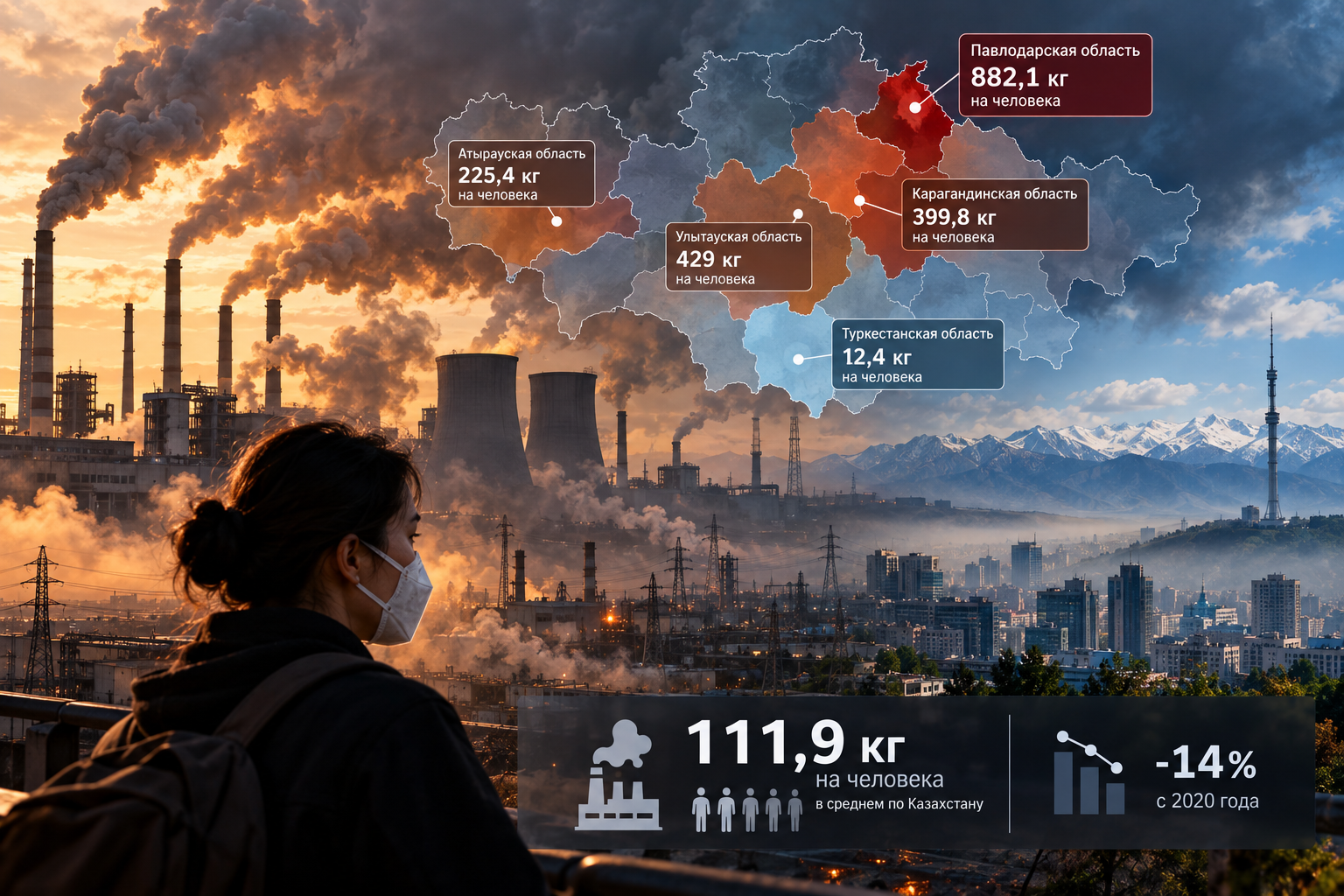
The highest emissions are in Pavlodar region — 882.1 kg per person, the lowest in Turkistan — 12.4 kg. The calculation was made by Finprom based on data from the Bureau of National Statistics.
The essence in brief
- The average per capita emission decreased from 130.1 kg in 2020 to 111.9 kg in 2025, by approximately 14%, but the pace of reduction has slowed.
- The leaders in per capita emissions: Pavlodar (882.1 kg), Ulytau (429 kg), Karaganda (399.8 kg) and Atyrau (225.4 kg) regions.
- Pavlodar and Karaganda regions account for 48.8% of all emissions in the country.
- Methane emissions have grown by 70.5% since 2020, and coal ash — by 34.6%.
Where per capita emissions are highest
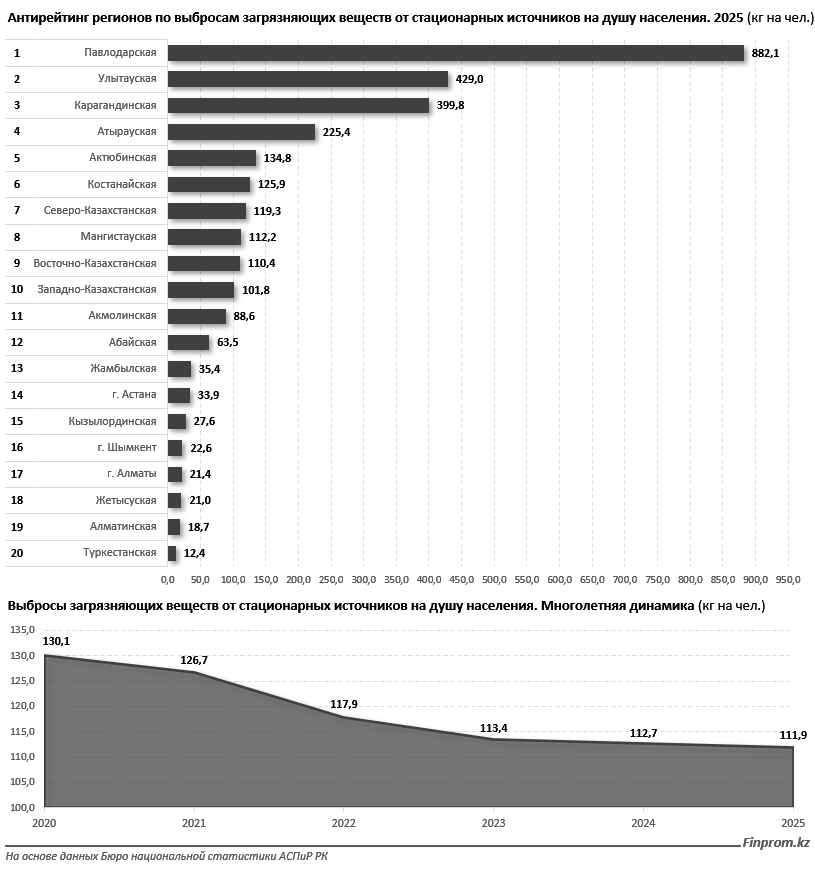
In the anti-rating for per capita emissions, the first place is occupied by Pavlodar region — 882.1 kg per person. Then, by a large margin, come Ulytau (429 kg), Karaganda (399.8 kg) and Atyrau (225.4 kg) regions. What they all have in common is a high concentration of large industrial enterprises and energy-intensive production.
The industrial legacy of Pavlodar region is not limited to the air. Independent ecologist Yuri Pavlenko believes that the protective barrier around Lake Bylkyldak, where mercury waste from the former Khimprom plant accumulated for decades, is leaking mercury toward the Irtysh. The regional administration states that the situation is under control, and monitoring has been conducted since 2005.
The lowest figures are in Turkistan (12.4 kg), Almaty (18.7 kg) and Zhetisu (21 kg) regions. There, the economy is oriented toward agriculture, and the share of the urban population is small. The gap between the extreme regions is more than 70-fold.
Finprom calculates the per capita indicator based on emissions from stationary sources, that is, from combined heat and power plants (CHPPs) and factories. It removes the distortions that arise if one looks only at gross volumes.
Why Almaty is among the favorable regions
In the anti-rating, Almaty ended up in the top five most favorable. The total volume of emissions from stationary sources in the city is 49.6 thousand tons, or 21.4 kg per person. At the same time, according to observations by the RSE Kazhydromet, the southern capital has been among the dirtiest cities in the country for several years.
There is no contradiction here, Finprom explains: in large cities, the air is spoiled not only by factories and CHPPs, but also by transport, geographical location and poor ventilation of dense buildings. These factors are recorded by Kazhydromet sensors, while stationary sources are not included in the per capita indicator.
How emissions changed over five years
Per capita emissions have been declining since 2020. In 2021 and 2022, they decreased by 8-9 kg per year, and in 2023-2025 — by less than 2 kg per year. The total volume of emissions decreased by 6.6% and amounted to 2.3 million tons, while the number of stationary sources decreased by only 1.6%, to 239 thousand.
The main part of emissions comes from two regions. Pavlodar (660 thousand tons) and Karaganda (452.8 thousand tons) regions accounted for 48.8% of the total volume in 2025. There are relatively few sources there, just over 12 thousand in each, which means the burden is created by individual large enterprises. In Pavlodar region, one source accounts for about 53.7 tons of emissions per year, in Kyzylorda — about 2.6 tons.
What substances are emitted
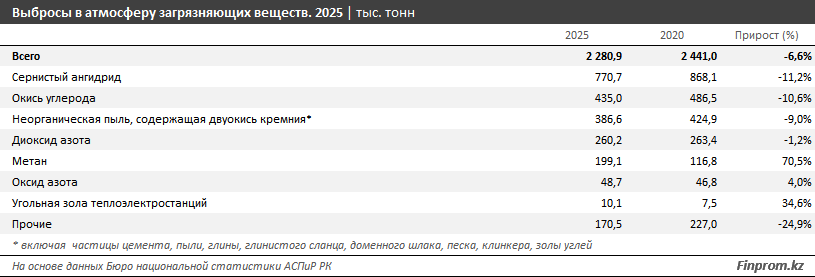
Emissions of the most widespread substances decreased: sulfur dioxide (by 11.2%), carbon monoxide (by 10.6%) and inorganic dust (by 9%). Sulfur dioxide remains the largest pollutant: in 2025, 770.7 thousand tons were emitted, more than a third of the total volume.
But for a number of substances the situation is the opposite. Methane emissions have grown by 70.5% since 2020, to 199.1 thousand tons, and coal ash from thermal power plants — by 34.6%, to 10.1 thousand tons. The maximum permissible emission of coal ash over these years was raised from 10.7 thousand to 12.3 thousand tons per year, so formally the plants remained within the norms. According to Finprom's assessment, this indicates that coal generation retains its role in the energy balance.
How much is spent on air protection
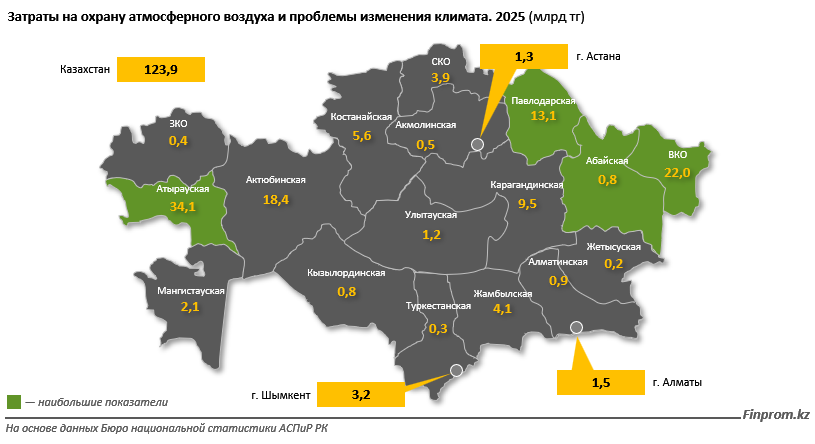
The regions with the highest emissions do not lead in spending on atmospheric air protection. Pavlodar region spent 13.1 billion tenge, Karaganda — 9.5 billion tenge. The most is spent by Atyrau (34.1 billion tenge), East Kazakhstan (22 billion tenge) and Aktobe (18.4 billion tenge) regions; together they account for more than 60% of all such costs.
The least is invested by Zhetisu (182 million tenge), Turkistan (272 million tenge) and West Kazakhstan (391 million tenge) regions. This, according to Finprom's assessment, is consistent with lower emission volumes.
Why this is important for people
The impact of dirty air on health is being studied ever more closely. A recent review of more than 40 studies linked short-term and long-term exposure to fine particles and nitrogen dioxide with an increased risk of suicidal thoughts, although the authors emphasize that it does not prove a direct causal link. This is not tied to Kazakhstani data, but it shows that the issue goes beyond ecology alone.
Author's conclusion
The overall picture is improving, but more slowly: over the past three years, per capita emissions have been declining by less than 2 kg per year. The heaviest burden is concentrated in a few industrial regions, while their spending on air protection is not the largest. The per capita indicator does not replace observational data: Almaty demonstrates this well.

Comments ()