Algal bloom disabled nearly all of Israel's desalination plants.
Abnormal bloom of microscopic algae in the Mediterranean has knocked out five of six major desalination plants, which supply nearly a third of Israel's drinking water.
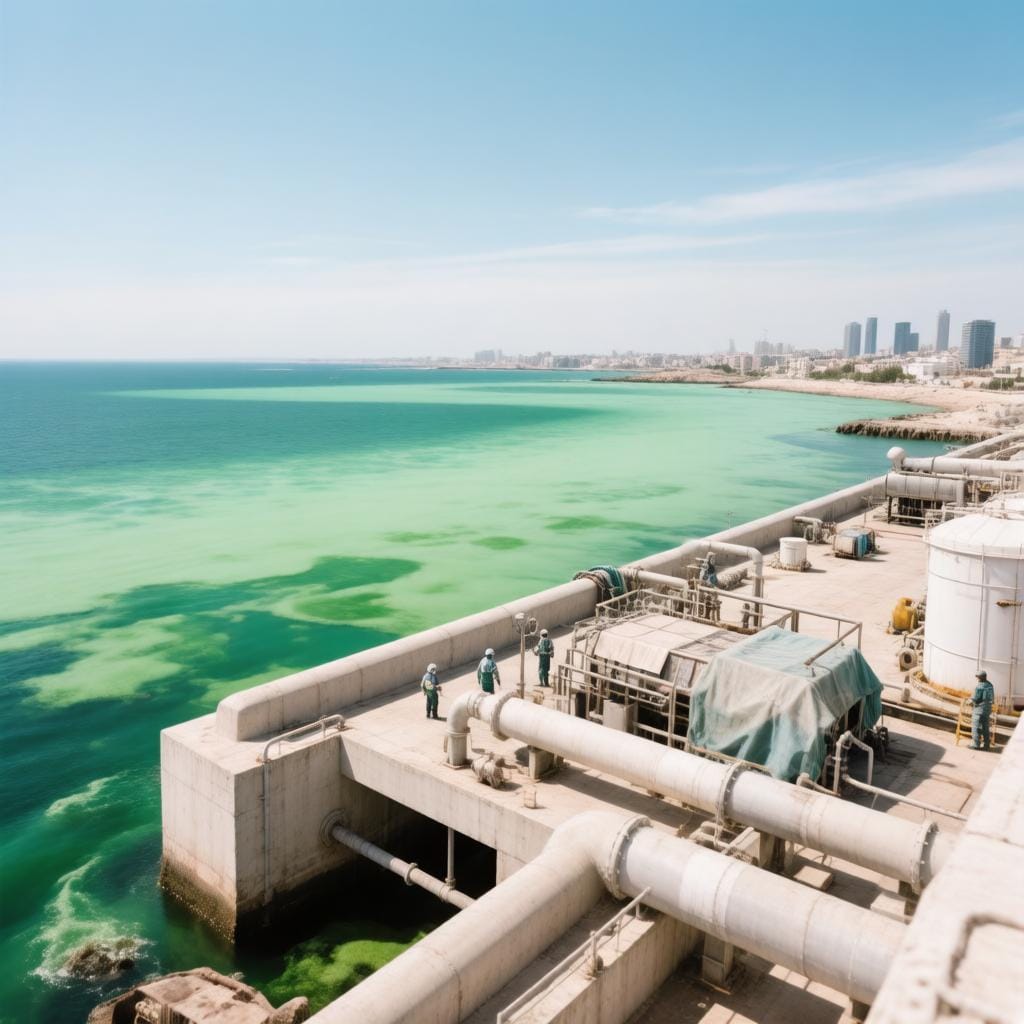
Less than a week ago, we wrote about Israel's plans to build one of the world's largest desalination complexes. Meanwhile, the country has been battling a threat of the exact opposite scale for days now, Israelinfo reports.
The gist in brief
- Israel is facing an unprecedented bloom of microscopic algae in the Mediterranean Sea — of the country's six major desalination plants, only one, in Hadera, is operating without interruption, while the other five south of Tel Aviv are completely shut down.
- Desalinated seawater provides almost a third of Israel's total annual water needs — the shutdown of most plants has forced authorities to sharply increase water extraction from the Sea of Galilee and underground aquifers, already depleted after two consecutive low-water years.
- According to satellite monitoring by Satalize, the algal bloom began near the Nile Delta last month, and currents carried the biomass through the Bardawil Lagoon to the coasts of the Gaza Strip and Israel; among the likely causes, specialists cite a combination of warm seawater and an influx of nutrients from untreated sewage discharges.
- Reverse osmosis technologies at desalination plants are extremely vulnerable to such phenomena — excessive density of microorganisms can clog and physically damage thin filtration membranes, and replacing them can take months.
How the sea water "turned green"
Scientists track the scale of the phenomenon by the concentration of chlorophyll in the water — the main indicator of the rate and area of algal spread. Satellite reconnaissance imagery records critically high concentration levels from Israel's southern borders to Tel Aviv and moderately elevated readings further north, up to Caesarea. Or Bialik, a researcher at the Israel Oceanographic and Limnological Research Institute who has worked with the Mediterranean Sea for many years, admitted to Haaretz that he had never encountered anything like this: the water turned green and began to resemble an opaque lake, and underwater visibility dropped so much that submerged instruments disappear from view at a distance of just half a meter.
Why desalination plants proved powerless
The vulnerability of desalination complexes lies in the very nature of reverse osmosis technology — a process in which saltwater is forced under high pressure through ultra-thin membranes that trap salt and turn seawater into drinking water. These membranes are extremely sensitive to changes in water composition: excessive microorganism density and high turbidity can quickly clog and destroy the filtration layer.
CEO of the Israel Oceanographic and Limnological Research Company Alon Zask described how specialists are trying to manage the situation: "Since these are tiny algae measuring a micron in size, we are trying to create protocols that will help deal with the algae. Ultimately, we will try to find a method that makes them stick together and form large clusters so they cannot seep through and clog the filters of desalination plants."
Zask admitted that scientists do not yet know how long the algae will remain off the country's coast, and meanwhile the algae continue moving north — toward Hadera, the last of the six plants still operating normally.
Emergency measures and their cost
Authorities are trying to compensate for the lost volumes of desalinated water by sharply increasing extraction from natural sources — the Sea of Galilee and underground aquifers. But these reserves are already depleted after two consecutive low-water years, one of which was accompanied by severe drought — meaning the desalination crisis is hitting the water supply system precisely at a time when alternative sources are least able to absorb additional strain.
Continuation of a story we already covered
The irony of the situation is hard to miss: less than a week ago we wrote about how Israel is preparing to build one of the world's largest desalination complexes precisely to insure the country against future water shortages. The current crisis reveals the flip side of this strategy: the greater the share of desalinated water in the country's overall water balance, the more sensitive the entire water supply system becomes to any disruption in the operation of desalination plants — whether it be an energy shortfall, a technical failure, or, as in this case, an unpredictable natural phenomenon. For a country that bet on desalination as a way to reduce dependence on rainfall and natural sources, the algae have unexpectedly proven that desalination technology itself is not free from its own vulnerabilities.
Author's conclusion
The algae story is a rare example of how the same technology can simultaneously be a solution to the problem of water scarcity and a source of new risk. Israel has almost eliminated its dependence on rain and natural water bodies, only to discover that it has instead gained a dependence on the condition of the sea — and marine ecosystems, as the current episode shows, can change so rapidly and unpredictably that even the most modern desalination infrastructure proves powerless against them.


Comments ()