Aral Sea bed released 748 million tons of CO₂ into the atmosphere — scientists propose monetizing its restoration
Spanish scientists have for the first time calculated the climate damage from the Aral Sea's drying: since the 1960s, its exposed bed has released about 748 million tons of CO₂—comparable to the annual emissions of Spain, France, and Belgium combined.
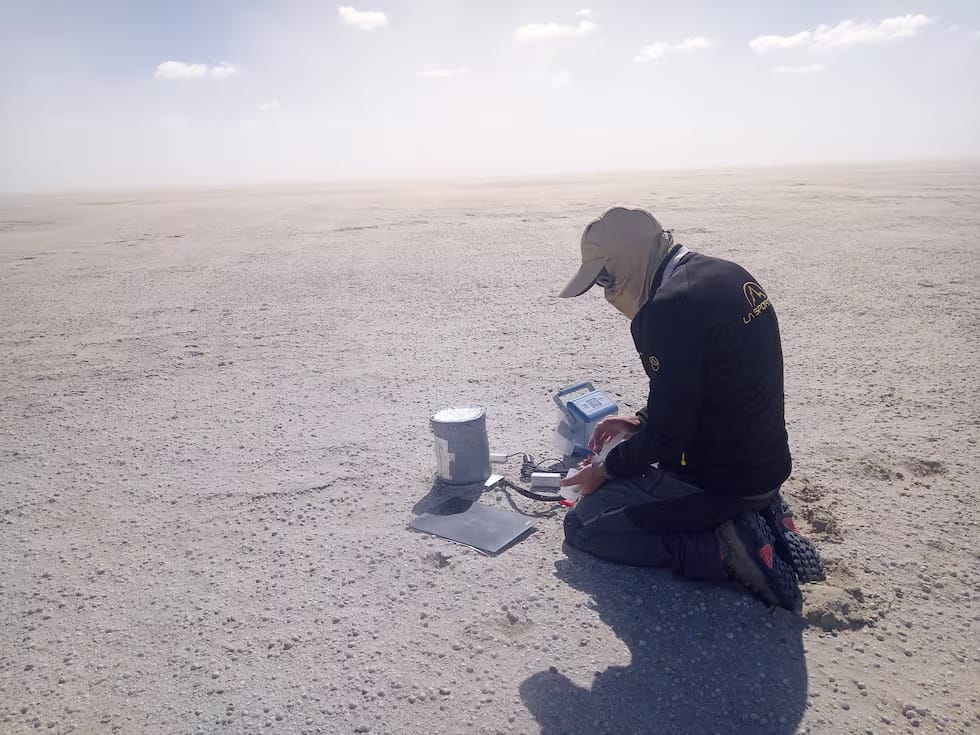
A study published in the journal Science is changing the understanding of an ecological catastrophe: the Aral Sea is not just a vanished sea, but an active source of greenhouse gases. And it also offers a non-standard solution: financing restoration through carbon credits worth up to €15.8 billion.
The Gist
- A team of scientists led by Rafael Marcé from the Spanish Center for Advanced Studies has established: since the Aral Sea began to dry up, its bed has released 748 million tons of CO₂ into the atmosphere. In the future, another 605 million tons could be released.
- The mechanism is simple: when water disappears, bottom sediments come into contact with oxygen, microorganisms decompose organic matter and release CO₂. Lakes are carbon sinks; dried-up lakes are carbon sources.
- Greening the seabed, which is actively carried out in the region, has virtually no effect on carbon absorption. The only effective way to stop emissions is to cover the area with water again.
- The scientists propose valuing prevented emissions as an economic asset and attracting international financing through carbon credits. Their potential value ranges from €3.1 to €15.8 billion.
- An investment of €8.5 billion could restore up to half of the Aral Sea's area from its 1960 level and simultaneously generate a significant volume of carbon credits.
The Aral Sea as a Slow-Motion Climate Bomb
The Aral Sea disaster is usually described as an ecological tragedy on a regional scale: the collapse of fisheries, soil salinization, and dust storms from the dried-up seabed. The study by the Spanish team adds a global climate dimension to this picture.
Fieldwork in 2022 showed that recently dried-up areas of the seabed contain more organic carbon and have a higher emission potential. As drying progresses, water first evaporates, then oxygen begins to break down organic deposits accumulated over millennia. This process is irreversible without the return of water — and it continues every year.
A fundamentally important conclusion: the Aral Sea problem did not end when the sea dried up. It continues right now — in the form of invisible CO₂ emissions from the surface of the former seabed.
Why Trees Won't Help
One of the key findings of the study was the refutation of a popular approach to rehabilitating arid territories — greening. Large-scale projects are being implemented in the region to plant saxaul and other drought-resistant crops on the dried-up Aral seabed. This reduces dust storms and partially stabilizes the soil. But as a tool for combating CO₂ emissions, it is practically ineffective.
Rafael Marcé directly states: the only effective way to stop emissions is to cover these areas with water again. Everything else is palliative.
Carbon Credits as a Financial Mechanism for Restoration
Here, the study moves from diagnosis to therapy — and offers a non-standard tool. If restoring the Aral Sea's water surface prevents hundreds of millions of tons of future CO₂ emissions, these prevented emissions can be turned into carbon credits and sold on the international market.
According to the scientists' calculations, the potential value of such credits is from €3.1 to €15.8 billion, depending on the price of carbon. These funds could cover the costs of modernizing irrigation infrastructure, where up to 90% of water is currently lost.
The authors acknowledge the controversial nature of the carbon credit mechanism — the tool is often criticized for a lack of transparency and real climate impact. However, in this case, the emission calculations can be accurately measured, and the link between restoring the water surface and prevented emissions is direct and verifiable.
The Kazakhstan Context
The northern part of the Aral Sea — the Small Aral — is located on the territory of Kazakhstan. It was here in 2005 that the Kokaral Dam was built, separating the Kazakh part from the Uzbek part and allowing the water level in the Small Aral to gradually recover. This is a local success: the water level has risen by several meters, fisheries have partially recovered, and salt evaporation has decreased.
However, the main part of the dried-up seabed — the Southern Aral — remains a wasteland on the territory of Uzbekistan and partially Kazakhstan. This area is the main source of the CO₂ emissions described by the scientists.
For Kazakhstan, the Spanish study opens up several opportunities. First, participation in developing a carbon credit mechanism for the region — the country is interested in developing the carbon market and already has an Emissions Trading System (ETS). Second, international financing for the modernization of irrigation infrastructure — the very reconstruction we wrote about in the context of the state program for canal renovation. Finally, it provides an argument for cross-border dialogue with Uzbekistan on managing the water resources of the Syr Darya and Amu Darya rivers.
Author's Conclusion
The Aral Sea has ceased to be just an ecological catastrophe of the last century — it is now an active source of global emissions, the figures for which have been published in one of the world's most authoritative scientific journals. Spanish scientists propose turning the tragedy into an economic incentive: making the restoration of the sea profitable through carbon credits. This is not romanticism — it is financial mathematics. It remains for Kazakhstan and Uzbekistan to decide whether they are ready to seize this window of opportunity, while the Aral Sea continues to exhale CO₂ into the atmosphere.
Comments ()