Australian scientists have learned to turn plastic waste into hydrogen using sunlight.
University of Adelaide researchers developed a method to turn plastic waste into clean hydrogen and useful chemicals using only sunlight.
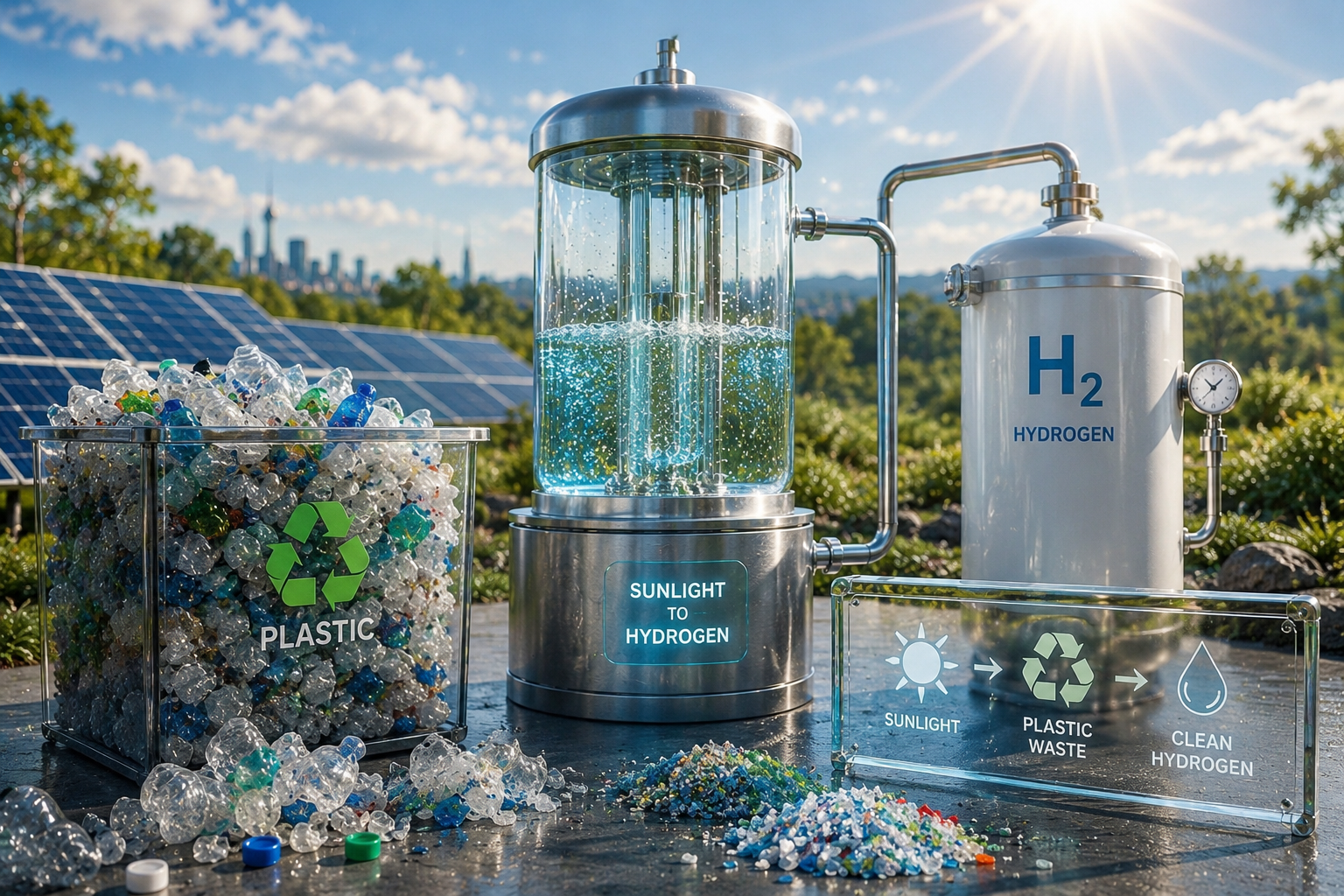
The technology is still at the laboratory testing stage, but its potential is twofold: simultaneously solving the problem of plastic pollution and producing fuel without CO₂ emissions. For Kazakhstan, which has accumulated a huge amount of polymer waste and where the hydrogen agenda is enshrined in a state concept, this area deserves close attention.
The Gist
- The method is called solar photoreforming: photosensitive materials — photocatalysts — absorb sunlight and, at relatively low temperatures, break down plastic, converting it into hydrogen, synthesis gas, and other industrial chemicals.
- More than 460 million tons of plastic are produced annually worldwide, a significant portion of which ends up in landfills and oceans. Plastic is rich in carbon and hydrogen — meaning it is a potential energy resource.
- Experiments have recorded high rates of hydrogen production, as well as the production of acetic acid and diesel-range hydrocarbons. Some systems operated continuously for over 100 hours.
- The main barriers to scaling up are the heterogeneity of plastic waste, catalyst degradation over time, and the energy-intensive separation of reaction products. The technology is still several years away from industrial application.
Plastic as a Hidden Energy Resource
The global problem of plastic pollution and the search for alternatives to fossil fuels usually exist on different agendas. A study from the University of Adelaide, described in the journal Chem Catalysis, proposes solving both problems with one method.
“Plastic is often seen as a serious environmental problem, but it also represents a significant opportunity,” says the study’s lead author, PhD student Xiao Lu. “If we can efficiently convert plastic waste into clean fuel using sunlight, we can simultaneously address pollution and energy challenges.”
The logic is simple: plastics contain a high concentration of carbon and hydrogen — the very elements that make up traditional fuels. Instead of burying these substances in landfills or burning them, photoreforming turns them into valuable raw materials.
How It Works
The method is based on photocatalysts — photosensitive materials that absorb solar radiation and trigger chemical reactions to break down plastic. A key difference from traditional recycling and pyrolysis methods is the relatively low process temperature, which reduces energy consumption.
Compared to classic water electrolysis for hydrogen production, this approach is potentially more efficient: plastics oxidize more easily than water, requiring less energy to initiate the reaction. A single unit can simultaneously produce hydrogen, synthesis gas, acetic acid, and hydrocarbons — a broader product spectrum than most existing plastic recycling technologies.
Results and Barriers
Early experiments have yielded promising results: high hydrogen production rates and stable system operation for over 100 hours. However, Professor Xiaoguang Duan from the School of Chemical Engineering at the University of Adelaide honestly outlines the gap between the lab and industry.
“One of the main barriers is the complexity of the composition of plastic waste,” he says. “Different types of plastic behave differently in the conversion process, and additives — dyes, stabilizers — can interfere with the reaction. Therefore, effective sorting and pre-treatment are critically important.”
Another problem is the photocatalysts themselves. They need to be highly selective and durable, resistant to harsh chemical conditions. Current versions degrade over time, limiting their reliability. Separating the final products — a mixture of gases and liquids — also remains an energy-intensive process, reducing the overall environmental benefit.
The Kazakhstan Context
For Kazakhstan, this technology intersects with two strategic agendas. The first is plastic pollution: the country produces hundreds of thousands of tons of polymer waste annually, a significant portion of which ends up in unauthorized dumps and landfills with outdated infrastructure.
The second is hydrogen energy. Kazakhstan’s Concept for the Development of the Hydrogen Industry until 2040 provides for the production of both “green” and “blue” hydrogen. Photoreforming of plastic is potentially a third path: “yellow” hydrogen from waste, requiring neither natural gas nor additional renewable energy capacity beyond what is already being built. It will take at least ten years before the technology reaches commercial application — but now is precisely the time for Kazakh research institutes and universities to start monitoring this field.
Author's Conclusion
Turning waste into fuel using sunlight is not science fiction, but a field that is already being published in peer-reviewed journals and showing measurable results. The technology is at an early stage, but it is precisely such developments that change industries a decade from now. For Kazakhstan, simultaneously grappling with a landfill crisis and building a hydrogen agenda, solar photoreforming of plastic is a rare case where one solution addresses two challenges at once.


Comments ()