Battery for thousands of years: Chinese scientists create nuclear power source smaller than a matchbox
Researchers from China’s Northwest Normal University and Gansu Zhulong Technology have developed a new-generation nuclear battery using carbon-14 and silicon carbide.
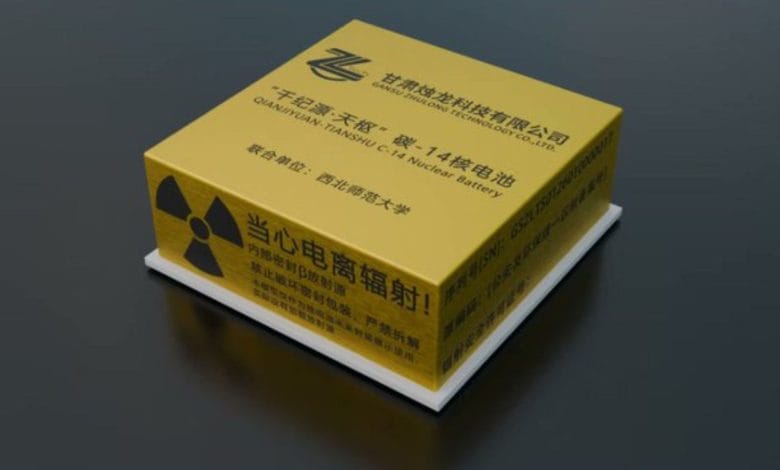
A device with a volume of 16.8 cm³ generates energy through radioactive decay and can operate without maintenance for thousands of years — the half-life of carbon-14 is 5,730 years, writes New-Science. Compared to the previous model, the volumetric power density has increased nearly 15 times. For Kazakhstan — the world's largest uranium producer and a country planning its own nuclear power plant — the technology opens up an interesting question: can radioactive isotopes from the domestic nuclear cycle be used for such devices?
The Gist in Brief
- The Qianjiyuan Tianshu battery is the second generation of the development by the team of Su Maogen. The first version (Zhulong-1) was released in 2024. The device is entirely manufactured using Chinese technology.
- Size — approximately 16.8 cm³, only slightly larger than the volume of one cubic inch. At the same time, the volumetric power density has increased nearly 15 times compared to the previous model.
- Output parameters: current 0.713 µA, voltage 2.06 V, maximum power 1.13 µW — with a carbon-14 activity of 129 mCi.
- The operating principle is similar to a solar panel: beta particles from the decay of C-14 hit a silicon carbide semiconductor and directly generate an electric current — without thermal conversion.
- Service life — thousands of years thanks to the half-life of C-14 of 5,730 years. Target applications: autonomous sensors, medical implants, space technology, industrial electronics.
Nuclear Battery — Not What You Think
The phrase "nuclear battery" evokes associations with a reactor or weapons. In reality, it is fundamentally different: a compact device in which the energy of natural radioactive decay of an isotope is directly converted into electricity — without combustion, without a chain reaction, without the fission of heavy nuclei.
Such power sources have long been used in space: NASA used them on the Voyager spacecraft, launched back in 1977, and they are still operating. China used similar batteries on the "Chang'e" lunar missions. The novelty of the development is not in the principle itself, but in the radical improvement of parameters with a sharp reduction in size.
How It Works and Why It Is Not Dangerous
Unlike most existing radioisotope batteries, where decay heat is converted into electricity via a thermoelectric element, the new development uses direct conversion. Beta particles — electrons emitted during the decay of carbon-14 — directly hit a silicon carbide semiconductor and generate an electric current. It's like a solar panel, only the radiation source is not the sun, but an isotope.
Carbon-14 was chosen for a reason. It emits low-energy beta radiation — which is blocked by a thin layer of material and poses no radiation hazard outside the casing. At the same time, the half-life of 5,730 years ensures virtually unchanged power output for hundreds of human lifetimes.
An Order of Magnitude Increase at the Same Volume
Key progress figures: while reducing the size by only 17%, the new device provides a power density 15 times higher than the previous version. The amount of radioactive material has been reduced to 22% of the previous level, while the output power has increased by 2.6 times.
This was achieved through several solutions: a three-dimensional multi-layer structure saves space, a new domestically produced Chinese SiC semiconductor increases conversion efficiency, and an integrated ultra-low-power management system allows the device to operate completely autonomously.
What It Is For — And What It Is Not For
The Qianjiyuan Tianshu battery will not replace a smartphone battery or an electric vehicle traction battery: its power — 1.13 microwatts — is a million times less than what is needed to charge a phone. But this exact power level is ideal for devices that need microwatts for decades without any maintenance.
Implantable pacemakers — today they are replaced every 5–10 years due to battery depletion, requiring repeat surgeries. Sensors in hard-to-reach places — underground, underwater, in Arctic conditions — where battery replacement is physically impossible. Space probes venturing beyond the solar system. Critical infrastructure monitoring systems that must operate without human intervention.
The Kazakhstan Context
For Kazakhstan, this news intersects with several strategic directions. The country mines about 43% of the world's uranium, and within the framework of the planned NPP and the Pax Silica program, it has declared an ambition to move beyond raw material exports into the technological stages of the nuclear cycle.
Carbon-14 is produced in nuclear reactors by irradiating nitrogen with neutrons — meaning the presence of a reactor opens up the possibility of producing the isotope domestically. This is not tomorrow's reality, but it is also not science fiction: with an NPP and the appropriate isotope infrastructure, the production of radioisotope batteries could become one of the high-tech products of the Kazakh nuclear cycle.
Author's Conclusion
A battery the size of a sugar cube, operating for thousands of years without maintenance, is neither fantasy nor the distant future. It is a peer-reviewed development that has passed laboratory tests and received specific numerical characteristics. The market for applications is small in units but enormous in value — medicine, space, critical infrastructure. Kazakhstan, with its nuclear ambitions and uranium base, has every reason to track this direction not as an outsider, but as a potential participant.



Comments ()